I used to own an '02 Ric 4003 in midnight blue, customized it with black hardware and pickguard, looked cool, and sounded and played nice, but 3 things I hated about it secretely were the stupid bridge pickup cover. I know it looks cool, but it's very annoying to play closer to the neck pickup for me as I like more tension and the higher tension lies exactly where the neck pickup is, looks kinda ugly without he cover, but that's exactly what I had to do to feel comfortable playing it. Next and most annoying problem with this thing, the ultimate swan dive. I mean it's fun playing this bass while sitting down, but once you got it on a strap and trying to rock out, forget it, you'll have to spend long hours adjusting to holding the neck up as it will keep going down under as the neck has 2 truss rods, very stupid invention if you as me, they are prone to breakage much easier adn also the super huge headstock that looks so cool, yes that's right the gigantic headstock is what gives this bass an unbalanced feel while on a strap. The third and annoying to maybe a minority of bassists is the 20 frets, why only 20 I don't know, I guess they like the vintage 20 frets as the standard, but I started with 24 and I liked the idea of having the 4 extra half steps at the end of my fingerboard. So there you have it. As far as comfort, no it's not the most comfortable bass out there. Ibanez makes some of the neatest instruments that meet my demands, super thin neck, nice low action for tapping the **** out the frets, great for chording, comfortable body, no digging contours on the body. I know many of you bash Ibanez for being cheap, but they know they're stuff, and Ibanez is only cheap if you get the non genuine Ibanez aka made in Korea, Indonesia, China, yeah they're Ibanez, but they use inferior quality materials to the Japanese which is the true Ibanez. Compare the quality and prices of those to the cheaper ones, and there you have it. It's like bashing Gibson for their Epiphone instruments or Fender for their Squire or Warwick for their Rockbass or BCRich for their noncustomshop....etc. In the end Ric is a nice instrument and like every other Manufacturer has its ups and downs. I personally don't find anything wrong with any of the popular guitar/bass brands. Ric, fender, MM, Gibson, Warwick, Ritter, Ibanez, Gretsch, Yamaha, Aria, Alembic, Jackson, ESP, and many others are all great instruments and all have something good to offer.

Enjoy the benefits of a premium membership!
Upgrade Account
-
TalkBass has been independent since 1998. Add your voice.
Create a free account to reply to discussions, view embedded media, and browse with fewer display ads.
Join free Log in
Want zero display ads or expanded classifieds tools? Compare plans.
You are using an out of date browser. It may not display this or other websites correctly.
You should upgrade or use an alternative browser.
You should upgrade or use an alternative browser.
Rickenbackers - the bad stuff?
- Thread starter LaXu
- Start date
More options
Who Replied?Line breaks help others read jumbled words.I used to own an '02 Ric 4003 in midnight blue, customized it with black hardware and pickguard, looked cool, and sounded and played nice, but 3 things I hated about it secretely were the stupid bridge pickup cover. <press Enter key>
I know it looks cool, but it's very annoying to play closer to the neck pickup for me as I like more tension and the higher tension lies exactly where the neck pickup is, looks kinda ugly without he cover, but that's exactly what I had to do to feel comfortable playing it. <press Enter key>
Next and most annoying problem with this thing, the ultimate swan dive. I mean it's fun playing this bass while sitting down, but once you got it on a strap and trying to rock out, forget it, you'll have to spend long hours adjusting to holding the neck up as it will keep going down under as the neck has 2 truss rods, very stupid invention if you as me, they are prone to breakage much easier adn also the super huge headstock that looks so cool, yes that's right the gigantic headstock is what gives this bass an unbalanced feel while on a strap. <press Enter key>
The third and annoying to maybe a minority of bassists is the 20 frets, why only 20 I don't know, I guess they like the vintage 20 frets as the standard, but I started with 24 and I liked the idea of having the 4 extra half steps at the end of my fingerboard. <press Enter key>
So there you have it. As far as comfort, no it's not the most comfortable bass out there. Ibanez makes some of the neatest instruments that meet my demands, super thin neck, nice low action for tapping the **** out the frets, great for chording, comfortable body, no digging contours on the body. <press Enter key>
I know many of you bash Ibanez for being cheap, but they know they're (sic) stuff, and Ibanez is only cheap if you get the non genuine Ibanez aka made in Korea, Indonesia, China, yeah they're Ibanez, but they use inferior quality materials to the Japanese which is the true Ibanez. Compare the quality and prices of those to the cheaper ones, and there you have it. It's like bashing Gibson for their Epiphone instruments or Fender for their Squire or Warwick for their Rockbass or BCRich for their noncustomshop....etc. <press Enter key>
In the end Ric is a nice instrument and like every other Manufacturer has its ups and downs. I personally don't find anything wrong with any of the popular guitar/bass brands. Ric, fender, MM, Gibson, Warwick, Ritter, Ibanez, Gretsch, Yamaha, Aria, Alembic, Jackson, ESP, and many others are all great instruments and all have something good to offer.

I think you must have had something completely wrong with yours if the head dove as much as you say it did.
On my 5 stringer, it is rock solid. On my early 90s 4003 it was rock solid. No noticeable dive.
Maybe it's your stance or the location of the strap. This is one issue I've never heard leveled at Rickenbackers.
I see you have a Thunderbird on you GAS list... I believe the consensus between these two (Rickenbacker 4003 and Thunderbird) is that the T-Bird wins hands down on the head diving competition.

In fact, I strongly suspect that it plays a major role in a Rickenbacker problem that nobody has mentioned so far, that being...
An E string that is not as loud as the ADG strings.
There are too many threads, both here and at the Rick forums, to deny its existence. Fortunately, this does not effect all Ricks, and I'm happy to say that the volume on mine is consistent from string to string.
On many vintage Ricks, you can see the crack in the pickguard on the bass side, where people have tried to overly raise that side of the pickguard (thus cracking the plastic). You never see a crack on the treble side.
I suspect that there are two reasons for the weak E. I had a friend who collected Ricks and Rick copies. He told me that while he had owned a number of Ricks with weak E strings, none of his single truss rod Rick copies had a weak E. I suspect that the huge truss rod channel that is required for two rods may play a part in the problem.
The second reason is the already mentioned capacitor that cuts bass frequencies. It's hardly surprising that this results in a weak E.
I've owned two 4003's over the years. Both stunningly beautiful (Fireglo and Montezuma Brown). Both had the weak E string that absolutely drove me crazy. I sold both because of that. Tried everything to get it to sound beefier, including taking it to a highly respected tech in Memphis. Nothing worked. Finally gave up and got rid of them. Loved the look. Didn't love the weak E...

If true, that is really, really stupid.Chris Squire states this when he toured the factory and was expecting praise for everybody wanting (a Rickenbacker bass) because of him. But he was chastised when they showed all the basses returned for fret jobs.
Blame the guy who sold a gazillion instruments for you?
 Instead of simply switching to harder fret wire? :scowl:
i really hate that binding and that sharp corner. its cuts my forearm and make the playing uncomfortable. i rounded the sharp corner with scraper, but nothing is comfortable like the fender contour.
that is the really only bad thing about Ric's.
i also thought that the bridge is problematic, and installed the hipshot bridge, but it took away lot of the rick sound and feel, so, i put the original bridge and sold the hipshot.
just removed the mute pad and its two screws that got in the way.
that is the really only bad thing about Ric's.
i also thought that the bridge is problematic, and installed the hipshot bridge, but it took away lot of the rick sound and feel, so, i put the original bridge and sold the hipshot.
just removed the mute pad and its two screws that got in the way.

For me it is the most over-rated guitar ever, while being the coolest looking. The loyalty that can turn into elitism with their owners is infamous. So is the price. Just did not feel ergonomic without contour and the uniformity of the body and neck. The guards and mutes were in my way and limited movement. The pups on my 4001 were weak and very woofy in the bass. There seems to have been a capacitor cap that was removed since, but when I had mine it just sounded pale. I've always preferred a P style bass over any other, and this is my primary source of comparison. The Ric IS unique indeed. I have come to the conclusion that the players who are well known heavily modify them. There is a thread on talkbass with pics showing all the mods if anyone wants to search it out (Geddy, Burton, Trujillo, etc). It kind of confirmed for me that my view wasn't alone. I went back to Fender. So did Geddy. And you might too if you haven't played a Ric.
I wonder if anyone here has swapped their screws out for Allen screws? I'd give it a shot myself, if I knew where to get the correct size/length of screws.
I did it... a RIC forum forumite linked me to the proper screws once. I wish I could find it for you. Worked like a charm.
So what's bad about a Ric?
This is a highly subjective question that everyone will answer differently. What's bad about a P Bass? Yep, there can be bad things about a P Bass, too. My opinion on the modern Rickenbacker 4003 (post-2006) is that its only flaw is the TEETH on the tailpiece that block palm muting. I don't have a problem intonating the stock bridge nor do I experience tail lift, so these gripes don't make sense to me. However, the teeth block palm muting. That is literally the only issue I've ever had with the tailpiece. But for me that is outweighed by how good these basses sound to my ears... I own three and they are each extremely fantastic. Rics get extremely negative reviews from some people, and I think that has as much to do with the fact that they are perceived as needlessly "exotic" as it does with the fact that lemons do leave the factory sometimes, sad to say. There is also plenty of misinformation spread about them as well, that just fuels the fire, generally regarding how the neck is adjusted.
A new one in stock right now can be easily had for around $1600. Don't let the MSRP fool you.
I have come to the conclusion that the players who are well known heavily modify them.
I guess the exception to that is Chris Squire and Paul d'Amour, and generally I prefer those guys over the ones you have listed. I think the reason Rics are modded so often is that a lot of people would rather be playing a Fender, but want a Ric. If that's the case then I can see why their basses develop identity crises. Those people need to try a 4004 or go back to Fender. Rics are simply different because they were designed apart from the Fender instruments from the earliest days of electric bass (heck, RIC made an EUB some time in the 1930s), so the flagship 4003 model will probably never be what a person who is obsessed with the Fender design will ever really want. I'd rather it be that way, actually.

Ric5
Inactive
- Jan 29, 2008
- 29,772
- 30,452
- Disclosures
- I like 5, 8, 10, and 12 string basses
+1 to that, never had neck dive issues with any of my 8 Rics.
I have owned and played and worked on over 50 Rics and not a single one showed even a slight amount of neck dive... Gibson basses seem to have cornered the merket on neck dive.
Ric5
Inactive
- Jan 29, 2008
- 29,772
- 30,452
- Disclosures
- I like 5, 8, 10, and 12 string basses
One way to make the E string stronger ... Add a 5th string.
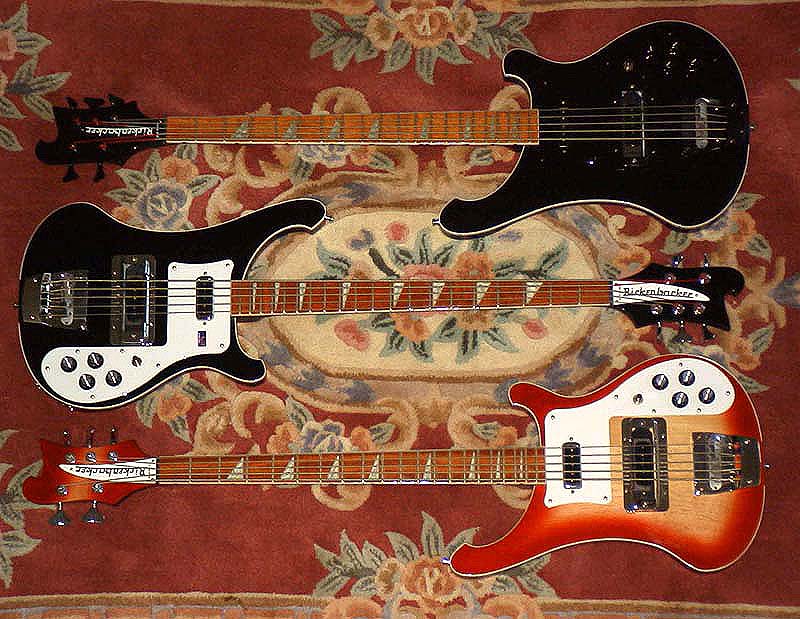
The additional tension of a 5th string makes the whole bass more resonant.
I only play 5 string basses so none of them have weak E strings. But the problem can be transfered down a string. The 2 outside strings on any bass can be weaker. I build my own basses with many different body styles and many different pickup styles. Some of them get a weak B or G string. A tapered string can help sometimes. A different bridge can help. It can be a mysterious problem like dead spots on a neck.
The additional tension of a 5th string makes the whole bass more resonant.
I only play 5 string basses so none of them have weak E strings. But the problem can be transfered down a string. The 2 outside strings on any bass can be weaker. I build my own basses with many different body styles and many different pickup styles. Some of them get a weak B or G string. A tapered string can help sometimes. A different bridge can help. It can be a mysterious problem like dead spots on a neck.

Ricks are not finished in Nitro-Cellulose, they are finished in a polymer finish...call Rickenbacker they will tell you the same thing. This is from Rickenbackers website:
"Following many coats of sealer and color coats, numerous applications of a super high gloss finish are made. Providing not only great visual appeal, this surface treatment protects the guitar from dings and scrapes; the unique chemistry of the material makes it both hard and flexible at the same time. Impact areas do not craze or radiate like polyester, nor does this material turn cloudy or finish-check in cool weather like nitrocellulose"
Which I will claim BS to, my 1980 Azure is seriously checked!!!
Regardless a Rickenbacker is iconic, you cannot mistake it for any other bass. I think if you can afford one and you have your favorites already....get one, it is nice to have at least one in the collection.
"Following many coats of sealer and color coats, numerous applications of a super high gloss finish are made. Providing not only great visual appeal, this surface treatment protects the guitar from dings and scrapes; the unique chemistry of the material makes it both hard and flexible at the same time. Impact areas do not craze or radiate like polyester, nor does this material turn cloudy or finish-check in cool weather like nitrocellulose"
Which I will claim BS to, my 1980 Azure is seriously checked!!!
Regardless a Rickenbacker is iconic, you cannot mistake it for any other bass. I think if you can afford one and you have your favorites already....get one, it is nice to have at least one in the collection.

Never experienced neck dive with my Ric.
Never experienced the coated neck to be slow.
It's a great bass....just not 2K great.
Never experienced the coated neck to be slow.
It's a great bass....just not 2K great.
I wonder if anyone here has swapped their screws out for Allen screws? I'd give it a shot myself, if I knew where to get the correct size/length of screws.
Hey, thanks, Cassius your post made me do a quick search on the RIC forum, where I found [Invalid or Expired Link Removed]:I did it... a RIC forum forumite linked me to the proper screws once. I wish I could find it for you. Worked like a charm.
Tim4003 said:I switched out the stock intonation screws for this hex type. They're much easier to work with.
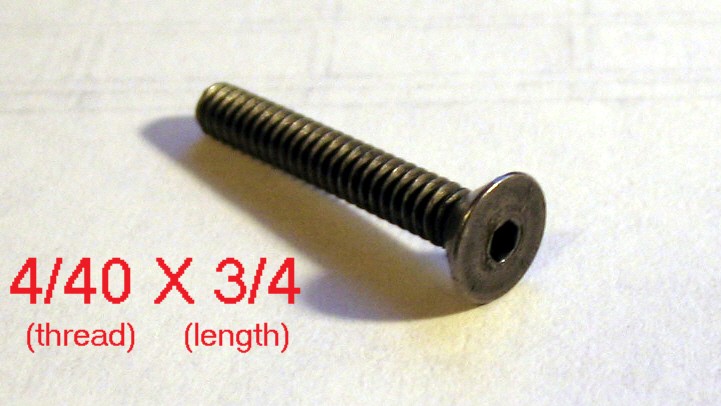
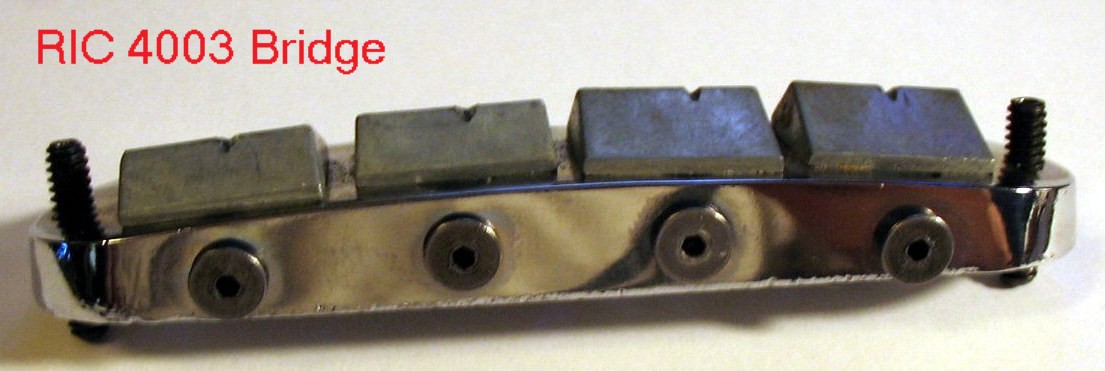
PandaNinja said:I did the same thing that Tim4003 did. Much easier to set up now! You can use the same allen wrench as the bridge height grub screws. AND you don't need to loosen the strings so much and take out the bridge piece. 100% improvement for under a buck at the local hardware store.
I stand corrected on the Nitro issue, as they actually use Conversion Varnish (CV). Straight from the horse's mouth:Ricks are not finished in Nitro-Cellulose, they are finished in a polymer finish...call Rickenbacker they will tell you the same thing.
My point does still stand however, that CV takes quite a long time to cure and finish when compared to poly:John Hall said:What we use is a proprietary conversion varnish. Unfortunately it's not something you'll be able to purchase, although generic conversion varnish can be had. Of course, you must use stainless guns to spray it and there's some serious experience involved to get it right.
More important than the material is the time spent processing the finish- the prep, the between coat work, and a great deal time spent hand buffing. [Invalid or Expired Link Removed]
jingle_jangle said:Rick finishing is like this, beginning to end:
Sand body/neck/fretboard about a zillion times by hand and machine, with many different grits of paper, going from coarse to fine.
Seal with thinned CV and allow to cure. You theoretically could hasten this by a short oven-bake, but we're talking about wood here, so elevated curing schedules are a strict no-no. Average cure time per application of CV is three days, and there are at least three applications of CV on every instrument, with sanding between every application. This means that instruments cycle through the sanding department and paint shop for somewhere between ten days and two weeks, typically!
(An aside: I spoke to a customer in North Carolina yesterday concerning refinishing his botched-up '73 4001--I do a lot of these--and he registered surprise when I told him that my turnaround time once these are begun, is two to three weeks. I asked him if he thought that was too long or too short, and he laughed and replied that it was a long time. I had to inform him that 99+% of that time is curing time for the CV.)
Sand the CV seal coat to knock down the grain, and apply color (if solid) or dye (if burst). Allow to dry. (Not cure in this case, as the color coats--including JG--are air-dry paints which are compatible with CV.)
Now apply another coat of CV, full-viscosity. Allow to cure.
Sand the first CV coat once cured, and apply another coat. Repeat several times, allowing the CV to cure fully between subsequent recoats.
Handwork does not stop here...once the final coats of CV have cured nice and hard, the entire guitar is once again flatted by machine and hand. Then it goes to the buffing department, where it's treated to a regimen of handheld car buffers with lambswool pads (for flat surfaces), large muslin wheels with pricey Menzerna compound (for the sides) and hand-buffing (to finish and detail). Each guitar receives about 90 minutes of attention here before it moves on to final assembly.
[Invalid or Expired Link Removed]
Del Breckenfeld from Fender says Fender finishing takes three days.

I'm now on my 5th - 2009 4003.
I did have glitches with the others, and for a time, tried to live without one.
No chance - one you've got the bug, nothing else will do.
Customer service in the UK is beyond a joke - the Ric warranty is only valid in the US. Prices are through the roof, and they quote a 3+ year wait.
Odd shops do occasionally get them, and there is the odd bargain given the economic climate.
What is true is the resale value. My previous 4003 went up....but the 4004's didn't hold quite as much.
Basically, they aren't for everybody, and that's cool. I dig some Fenders, etc, but when it comes to the crunch, it's Ric all the way. The tone from my late 2009, with the newer neck design is immense!
I did have glitches with the others, and for a time, tried to live without one.
No chance - one you've got the bug, nothing else will do.
Customer service in the UK is beyond a joke - the Ric warranty is only valid in the US. Prices are through the roof, and they quote a 3+ year wait.
Odd shops do occasionally get them, and there is the odd bargain given the economic climate.
What is true is the resale value. My previous 4003 went up....but the 4004's didn't hold quite as much.
Basically, they aren't for everybody, and that's cool. I dig some Fenders, etc, but when it comes to the crunch, it's Ric all the way. The tone from my late 2009, with the newer neck design is immense!
Never experienced neck dive with my Ric.
Never experienced the coated neck to be slow.
It's a great bass....just not 2K great.
Play 15 miles from Lake MI on a 90 degree day in the basement. Fastest neck I ever had in this situation was a Cirrus.
I'm not going to bore anyone with a wall of text, but what I am going to say is that I'm too afraid of setting up the intonation for C-standard tuning because I'm afraid of messing it up...
But, they are pretty much the greatest instruments ever conceived by human beings, including guitar, since the 4001 tone is that trebly that it can mimick a guitar fairly easily. Throw in some good over drive and fuzz, a ton of amps and you have a tool that is capable of tearing the universe a new *******.
But, they are pretty much the greatest instruments ever conceived by human beings, including guitar, since the 4001 tone is that trebly that it can mimick a guitar fairly easily. Throw in some good over drive and fuzz, a ton of amps and you have a tool that is capable of tearing the universe a new *******.


