• TalkBass has been independent since 1998. Add your voice.
    Create a free account to reply to discussions, view embedded media, and browse with fewer display ads.
    Join freeLog in
    Want zero display ads or expanded classifieds tools? Compare plans.

Roasted/torrefied is misunderstood by industry

Musicians interested in roasted wood for bass or guitar should instead look for
Thermally Aged Tonewood, rather than looking for Roasted
Roasted is overdoing it
As I remember it, Thermally Aged Tonewood has strengthen its cell walls
The Roasted ones have lost strength in some degree, and is very brown

In Finland they learned how to do it, and looks like industry in U.S.A. caught the
Idea of it, but with less finesse, and ended up with Caramelizes & Roasted, Torrefied wood
Maybe it was their way of trying to come up with their own recipe of Thermally Aged
With a Look of its own?

Try to do a search on Thermally Aged Tonewood, if you find something from Finland you are on the track
Serious stuff with professional studies has bin don in Finland

Ruokangas Guitars Juha has written intersting stuff

Also Stenback have had succes with Thermally Aged woods, witch he has done in a very special way
Kind of taking it to a hole new new level

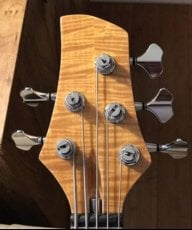
 
Invalid Link Removed

You got me started...

My bread and butter is an iOS developer, so I made this image:

ThermallyAged-iPhoneMagicalButton.png


:)
 
The pictures is from Stenback
As I remember it Stenback use a method of cutting the bass a little bigger than it will end up as finished product
Then he wrap it in thin layers of kevlar or something similar to kevlar, and then put the bass on fire
After this proces and the bass has settled again he starts working the bass down to its finished size
Its very important to controll the timing strictly, so you dont end up with torrefied or caramelized wood, or is the idea to have the shell of the hole instrument torrefied? maybe less
Im sure Stenback being from Finland,Tom use already Thermally Aged wood
In my head it looks like he is creating some kind of shell on the surface of the hole instrument?
I cant find the old interviews on this particular subject?
Stenback is the only Bass Luthier as I understand it that has sky rocket like no one else, with innovation and prices going for the moon, were others has spent a lifetime trying to get half the price for instruments?
 
Last edited:
If im right about this Tom Stenback has taken Thermally Aged tone wood and only giving the shel/ surface of the
Bass a harder layer
And putting body and neck together in this process the bass kind of becomes ONE UNIT like the bass is kind of born in to its new being
As I see, it if he had burnt the neck and body separately then you would have 2 new born units
Instead of one unit melted together being the hole bass
He takes the bass apart again, and start working taking of the xtra torrefied wood
 
Last edited:
Steinbeck is unique for sure…'tuning' the body with little weights in the control cavity etc. He's built a mystique around the brand with prices to match, so if he wants to set the basses on fire as part of the construction process, I am sure his customers appreciate it. It doesn't necessarily mean there's science behind it or something to emulate, but it certainly elevates the brand.
 
Roasted wood is more brittle than thermally aged.
So you have the three point bend statistics to prove that? I feel like every one of these people that treat wood would benefit by working with an engineer and get some testing data. Also, someone explain to me in specific terms the time and temperature and conditions difference between the totally unhelpful industry terms of "Roasted" and "Thermally Aged", because as someone in the field of material science and that work in the paper and pulp industry for decades, they sound like exactly the same thing to me.
 
Pretty much misinformation in this thread. Caution.

As @deff just posted, heat treating wood requires process optimization. You don't just toss the piece of wood in the fire.

Heat treatment of wood does change properties. Modulus, hydrophobicity, density, strength; to name a few. Times and temperatures need to be controlled.

When done correctly, there are definite performance advantages. But, doing it correctly means looking critically at data to control the process.

Here is one reference that shows some of the complexity.
Invalid Link Removed

But, as usual, when someone doesn't understand something, making fun of it or belittling it is preferable to fessing up to ignorance.
 
Last edited:
Pretty much misinformation in this thread. Caution.

As @deff just posted, heat treating wood requires process optimization. You don't just toss the piece of wood in the fire.

Heat treatment of wood does change properties. Modulus, hydrophobicity, density, strength; to name a few. Times and temperatures need to be controlled.

When done correctly, there are definite performance advantages. But, doing it correctly means looking critically at data to control the process.

Here is one reference that shows some of the complexity.
Invalid Link Removed

But, as usual, when someone doesn't understand something, making fun of it or belittling it is preferable to fessing up to ignorance.
Excellent points and I've never seen any papers written on the subject. I feel like there is so little written on the subject and so many claims being made as to how company A's process is better than everyone else but with no explanation as to why. I get that companies want to protect their IP, but since most of the secrets of torrefaction are process related and minor changes could likely have significant influence over performance they are reticent to publish.

You bring up a good point on density and hydrophobicity. Heat treated wood having a lower density and being more hydrophobic in general terms means that these necks could weigh less. I mean probably not by much but I'm surprised the "roasted" cures everything people haven't jumped on the whole neck dive issue.

I also find the wrap/firing thing to be funny. It's like some metallurgist got a wild hair and said, "let's try annealing these things". If only metal and wood grain structures changed in the same way they might be on to something, but I feel like this is just more snake oil.

But by all means company Y show us the elastic modulus numbers. Show us the ultimate tensile three point bend and charpy impact value changes! Tell us company X how your process differs from others. Maybe you are doing this in a reduced oxygen environment for a shorter duration and higher temp to achieve the desired results? So far I haven't seen anything but wind.
 
The term "Roasted" is used because it sounds better than "Torrified". The correct way is to thermally treat in a oxygen-free kiln and the amount of brown that you get is based on the amount of sugar in the wood that carmelizes and give the brown shade. Some people wrap the wood in aluminum foil and roast in their kitchen oven, then call that "torrified".
 
Excellent points and I've never seen any papers written on the subject. I feel like there is so little written on the subject and so many claims being made as to how company A's process is better than everyone else but with no explanation as to why. I get that companies want to protect their IP, but since most of the secrets of torrefaction are process related and minor changes could likely have significant influence over performance they are reticent to publish.

You bring up a good point on density and hydrophobicity. Heat treated wood having a lower density and being more hydrophobic in general terms means that these necks could weigh less. I mean probably not by much but I'm surprised the "roasted" cures everything people haven't jumped on the whole neck dive issue.

I also find the wrap/firing thing to be funny. It's like some metallurgist got a wild hair and said, "let's try annealing these things". If only metal and wood grain structures changed in the same way they might be on to something, but I feel like this is just more snake oil.

But by all means company Y show us the elastic modulus numbers. Show us the ultimate tensile three point bend and charpy impact value changes! Tell us company X how your process differs from others. Maybe you are doing this in a reduced oxygen environment for a shorter duration and higher temp to achieve the desired results? So far I haven't seen anything but wind.
Wood or metal (or any other material for that matter); we know that properties derive from structure. Wood is actually a somewhat complex natural example of a composite material. The structural changes with various heat treatments are controllable; but, since the structure is complicated to begin with, the changes require empirical characterization.

The marketing terms don't help at all; or perhaps I should say that they create both excitement and derision. In any case, they tend to be inaccurate and misleading.

And, the different wood parts of bass guitars do not have the same property requirements. So, the whole thing is somewhat non-trivial.
 
What in the hayche-ee-double-hockey-stick are you guys talking about? There is a veritable crap-ton of research out there with many, many academic articles going back decades. A very quick search in my peer reviewed studies sites (academia links) brings up four pages of lists of research articles, almost all of them from Europe.

Torrefied, roasted, burnt... all are just word descriptors and indicate nothing themselves on their surface.

If you want to optimize all of the engineering properties so that you can use them in construction with huge forces at play, then yes, you have to control the oxygen in the thermal process in order to prevent things from oxidizing and gain all of the properties. For musical instruments, the forces at play are nowhere near where this careful construction approach is required for the optimal structure.

You can literally home roast wood in your oven to change the colour and they will continue to work well enough for instrument construction. Especially if you take other factors into consideration in your construction methods. @MPU nailed it with the comment on brittleness with roasting. Roasting (with no O2 control) just burns the wood in a controlled manner, allowing you to change some properties but it does burn, so it becomes more brittle, and dust becomes powdery. Many manufacturers are using the term 'roasted' but they are using thermally modified tonewoods done with an oxygen controlled process. I'd guess the term 'roasted' is easier to understand for consumers than 'torrefied' - note that it's all about sales. :)
 
Pretty much misinformation in this thread. Caution.

As @deff just posted, heat treating wood requires process optimization. You don't just toss the piece of wood in the fire.

Heat treatment of wood does change properties. Modulus, hydrophobicity, density, strength; to name a few. Times and temperatures need to be controlled.

When done correctly, there are definite performance advantages. But, doing it correctly means looking critically at data to control the process.

Here is one reference that shows some of the complexity.
Invalid Link Removed

But, as usual, when someone doesn't understand something, making fun of it or belittling it is preferable to fessing up to ignorance.
Do a search on Ruokangas Guitars, on their website Juha does a short explain of the subject and he is one of the people from Finland who have some lessons under the belt, and experience with pioneers
 
Reading that back, I probably should have had my morning coffee first. :laugh:
Im sure you are familiar with Thom Stenback, he is doing many small and big adjustments on Fender style basses down to the very detail you can ask a bunch of the worlds best bass players from all over the world what is special about Stenback, & why they pay that kind of money for a bass made by an young guy from Finland?
 

Latest posts