
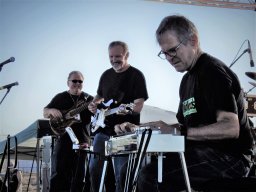
Yeah, it was. We do it once a year, maybe twice. Couple hours of covers and some originals. People bring snacks and have wine. It’s pretty fun. Tip jar had $170 after 2 hours so not too bad. I guess they liked us. The P with flats is PERFECT for a gig like this.Looks and sounds like it would be a fun and relaxed gig Steve.

Enjoy the benefits of a premium membership!
Upgrade Account
-
TalkBass has been independent since 1998. Add your voice.
Create a free account to reply to discussions, view embedded media, and browse with fewer display ads.
Join free Log in
Want zero display ads or expanded classifieds tools? Compare plans.
You are using an out of date browser. It may not display this or other websites correctly.
You should upgrade or use an alternative browser.
You should upgrade or use an alternative browser.
Roscoe Club
- Thread starter JOME77
- Start date
More options
Who Replied?

Time for me to post this image once again. This is two Roscoe necks, one 34" and one 35" shot from above the first fret. THAT is the difference your left hand is dealing with.
View attachment 7021652
I've seen this posted before, and while it looks minimal surely it doesn't account for the added 1" reach to get out there in the first place. That extra 1" puts strain on the wrist etc so the fingers still have to do additional work not relative to this minimal first fret difference.
Hey Joe!
I'd be a bit cautious in selling your beloved 35" scale Roscoe and buying a Roscoe 34" scale. You may find that it doesn't really feel any different to your left hand than the 35" scale.
And I I'll tell you why. Usually what really happens is the nut stays in relatively the same position (because the neck pocket didn't move) and the only thing that really moved is the bridge relocated an inch further from the end of the bass. Yes, you will still get frets that slightly closer than a 35" scale (~1/16 less width at the first fret and gradually less as your progress up the neck) but you may still experience the same discomfort as your 35" scale.
Sometimes truth is stranger than fiction!
- Apr 1, 2000
- 17,398
- 9,831
- Disclosures
- Endorsing Artist: Roscoe Guitars, DR Strings, Aguilar Amplification
Well, that's because there's *not* 1" further to reach. That 1" increase in scale length is spread over the entirety of the bass. The feeling of reach to the 1st fret has far more to do with where the forward strap button is on the bass than a 34" or 35" scale.I've seen this posted before, and while it looks minimal surely it doesn't account for the added 1" reach to get out there in the first place. That extra 1" puts strain on the wrist etc so the fingers still have to do additional work not relative to this minimal first fret difference.
Right. Hence my preferring the Century body over the LG or SKB. It "hangs" slightly different. If I wouldn't have tried a Century after not "clicking" with the SKB, I may not be playing my fabulous Century Pus 5's today.Well, that's because there's *not* 1" further to reach. That 1" increase in scale length is spread over the entirety of the bass. The feeling of reach to the 1st fret has far more to do with where the forward strap button is on the bass than a 34" or 35" scale.
Well, that's because there's *not* 1" further to reach. That 1" increase in scale length is spread over the entirety of the bass. The feeling of reach to the 1st fret has far more to do with where the forward strap button is on the bass than a 34" or 35" scale.
I'm not trying to be conflicting here, I'm really just trying to understand it as I don't have access to 35" basses to try.
But wouldn't that only be true if, for instance, Keith changed the LG shape depending on the scale length. Which it's my understanding he doesn't.

It's my believe that folks have gotten more sensitive since the pandemic. I don't remember players whining as much about 34 verse 35 scale basses prior to Covid. Maybe it's another one of those long Covid symptoms that just linger on.

Two things. First, think of the scale length as the distance between the bridge and the nut (NOT the first fret). The difference in distance from the bridge to the first fret on a 35" scale and the bridge to the first fret on a 34" scale will not be 1". That is what Pacman's picture shows.I'm not trying to be conflicting here, I'm really just trying to understand it as I don't have access to 35" basses to try.
But wouldn't that only be true if, for instance, Keith changed the LG shape depending on the scale length. Which it's my understanding he doesn't.
Second, I wouldn't assume that the bridge on a 34" scale is at the exact same position on the body of a 35" scale.
So, I used my Classic P (flats) for the first set last weekend. Typical cover band, wedding/dance/party type songs. I thought it sounded good. Then I switched to my Century 5. It also sounded good. Actually, everyone preferred it to the P. I'm stumped. Everyone is using Precision basses these days, right? They sound good everywhere. It sounded great the next day at the "acoustic" gig with a couple guitars and singers. The 5 is more convenient for sure, no swapping when I need the B string, but that's only a few songs. Could it be it just doesn't sound good when I play one? You know how sometimes you hear someone else doing something and then you try it and it sucks. IDK.


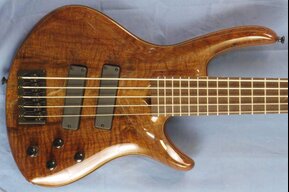
Oh man....this one looks special with that walnut body!
https://reverb.com/item/84571640-roscoe-skb-3005-mid-2000s-gloss
Also, I have to play basses from a 30" scale to a 35.5" scale (the larger being on a Broadway gig that I sub on....a giant bass!). I can play on all of them, but with smaller hands the larger basses are a chore. Again, totally doable, but not desirable long term. Yes, if a bass is designed properly for its scale length then it can be more comfortable....but I'm really tired of seeing one player tell another player what they should be comfortable with. The above photo is completely misleading. Where the bridge is set, and where the top horn ends...and the placement and shape of the lower horn if the player is sitting....all come into play. Roscoe basses are some of my favorite basses ever made, but I have no desire to play a scale length longer than a 34" scale any longer. It's not necessary for the sound I prefer, and over time, I'm uncomfortable with any bass that large because I'm a smaller human. Can we stop trying to shame folks into playing your favorite bass if it's uncomfortable for them...and possibly even causing them pain?
https://reverb.com/item/84571640-roscoe-skb-3005-mid-2000s-gloss
Also, I have to play basses from a 30" scale to a 35.5" scale (the larger being on a Broadway gig that I sub on....a giant bass!). I can play on all of them, but with smaller hands the larger basses are a chore. Again, totally doable, but not desirable long term. Yes, if a bass is designed properly for its scale length then it can be more comfortable....but I'm really tired of seeing one player tell another player what they should be comfortable with. The above photo is completely misleading. Where the bridge is set, and where the top horn ends...and the placement and shape of the lower horn if the player is sitting....all come into play. Roscoe basses are some of my favorite basses ever made, but I have no desire to play a scale length longer than a 34" scale any longer. It's not necessary for the sound I prefer, and over time, I'm uncomfortable with any bass that large because I'm a smaller human. Can we stop trying to shame folks into playing your favorite bass if it's uncomfortable for them...and possibly even causing them pain?
Last edited:
Hi Joe! thanks for sending the demeter clip, I really liked it but I'm curious since you mentioned the Pope Pre, could I please have that one also via the same email, i'd like to make an informed decision. @JOME77
E.
File sent Eric.
I love the sound of a Precision bass, that's what I started with and played for years. I have been tempted to get another one, but every time I play my Century 5's (with soap-bar pickups} with the band it just sounds great. But everyone hears things differently and is chasing their tone.So, I used my Classic P (flats) for the first set last weekend. Typical cover band, wedding/dance/party type songs. I thought it sounded good. Then I switched to my Century 5. It also sounded good. Actually, everyone preferred it to the P. I'm stumped. Everyone is using Precision basses these days, right? They sound good everywhere. It sounded great the next day at the "acoustic" gig with a couple guitars and singers. The 5 is more convenient for sure, no swapping when I need the B string, but that's only a few songs. Could it be it just doesn't sound good when I play one? You know how sometimes you hear someone else doing something and then you try it and it sucks. IDK.
Mark
For sure. I haven't liked a P bass until recently. The 5 works great for this band. I have no problem using it. I just wonder why so many make a P bass work in many situations, but it doesn't seem to for me.I love the sound of a Precision bass, that's what I started with and played for years. I have been tempted to get another one, but every time I play my Century 5's (with soap-bar pickups} with the band it just sounds great. But everyone hears things differently and is chasing their tone.
Mark
Two things. First, think of the scale length as the distance between the bridge and the nut (NOT the first fret). The difference in distance from the bridge to the first fret on a 35" scale and the bridge to the first fret on a 34" scale will not be 1". That is what Pacman's picture shows.
Second, I wouldn't assume that the bridge on a 34" scale is at the exact same position on the body of a 35" scale.
The difference in distance is about 0.96".
I agree on the bridge layout, most basses I've seen that are available in multiple scale lengths seem to have the end of the fretboard remain in approximately the same place and the bridge moves away from the end of the body. From a design point of view its probably to preserve upper fret access and ensure that the neck joint doesn't require a lot of reworking short of having a slightly different neck pocket shape.
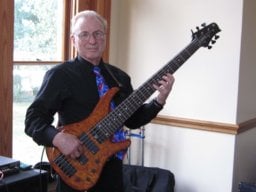
I have fairly small hands but regularly play upright bass so I can stretch my fingers out well. I own 34" and 35" scale basses and don't even have to think about it when I switch from one to another. The only one I make sure to play a bit before I use it is an Ibanez GWB 205 fretless since intonation is so important. Not to minimize the importance of fretting accuracy for clean playing, but fretless is another ball game.
I own 3 Roscoe bass and all are 35" scale. I also own Gould ggi5 and ggi6 and a Modulus Q6 and they are 35" scale. I also own an Ibanez SRSC806 and a pair of EB Bongo 6's which are 34" scale. It just does not seem to feel different to me as far as reach. The only minor difference is in the higher string tension on the 35" scale basses and I prefer that feel. It "feels" faster to me. Also, typically, the B and E strings sound more clear and defined on the longer 35" scale.
My remarks apply to me and others may feel different about scale length. The only 35" scale bass that I could not play well was a USA made Spector bolt on 6 string. It was a fantastic bass but the ergonomics did not work for me. I could barely reach 1st position and was very uncomfortable playing that bass. I could play it sitting down but standing with it on a strap it felt like the 1st fret was next door. Well, not quite but you get my drift. If I had longer arms I would probably still have the Spector. It was a very nice sounding bass and looked great.
I own 3 Roscoe bass and all are 35" scale. I also own Gould ggi5 and ggi6 and a Modulus Q6 and they are 35" scale. I also own an Ibanez SRSC806 and a pair of EB Bongo 6's which are 34" scale. It just does not seem to feel different to me as far as reach. The only minor difference is in the higher string tension on the 35" scale basses and I prefer that feel. It "feels" faster to me. Also, typically, the B and E strings sound more clear and defined on the longer 35" scale.
My remarks apply to me and others may feel different about scale length. The only 35" scale bass that I could not play well was a USA made Spector bolt on 6 string. It was a fantastic bass but the ergonomics did not work for me. I could barely reach 1st position and was very uncomfortable playing that bass. I could play it sitting down but standing with it on a strap it felt like the 1st fret was next door. Well, not quite but you get my drift. If I had longer arms I would probably still have the Spector. It was a very nice sounding bass and looked great.

@JOME77 since you were askingWell I took my Century 5 to get the fret sprout/rough edges taken care of (along with another non- Roscoe bass) by Carl Pedigo at Lakland, he had a special file and was literally done with each of them in a few passes. But while I was there, I had them both set up as well, since he does that so well (and also effortlessly). Thinking I would kill two birds with one stone, I replaced the stock Roscoe bridge with a new Hipshot a style, so I could get lower action. Well, I'm not always as clever as I think I am.
View attachment 4952984 View attachment 4952985 View attachment 4952986 View attachment 4952987 View attachment 4952990 View attachment 4952989 View attachment 4952988 View attachment 4952997
He also had trouble getting the B string intonated 100%, but he said it should only affect if I'm playing above the 12th fret, which I rarely do on any string, but definitely not the B. I'll probably switch back when I change strings next. I do stand by my decision to change bridges on my 6er though.
View attachment 4952993
Also, while I had the strings off, I checked out my fancy magnetic film and see the magnet pattern of the pickups. I'm confused though as these are supposed to be quad coils, which I thought would be two split coils side by side... maybe next time I have some time, I'll take the pickups out and make sure they're the right ones...
View attachment 4952996 View attachment 4952995
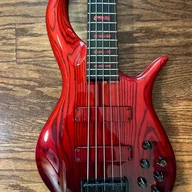
I’ve always been a fan of nickel strings, as I felt that stainless strings were always too bright and zingy, especially on my last few basses which were a couple MTDs and a Fodera Monarch, which definitely leaned toward the bright, zingy high end. Because of my affinity for nickel, I never seriously considered stainless on my Roscoe, but, boy, do these DR Hi Beams sound great. With the Barts being so mid focused and slightly dark, even with the Nordy pre, the Hi Beams compliment the overall tone so well and that bit of zing really opens it up and helps it shine in a full mix. For those like me that were nickel- biased, I highly recommend trying out a set of Hi Beams, or any stainless set for that matter. Appreciate this forum and group for the shared wisdom and encouragement!

Hi Beams are my favorite strings on a Roscoe with Barts.


