
Teeny-tiny, boy toy bus!
Say that 7 times really fast and then play "Stairway to heaven" backwards and see if it doesn't sound just like "Highway to Hell"!

Last edited:

TalkBass has been independent since 1998. Add your voice.
Create a free account to reply to discussions, view embedded media, and browse with fewer display ads.
Join free Log in
Want zero display ads or expanded classifieds tools? Compare plans.
Teeny-tiny, boy toy bus!
Say that 7 times really fast and then play "Stairway to heaven" backwards and see if it doesn't sound just like "Highway to Hell"!

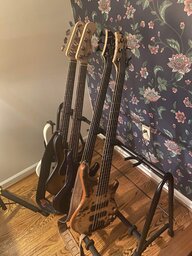
View attachment 3597950 I'll have my second Roscoe on Tuesday.
In addition to my LG3005 I will have a relic'd, gold, bound and blocked classic custom 5 that i just swapped for.
My first passive bass ever.
Played it today at the store where i got it from and its got a neck that feels wider than my old SKB 6 but the tone is to die for...
I'm looking forward to playing both and seeing which one wins in my goal to get to one instrument by end of 2020.

Are Roscoe Basses sensitive to changes in body wood? If the electronics are the same will a mahogany body sound different than ash? Or is it the neck wood that affects the tone?
I think all basses are influenced in tone by wood selection. There's certainly a difference between the end result of a bass with a Mahogany body vs. Ash. Likewise, there's going to be a difference between a bass with a Maple fretboard and Wenge. Personally, I've always felt that the fretboard material influences the overall tone more than body wood, but both play a role. Now, does anyone hear that in a full band mix, I think it's unlikely, but there is a small difference. With that, I think no matter what, your typical two soapbar Roscoe will still sound inherently Roscoe no matter what, especially when equipped with the Roscoe-spec Bartolini pickups.
No frets......the strings are vibrating between the metal of the fret and the metal of the bridge...
I agree with the above with exception to the statement stating that the fingerboard has the most influence on the tone. It certainly influences it but I believe the signature Roscoe tone has more to do with the neck construction (Keith's use of graphite reinforcement) and the Roscoe Bart pickups and pre. Of course everything contributes to the overall tone. For several years I just wasn't a huge fan of ash bodied Roscoe basses. They just sounded too aggressive to me. But when I traded for a Roscoe with a wenge wedge neck everything changed. The aggression of the ash was totally tamed by the oily wenge wood and the "in your face tone" was replaced with a nice growly compressed singing tone. Add then I traded for another Ash bodied Roscoe with a wedge wenge neck and a maple board (which requires Keith to use MORE graphite in the neck) and WOW! Suddenly that tone is still growly and compressed but it sounds clearer sounding and has a really nice snap to it.
I agree with the above with exception to the statement stating that the fingerboard has the most influence on the tone. It certainly influences it but I believe the signature Roscoe tone has more to do with the neck construction (Keith's use of graphite reinforcement) and the Roscoe Bart pickups and pre. Of course everything contributes to the overall tone. For several years I just wasn't a huge fan of ash bodied Roscoe basses. They just sounded too aggressive to me. But when I traded for a Roscoe with a wenge wedge neck everything changed. The aggression of the ash was totally tamed by the oily wenge wood and the "in your face tone" was replaced with a nice growly compressed singing tone. Add then I traded for another Ash bodied Roscoe with a wedge wenge neck and a maple board (which requires Keith to use MORE graphite in the neck) and WOW! Suddenly that tone is still growly and compressed but it sounds clearer sounding and has a really nice snap to it.
$5 says you don’t still have that ash/wenge/maple Roscoe


Where is the Gecko bass?


A stiff neck (not the we get in the morning the older we getI agree with the above with exception to the statement stating that the fingerboard has the most influence on the tone. It certainly influences it but I believe the signature Roscoe tone has more to do with the neck construction (Keith's use of graphite reinforcement) and the Roscoe Bart pickups and pre. Of course everything contributes to the overall tone. For several years I just wasn't a huge fan of ash bodied Roscoe basses. They just sounded too aggressive to me. But when I traded for a Roscoe with a wenge wedge neck everything changed. The aggression of the ash was totally tamed by the oily wenge wood and the "in your face tone" was replaced with a nice growly compressed singing tone. Add then I traded for another Ash bodied Roscoe with a wedge wenge neck and a maple board (which requires Keith to use MORE graphite in the neck) and WOW! Suddenly that tone is still growly and compressed but it sounds clearer sounding and has a really nice snap to it.
 ) is an important factor for the strings resonating- don’t forget Roscoes (not all the classics, but the Century, LG and SKB- in alphabetical order, no preference shown ) have quarter sawn necks, which imho really make the notes jump out and emphasizes certain frequencies as opposed to flatsawn necks... which is better is up to the player, i have basses with both (and 2 graphite necked ones as well), but a talented luthier (which I believe Mr. Roscoe qualifies as) knows how to combine the parts to make an instrument that works, and not just a bunch of off the shelf parts thrown together.
Oh yes I do!
But you can keep the $5!
View attachment 3602471 View attachment 3602469 View attachment 3602470


