• TalkBass has been independent since 1998. Add your voice.
    Create a free account to reply to discussions, view embedded media, and browse with fewer display ads.
    Join freeLog in
    Want zero display ads or expanded classifieds tools? Compare plans.

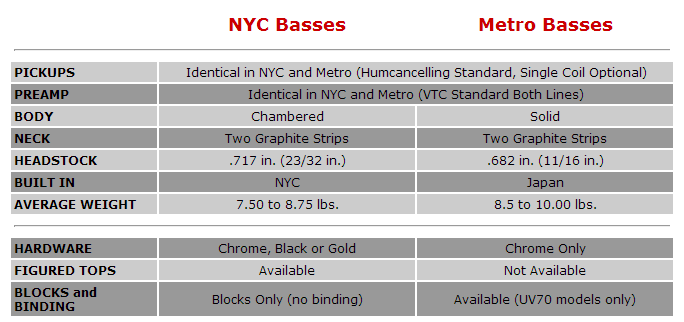
Sadowsky now uses graphite strips on its Metro basses??

When did this happen? I was always under the impression that graphite strips are only used on their NYC basses?
upload_2014-5-21_22-0-3.png
 
So he's decided that he likes graphite strips better than not having them? Last I heard, he was undecided. Me, I don't care one way or the other. They all still need adjusting when the weather changes drastically anyway.
 
  • Like
Reactions: SirMjac28
So he's decided that he likes graphite strips better than not having them? Last I heard, he was undecided. Me, I don't care one way or the other. They all still need adjusting when the weather changes drastically anyway.


Per the interview I posted above, it's not about neck stability. Ref. the 12:20 mark.
 
Oh, I didn't watch it. Guess I'm forced to watch it now that you didn't clue me in on what he said ;)

EDIT: Watched it...all about more even response and minimizing dead spots. I guess I could buy into that. My 09 AmStd Precision just barely has a dead spot, and you have to strain to hear it. OK, I'm sold.
 
Last edited:
Regarding dead spots, I used to own NYC 4 fretless (Ebony board, graphite bars) which had a very noticeable dead spot on the G string. I also had a 07' Metro MV4 with no bars and no dead spot whatsoever. My 08' American Std jazz doesn't have any either. It's true that more mass=less dead spot but in the end it's really a matter of luck, IME anyway.
 
Last edited:
  • Like
Reactions: MrDOS and srxplayer
Regarding dead spots, I used to own NYC 4 fretless (Ebony board, graphite bars) which had a very noticeable dead spot on the G string. I also had a 07' Metro MV4 with no bars and no dead spot whatsoever. My 08' American Std jazz doesn't have any either. It's true that more mass=less dead spot but in the end it's really a matter of luck, IME anyway.

This^

I think Roger is just starting one more musician urban legend. Physics says different. Graphite bars are stiff. They make the neck stiffer. No one can argue this because a full graphite neck like my Modulus has an amazingly stiff neck. But in a neck with bars the neck is still mostly wood so it's still going to depend a great deal on how the tree grew. Plus graphite bars are uniform and wood may or may not be so much. So that creates less variation which can give rise to dead spots. But again MOST of the neck is wood so wood effects like dead spots can still be there depending on luck. And while graphite isn't affected by weather and my Modulus stays in tune for years, a neck with bars again is definitely more stable than pure wood, but only slightly so. The neck is still mostly wood.

So I don;t agree with Roger's theory about graphite not making a neck more stable, but the key word here is slightly. It's slightly more stable, slightly more uniform and slightly fewer dead spots. So my bottom line would be carbon rods are a good thing in a wooden neck no matter what. And Roger, Fender and I all seem to agree on that one.

Personally I prefer the total stability of an all carbon neck, but some people hate the carbon tone and feel, and I can see that. So what you want is to try to find carbon performance with wood tone and feel. So compromises are in order. Carbon rods seem like a decent compromise.