Wes Borland is in fact the creator of the catchy bass line to "re-arranged" from SO, the "nookie" guitar line was from a sorth of self made piccolo-like instrument tuned very low, dunno details tough

It's a weirdly tuned custom guitar - it only has four strings, and is like the lower 4 strings of a 6 string, with the 6th string extra thick (think an 8th string) tuned to f#, so you have, from low to high pitch, f#, f# an octave higher, b, e.
Stalemate, Nookie, Full Nelson, The One and an unreleased Bside commonly known (if you search for it on youtube) as "No Control" or "Don't Remember" (recently rerecorded for a supposedly forth-coming album, under its proper name; "You Know").
Here is a recent-ish article about it:L
Limp Bizkit Guitarist Wes Borland Is Now Playing a 4-String Guitar, Footage Available | Music News @ Ultimate-Guitar.Com
From Wiki:
Borland used
Ibanez seven-string guitars exclusively from 1997 until 1999. However, he stated that he played a 6-string guitar on the entire
Three Dollar Bill, Yall record. Shortly after embarking on a tour with Korn, Ibanez got a hold of Borland and gave him a number of seven-string Universe guitars, essentially for free, which he continued to use extensively. During the touring in support of
Significant Other, Borland used two custom
Ibanez RG seven-strings with the electronic setup of an Ibanez AX7521 (two volume knobs and two tone knobs rather than one volume and one tone). Nothing is certain about the type of pickups that he used, however, he did use EMG pickups at one point, stating in an interview with GuitarCenter that he was moving from "passive to active pickups". Borland also endorsed the rare
Ibanez RG7 CST guitar, which is made from superior/high-quality materials and is also equipped with an [Invalid or Expired Link Removed]designed piezo system on a locking tremolo. He is currently one of two American owners of one. Additionally, Borland used a vintage Ibanez Musician MC150PW, which was modified to be fitted with 4-strings, which he used on songs such as "Nookie", "Full Nelson", and "The One". This guitar can be seen in the music video for "Nookie." Ibanez then made him a custom baritone 4-string AX that would be used to replace the Musician. This was eventually replaced by a custom-made Master Guitars "Cremona" 4-string, which he uses to this day.
During the recording for
Chocolate Starfish and the Hot Dog Flavored Water, Borland switched to 6-string guitars. The entire album was recorded using a Master Guitars Cremona semi-hollow body guitar, which is visible in the video for
My Generation. However, Borland did not tour with this guitar and instead used
Paul Reed Smith guitars, one of which is a Standard 24 in a Platinum Metallic finish, a Custom 24 in a Black Slate finish, and a 4-string baritone. After the tour, they were not seen again. In a recent Facebook photo posted by Fred Durst, Borland is shown playing the Cremona again in 2012 for studio purposes.
In 2005,
Yamaha approached Borland about a new signature guitar, which was almost 100% designed by Borland. The model CV820WB was released that same year. It is a semi-hollow body guitar with a large body and new Yamaha high-output split field humbuckers, made exclusively for that guitar. It also comes with the new Yamaha Quick Change finger-clamp locking tremolo system, which rids the user of having to cut the ball ends off of the strings, which is very unusual for a locking tremolo. This was Borland's main guitar for the recording of Black Light Burns'
Cruel Melody and the touring behind it, as well as most of the touring Limp Bizkit did before the recording of
Gold Cobra. Despite its innovative characteristics, it wasn't a popular guitar, per se, and was discontinued in mid-2011, when Borland switched to
Jackson Guitars, more or less beginning with the recording of Gold Cobra.
Borland was endorsed by Jackson shortly before the release of
Gold Cobra, and owned several Rhoads guitars, which he used on Limp Bizkit shows. He now plays a custom white Warrior model with black bevels, and a Gun Metal Grey Warrior, along with a white Randy Rhoads guitar. He does not currently have a signature model with Jackson. Additionally, Borland also uses a Fender Bass VI, tuned to one octave below E standard tuning. He uses this on "The Story" on
The Unquestionable Truth (Part 1), and again on "90.2.10", "Walking Away", and "Back Porch" on the
Gold Cobra record.
Other guitars Borland has been seen with before are a 1976 Fender Starcaster a stock ESP LTD V-401DX (used on the Limp Bizkit reunion tour for playing songs on Results May Vary) and Mayones Regius Pro 6, Legend and Setius GTM 6 Baritone guitars.
Borland tunes his guitars to C# standard tuning (C# F# B E G# C#) and to Drop B tuning (B F# B E G# C#). He also tunes his 4-string baritone guitars to a variant of this tuning with a low F# string, which is a bass string (F# F# B E). During the late 1990s when Borland played 7-string guitars, he played them like one would play a 6-string guitar by tuning the highest string to C# as well, while maintaining standard C# tuning all the way to the seventh string. This technique was later used by
Stephen Carpenter of
Deftones so he could play the songs he originally recorded on a six-string without losing the feel of a seven-string, as
Limp Bizkit and the
Deftones had toured together in the mid 90's.
Borland uses
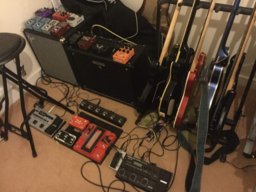
Ernie Ball .011-.052 gauge nickel-wound strings, where the G string is wound. For Limp Bizkit's first three albums, Borland used Mesa-Boogie Dual and Triple Rectifier amps. In 2000, Borland would use the Mesa Boogie heads in conjunction with a Diezel VH4. In the Mid 2000's, on the recording of
Cruel Melody and
The Unquestionable Truth (Part 1), Borland's main amp was the Diezel VH4. Starting with the 2008 recording of
The Moment You Realize You're Going to Fall Borland played mainly Orange Amps (specifically the Thunderverb 100 models) since touring in support of Cruel Melody began and has continued to use them since then, also on
Gold Cobra. Currently, Borland plays EVH Amps and cabinets for his heavier tones. The mainstay of Borland's amp setup has been a Roland JC-120 combo amplifier to generate his particularly exceptional clean tones.