• TalkBass has been independent since 1998. Add your voice.
    Create a free account to reply to discussions, view embedded media, and browse with fewer display ads.
    Join freeLog in
    Want zero display ads or expanded classifieds tools? Compare plans.

SBMM Ray35 truss/neck, is this normal?

rojo412

Sit down, Danny...
Supporting Member
Feb 26, 2000
10,913
15,076
46
Cleveland, OH.
A friend of mine recently got a used Sterling Ray35, one of the newer ones with the roasted neck. He was having issues getting the neck to straighten out enough, so he brought it to me.
I took off the strings and removed the tension from the neck to find that when under no truss or string tension, the neck has a pretty bad forward bow. Of course, this is hard to capture in photos, but here's a couple:

IMG_8334.jpg IMG_8335.jpg IMG_8336.jpg IMG_8337.jpg IMG_8338.jpg

The forward bow, yeah, I know THAT isn't normal. Or if it is, that's a really stupid design flaw, but my guess is the "roasted maple" doesn't have the magical properties that some claim and essentially, this thing is like any other neck that isn't terribly well built to begin with.

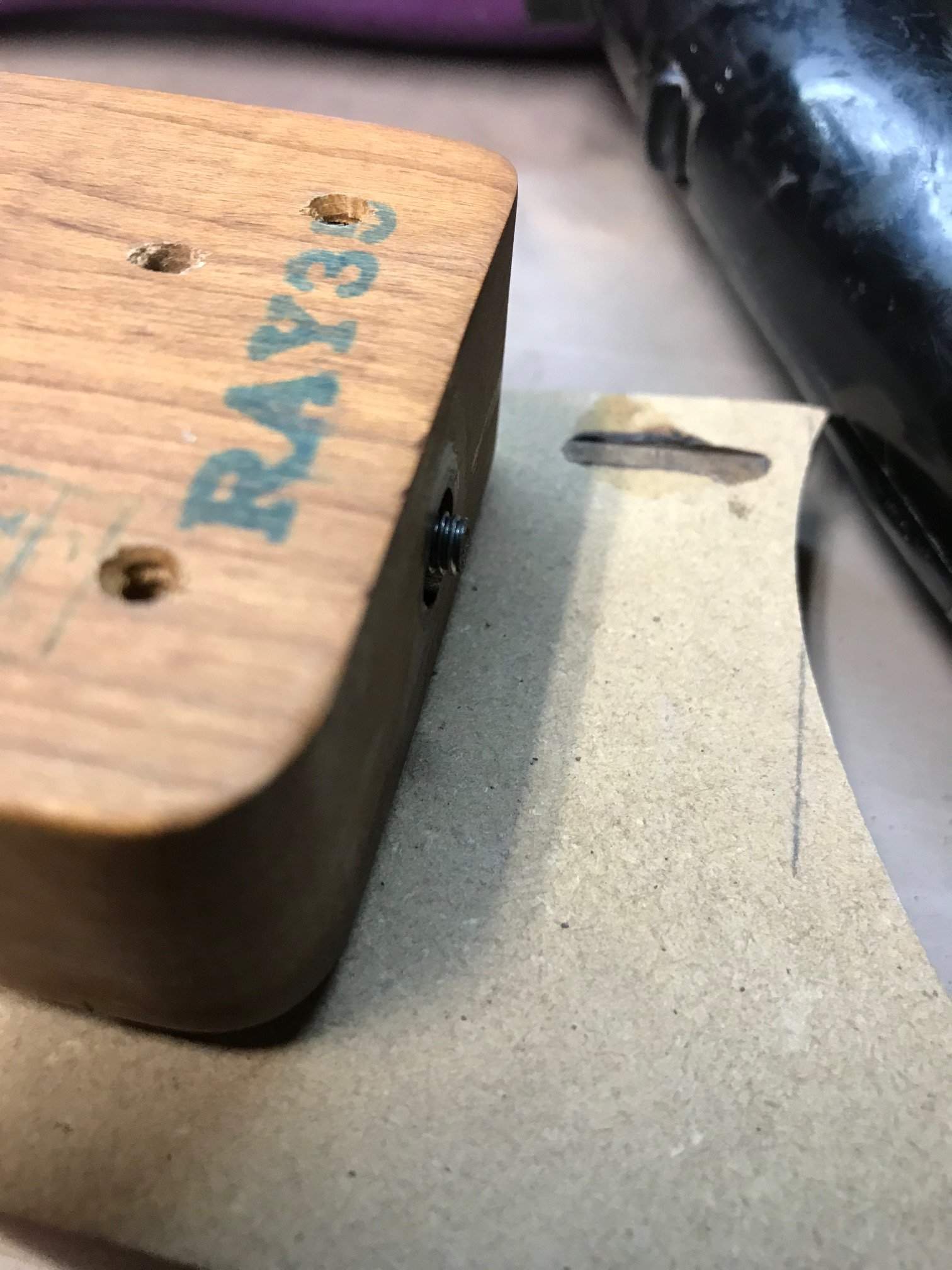
My question of normality relates to the end of the truss rod. If anyone has one of these, have they removed the truss nut and found the rod to protrude like this:

IMG_8341.jpg

I've never seen such a thing and was concerned that the rod may be creeping out of the neck. So I'm just looking to see if I'm right or wrong on this one.

Thanks in advance for any help!
 
  • Like
Reactions: CatchaCuda
A friend of mine recently got a used Sterling Ray35, one of the newer ones with the roasted neck. He was having issues getting the neck to straighten out enough, so he brought it to me.
I took off the strings and removed the tension from the neck to find that when under no truss or string tension, the neck has a pretty bad forward bow. Of course, this is hard to capture in photos, but here's a couple:

View attachment 4062125 View attachment 4062126 View attachment 4062127 View attachment 4062128 View attachment 4062129

The forward bow, yeah, I know THAT isn't normal. Or if it is, that's a really stupid design flaw, but my guess is the "roasted maple" doesn't have the magical properties that some claim and essentially, this thing is like any other neck that isn't terribly well built to begin with.

My question of normality relates to the end of the truss rod. If anyone has one of these, have they removed the truss nut and found the rod to protrude like this:

View attachment 4062133
I've never seen such a thing and was concerned that the rod may be creeping out of the neck. So I'm just looking to see if I'm right or wrong on this one.

Thanks in advance for any help!
The adjuster "wheel" that's supposed to be on the end of that truss rod seems to be missing.
 
What I’m trying to find out is, whether or not the truss rod normally protrudes from the end of the neck like that... or if the anchor deep in the neck has slipped and this neck is torched.

I’m well aware of the effects of removing a nut from a bolt. :thumbsup:
 
Okay, I may have answered this for myself here:

I threaded the nut back on partially and tapped it back inward. The truss rod moved back to flush with the heel of the neck.
So my guess is, the "anchor" portion of the truss rod is being pulled closer to the base of the neck with every adjustment. It's pulling through the wood that should be there to keep it in place.

My guess is, that may allow it to function for a little while, but eventually, this truss rod will either:
a) run out of threads and no longer adjust the neck;
b) pull the anchor far enough to actually damage the wood/structure of the neck and cause it to split;
c) snap the truss rod at some point in the neck.

And if I'm not mistaken, that means that the only real fix is to remove the fingerboard, remove the rod, replace the wood that was damaged, either replace or just re-install the original truss rod, put it all back together, and make this bass as good as (or better than) new.

Am I getting close?
 
Okay, I may have answered this for myself here:

I threaded the nut back on partially and tapped it back inward. The truss rod moved back to flush with the heel of the neck.
So my guess is, the "anchor" portion of the truss rod is being pulled closer to the base of the neck with every adjustment. It's pulling through the wood that should be there to keep it in place.

My guess is, that may allow it to function for a little while, but eventually, this truss rod will either:
a) run out of threads and no longer adjust the neck;
b) pull the anchor far enough to actually damage the wood/structure of the neck and cause it to split;
c) snap the truss rod at some point in the neck.

And if I'm not mistaken, that means that the only real fix is to remove the fingerboard, remove the rod, replace the wood that was damaged, either replace or just re-install the original truss rod, put it all back together, and make this bass as good as (or better than) new.

Am I getting close?
I believe you are correct, sir! Nice forensics...
 
Okay, I may have answered this for myself here:

I threaded the nut back on partially and tapped it back inward. The truss rod moved back to flush with the heel of the neck.
So my guess is, the "anchor" portion of the truss rod is being pulled closer to the base of the neck with every adjustment. It's pulling through the wood that should be there to keep it in place.

My guess is, that may allow it to function for a little while, but eventually, this truss rod will either:
a) run out of threads and no longer adjust the neck;
b) pull the anchor far enough to actually damage the wood/structure of the neck and cause it to split;
c) snap the truss rod at some point in the neck.

And if I'm not mistaken, that means that the only real fix is to remove the fingerboard, remove the rod, replace the wood that was damaged, either replace or just re-install the original truss rod, put it all back together, and make this bass as good as (or better than) new.

Am I getting close?

Unfortunately I think you are right. It is possible the route at the anchor was made too big in the first place. You could try the old tick of adding washers to the truss rod to get more adjustment.
 
Out of curiosity, I checked my SBMM SUB Ray4. Sure it's not the exact same bass. The threads were indeed sticking out, like in your first pic. Also, slight foward bow. Sure enough, I put the wheel back on and was able to push the rod back and the threads were just barley sticking out.

My guess, is that the anchor's route is oversized. Well, that's what I'm hoping.
 
  • Like
Reactions: RSBBass and rojo412
Thanks ‘Cuda! Much appreciated!

I did end up emailing them tonight to see if I can find out what the actual design of the rod might be. I was assuming the old fashioned style, but if it’s a single action/double rod style, it may end up being something that could be losing its “anchor point” closer to the base of the neck. That would also mean it may be possible to remove it with a little less “surgery” required.

I’ll definitely post any findings here for anyone else in this predicament.
 
  • Like
Reactions: CatchaCuda
Well, I hope SBMM gets back to you. FWIW mine is a very used and abused 2014, Indonesian SUB that I found on Craigslist. It needs fretwork, maybe even a refret- that's way beyond my current abilities, and tools.

Do I just pull the board off tomorrow, and see what is going on?:laugh:

I'm glad you started this thread.
 
  • Like
Reactions: rojo412
No word yet from SBMM, though they are a few hours behind and likely busy.
But I did want to show what I was doing to try and correct the bend in the neck (pardon the mess):

IMG_8343.jpg

There's a heating pad on the neck, then a clamp pressing it towards the bench, counteracting the forward bend. This should loosen the glue of the board, possibly train the neck to have more straightness, and hopefully take off the required effort from the truss rod.
This is the rod pushed back in, by the way:

IMG_8344.jpg

And this is what it looks like without the heating pad on it:

62768974041__8E05DDD8-4FF9-4AD2-B41A-F3034F1EFCFB.JPG

Not the most shining endorsement when a bass this new requires such treatment to HOPEFULLY function in a normal, working capacity :meh:
 
Okay... GOT IT!
(this may be a long read, but it's good, IMO)

Here's what I started thinking/doing:
@CatchaCuda the pic you sent me seemed familiar as the piece of wood started creeping in this one here too. That told me that it was likely that the rod was a double rod/single action. The "anchor" was the top rod, resting against a very thin and unsupportive piece of wood.
So I ended up doubling down and made myself a little support "bracket" out of scrap wood to allow the tightening of the rod to pull that piece out, so I could find out how deep things went.

IMG_8348.jpg

IMG_8349.jpg

Kept tightening until the piece of "support" came out:

IMG_8350.jpg

IMG_8351.jpg

That's about all there is, the little piece came off and revealed the style of truss rod.

IMG_8353.jpg

So I attached the nut and my sacrificial bolt to the truss rod, clamped the sac bolt into the vice and PULLED!

IMG_8352.jpg

The truss rod came out that far. It wouldn't go further though.

BUT... that really would be unnecessary because I figure out what the fix is and it's dumb easy (sort of).

@RSBBass you honestly nailed it. But I'll tell you why I was not immediately on your side with it and the answer is basically involving how this truss wheel works and where my head was at in the mistake. You were ABSOLUTELY RIGHT though.

- These truss wheels rest on the base of the neck and use that as a point to pull the rod itself. Under there is where I was thinking it would need a washer. Honestly, if the design were the old single rod, that would actually be kinda sorta true because a normal truss nut presses against the wood or metal "support" built into the neck. The wheel being external, I figured if I added a washer that was smaller and fit inside, it wouldn't actually accomplish much because the rod was traveling how it would travel and the washer wasn't making much difference anyway because the base of the neck held tension...
- What is happening HERE is that the truss wheel does use the shoulder of the neck heel to add tension. But being the design it is, it ends up pulling the whole truss outward! That is what knocks the wood out of place. It would stay sort of in place with the wheel holding it in, but would kind of come to a stop and the truss would run out of travel.

THE FIX AND HOW IT WORKS:

That little piece of wood that gets knocked out? It's trash. It's useless. You can toss it. Or glue it in carefully, if you want, but frankly, it's decoration more than function.
What you really need in there is the spacer that would fill the "travel area" and keep the rod from being pulled out of the neck.

IMG_8354.jpg

On the left is the stock "washer" for the rod, on the right is the spacer. That spacer is actually a piece of a bicycle chain, THE ROLLER. I used to work at a bike shop and snagged a bunch of them from scrap chains to keep as truss rod spacers. They are hardened steel and drastically better than most "washers" because they won't mushroom like this one did under pressure.

I ended up using 2 of those rollers as spacers and they appear to be working fantastically. They fill the gap, the rod tension is borne on those, not the heel of the neck wood, and I can get a mad back-bow in this neck (it still has a wicked front bow naturally, but I'm going to keep torturing it).
This one lives to fight another day.

Okay, so why does that work without an anchor point?

Well, if you've ever had a "golden era" Warwick, you may or may not know that the truss rods in those could be removed without taking the neck apart. They just slid out as a unit. The concept was, once it was seated in place, the truss rod worked fine to add relief by pushing against itself. There was no shoulder or support built into the neck, it was built into the rod.
This is essentially the same design. As you can see, the truss could likely be removed like this without much effort, other than pulling. And the only reason to remove it completely would be if it were snapped, which this one isn't so I'm not going to force the issue.

Point is, if the rod functions, there's no reason to do much more than fill that gap with a nice spacer and make sure the rod is seated as far in the neck as possible.

'Cuda, or anyone else with this issue, the fix can be had with these chain rollers. I'm happy to help anyone out if they need a pair, but you can also go to your local bicycle shop and peruse their scrap chains. I guarantee, if they are anything like my shop used to be, you can bribe them with beer and/or pretzels and they'll hook you up.

So yeah... I think I can put this one to bed at the moment. There are design issues and wood quality issues, but the fix involved is not rocket science and should allow for better performance out of these basses for practically no money and little effort (compared to removing a fingerboard).

Speaking of beer... I deserve one now!