

Enjoy the benefits of a premium membership!
Upgrade Account
-
TalkBass has been independent since 1998. Add your voice.
Create a free account to reply to discussions, view embedded media, and browse with fewer display ads.
Join free Log in
Want zero display ads or expanded classifieds tools? Compare plans.
You are using an out of date browser. It may not display this or other websites correctly.
You should upgrade or use an alternative browser.
You should upgrade or use an alternative browser.
SBO22 Sceptre
- Thread starter smart51
- Start date
More options
Who Replied?
It lives! As a gauge of its size, the strings are old ones taken of a 34" scale headless.
I'm not at all happy with the pickup cavity now I've seen it assembled. I'll have to make a trim of some kind. The back has picked up some dents during assembly which is annoying too.
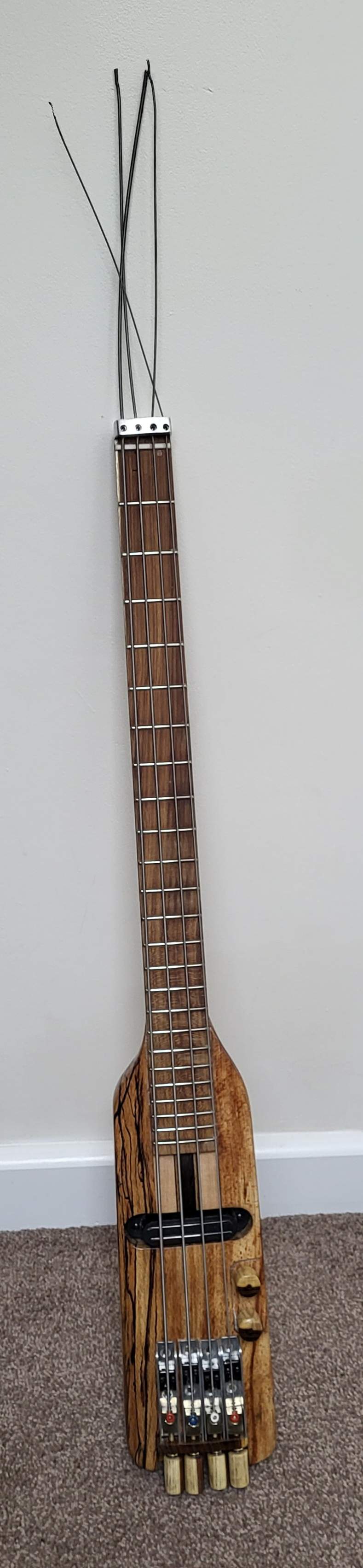

I'm not at all happy with the pickup cavity now I've seen it assembled. I'll have to make a trim of some kind. The back has picked up some dents during assembly which is annoying too.

So you shape the headpiece while it's mounted to the neck? Aren't you afraid to damage the neck with a tool for shaping metal? Since wood is generally softer than metal.I drilled the mounting holes and truss rod access on a square piece, then fitted it to the neck for shaping.
No, fit the head piece blank, scribe a line round the neck, remove the blank and shape it to the line.So you shape the headpiece while it's mounted to the neck? Aren't you afraid to damage the neck with a tool for shaping metal? Since wood is generally softer than metal.
Very nice.
And to think I haven't even started my thread yet.
And to think I haven't even started my thread yet.
The new strings have arrived. The nut has been slotted to match. I'm now done.
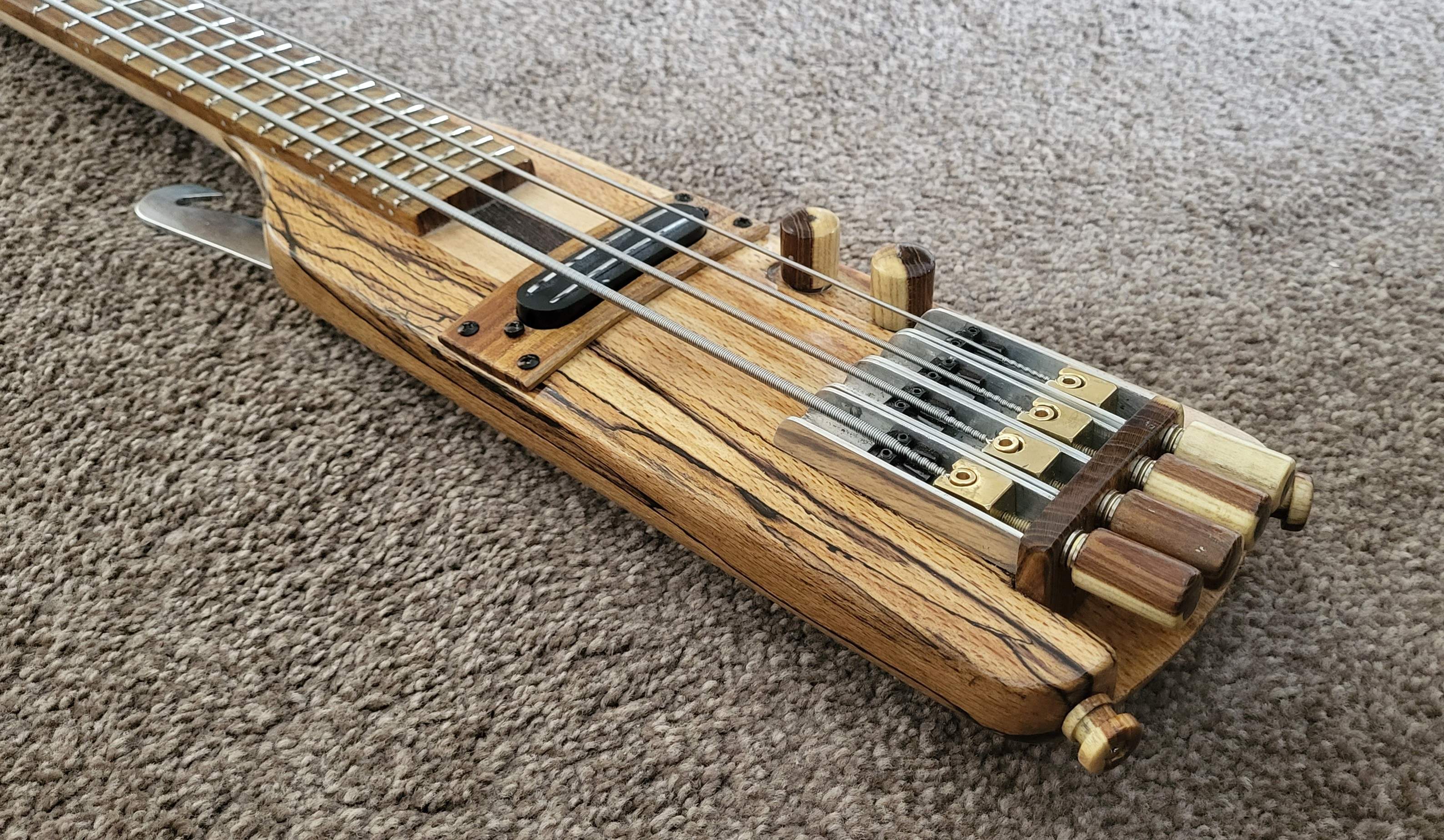
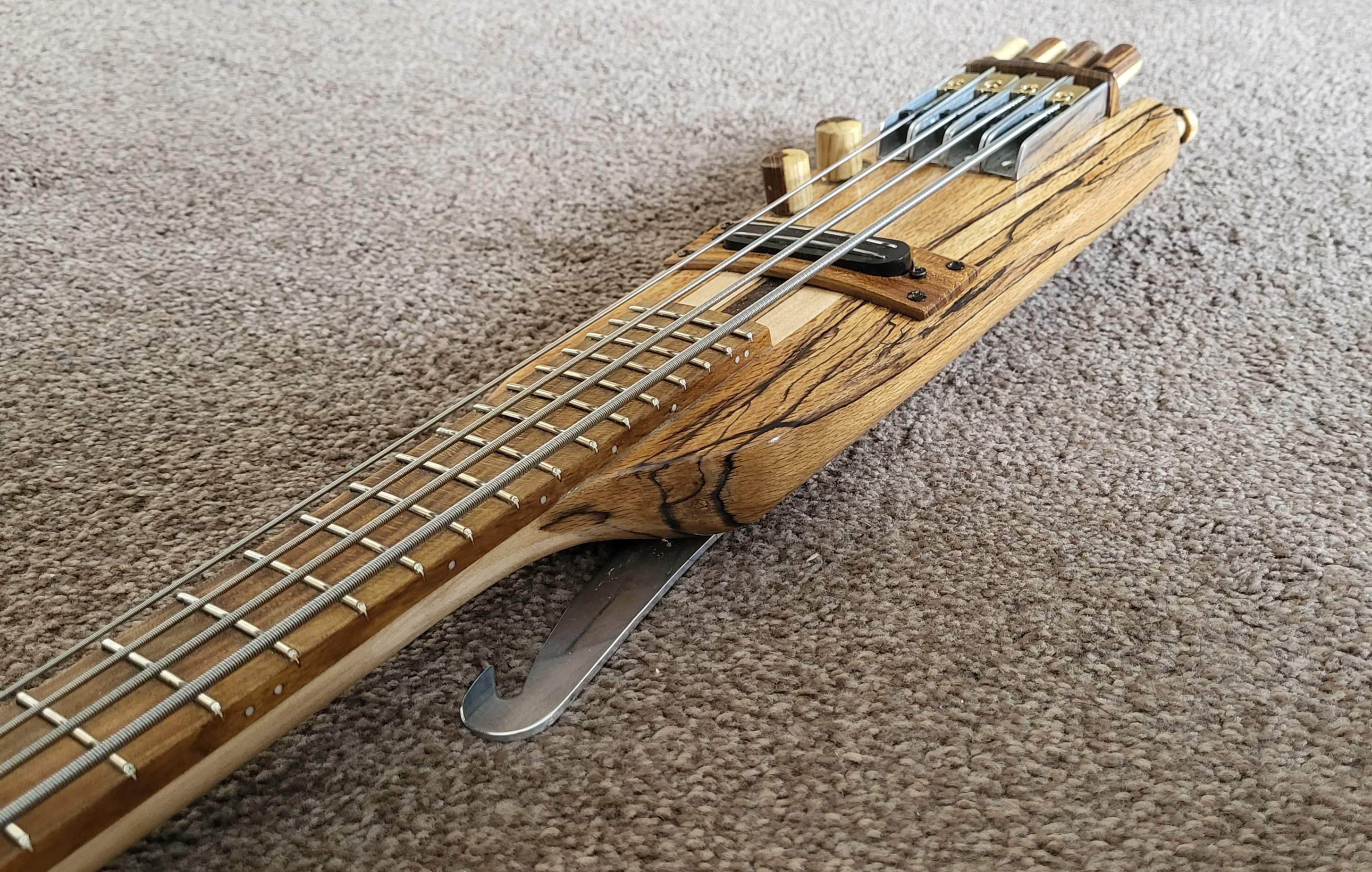
The E string has fairly pronounced inharmonicity which is a bit disappointing, but as an instrument it is surprisingly playable. At 760 X 110mm, you can take it with you anywhere.
The E string has fairly pronounced inharmonicity which is a bit disappointing, but as an instrument it is surprisingly playable. At 760 X 110mm, you can take it with you anywhere.
Fantastic! And completed the day after I begin my own build. 
Does the inharmonicity you are noticing seem more than just the usual super-short scale associated weird overtones? I've found that very short scale basses have a general timbre that is different from long scale and even short scale instruments and part of their character is a slightly different set of overtones. I'm curious if what you are describing is in this range of what I would call "acceptable" or if it's something beyond?
Does the inharmonicity you are noticing seem more than just the usual super-short scale associated weird overtones? I've found that very short scale basses have a general timbre that is different from long scale and even short scale instruments and part of their character is a slightly different set of overtones. I'm curious if what you are describing is in this range of what I would call "acceptable" or if it's something beyond?
I was expecting the E string to sound like a B string stopped at the 5th fret. That's what the 25.5" scale length was for. The 130 gauge string is not particularly heavy for the job. They're not strings I'm used to - stainless steel on hex cores. I don't know if they're stiffer, which I believe is what makes inharmonicity worse or what. With the tone rolled off it is less noticeable of course but it is very noticeable.Fantastic! And completed the day after I begin my own build.
Does the inharmonicity you are noticing seem more than just the usual super-short scale associated weird overtones? I've found that very short scale basses have a general timbre that is different from long scale and even short scale instruments and part of their character is a slightly different set of overtones. I'm curious if what you are describing is in this range of what I would call "acceptable" or if it's something beyond?
Looking at this photo again, I feel that the bass in the middle has a really interesting shape. It achieves all that we usually strive for (strap pin at the twelfth fret, left hand reach to the top fret, leg curve for seated play) in an unusual way. And without a lower horn! Nice. Does it play well?
Thank you. It has become my daily player (taken over from the one on the left). While the long scale bass has a better low B, I prefer the short scale and the Jazz bridge pickup.Looking at this photo again, I feel that the bass in the middle has a really interesting shape. It achieves all that we usually strive for (strap pin at the twelfth fret, left hand reach to the top fret, leg curve for seated play) in an unusual way. And without a lower horn! Nice. Does it play well?
I designed the shape to fit me and the left hand up way I tend to play. The offset between the upper and lower body carves is much bigger than usual to achieve that. Plus, what's a lower horn for? It doesn't do anything other than restrict access to the higher frets.
Sometimes it completes the curve that fits around the seated player's leg.Plus, what's a lower horn for?
But as you said, a bigger offset so no need for that.
Now I look at the photo again, and now it's a development from two horns, via one horn, to no horns.


Could your inharmonicity problem be "strat-itis"? If you don't have your pickup as low as possible already and you drop it to the maximum possible that should be an audible improvement if strat-itis is the cause.


