
Enjoy the benefits of a premium membership!
Upgrade Account
-
TalkBass has been independent since 1998. Add your voice.
Create a free account to reply to discussions, view embedded media, and browse with fewer display ads.
Join free Log in
Want zero display ads or expanded classifieds tools? Compare plans.
You are using an out of date browser. It may not display this or other websites correctly.
You should upgrade or use an alternative browser.
You should upgrade or use an alternative browser.
Scales: do you practice the lowest position with the most open strings?
- Thread starter PaulYeah
- Start date
More options
Who Replied?

Ric5
Inactive
- Jan 29, 2008
- 29,772
- 30,452
- Disclosures
- I like 5, 8, 10, and 12 string basses
I was wondering something about practicing scales: how important is it to practice scales in the very lowest position, the one where you'll be playing multiple notes on open strings? It seems like I rarely see pros playing in this position, but I may be mistaken. Thoughts?
I remember an interview with Chris Squire .... when asked if he practiced scales he said no ... he would practice songs

I am a fretless player, so I use open strings a lot to anchor my intonation, or center my ears if that makes any sense. I think it's also important to know all the available notes on your instrument, so when I practice scales and exercises I include the open strings.

That said, upright and fretless players use open strings more than players playing fretted basses because it helps them more accurately intone notes played higher up the neck.
Ahem.....I think you have some of that backwards. Playing fretless (I do that a fair amount) is the one time I avoid open strings. An open string on a fretless with a hard fingerboard sounds very different than a fingered note - there's tons of mwah on fingered notes on my bass (ebonol fingerbard with rounds), but on an open string - no mwah.

I remember an interview with Chris Squire .... when asked if he practiced scales he said no ... he would practice songs
I'm with Chris - if you play enough songs in enough keys, you learn harmonic relationships and intervals better doing that than if you spent that time practicing scales. On a gig, I've never been expected to play scales, but knowing where to go for the note I'm hearing in my head as the next note? - that's something that comes up all the time - it's a much more vauable skill.
I know not practicing scales is controversial, but at least for the first 43 years of bass playing, I've been able to get away without it. Maybe it'll catch up to me next week.
I do it often. It is called “half” position.
I also play DB and EUB, so the open strings help me with intonation.
My basses are five string wit a high C,
So I can play from a low E to two octaves higher by only shifting 1/2 step (1 fret).
Comes in really handy when reading charts.
Many big band charts are in flat keys and I only have to shift do Ab, DB, Gb.
I also play DB and EUB, so the open strings help me with intonation.
My basses are five string wit a high C,
So I can play from a low E to two octaves higher by only shifting 1/2 step (1 fret).
Comes in really handy when reading charts.
Many big band charts are in flat keys and I only have to shift do Ab, DB, Gb.
Jamerson was big on open strings - it helps you move around a lot - you can shift positions easily when you've got an open string holding things down for half a second.
Since Jamerson started as an upright player, his use of open strings on the Fender bass probably also represented a habit he'd developed on the upright whereby he used open strings as a pitch reference to help him keep his stopped notes in tune.
Ric5
Inactive
- Jan 29, 2008
- 29,772
- 30,452
- Disclosures
- I like 5, 8, 10, and 12 string basses
I'm with Chris - if you play enough songs in enough keys, you learn harmonic relationships and intervals better doing that than if you spent that time practicing scales. On a gig, I've never been expected to play scales, but knowing where to go for the note I'm hearing in my head as the next note? - that's something that comes up all the time - it's a much more vauable skill.
I know not practicing scales is controversial, but at least for the first 43 years of bass playing, I've been able to get away without it. Maybe it'll catch up to me next week.
a beginner on his first has to absolutely practice scales ... but once you learn it you know it ... so practice something fun
Since Jamerson started as an upright player, his use of open strings on the Fender bass probably also represented a habit he'd developed on the upright whereby he used open strings as a pitch reference to help him keep his stopped notes in tune.
Maybe, but if you play some of his lines, you realize that they're pretty busy, and an open string is (as someone else here put it) an oasis in time, allowing you to shift easily to the next position you need to be in. I don't think it's all about pitch reference - a good jazz player should be able to work off of the notes of others in the ensemble, and not need open notes as a reference.
A fretted bass is distinctly different than an upright or freltess, in that the fingered notes are very similar in tone on the fretted, something not present on the other instruments - open strings are much more useful on a fretted instrument, as they don't stick out tonally.
I've been a 5 string player since very early on in my "career". My primary reason for using the 5er is to be able to reposition lines to a more comfortable playing position (a lot of 5th fret anchors for me). For a long time I avoided the open strings because I found them hard to control (muting) and as has been mentioned, transposing is a simple as moving a fret or two. I have since started adopting to them to play certain lines that are near impossible in a non-open string approach.
Short answer: yes: learn ALL ways to play something. Versatility is your friend.
Short answer: yes: learn ALL ways to play something. Versatility is your friend.

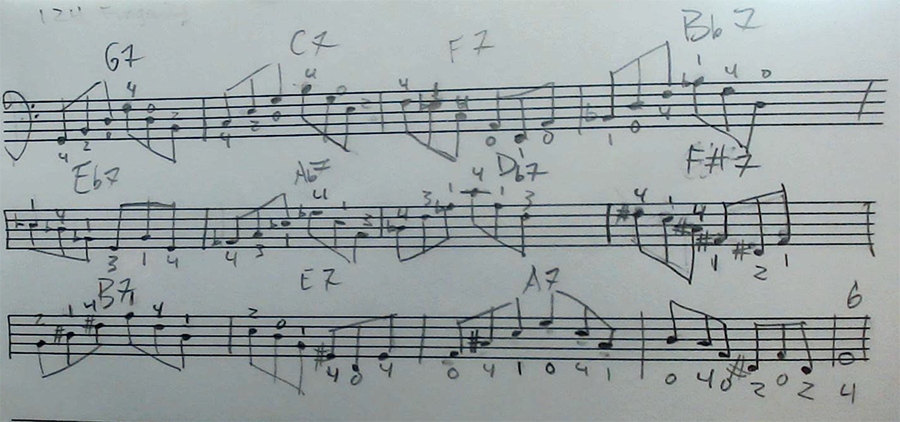
One of the things I love about forcing my self to paly in half position is how you get to think differently about the shapes you habitually use in closed positions. Here is an exercise I like to use involving half-position open strings. Dominant 7th chords around the circle of 5ths,played as low on the neck as possible. It's a 124 fingering, the numbers represent fingers (not frets)
On the 6 string basses, I was not really practicing open string playing (except when slapping). As others have noted, the same note gets different tone when played on different strings in different positions. Most of what I’ve been doing called for the bass to sound as ‘upright’ as possible, and on the Portamento 6 that happens from 5th position thru 12th position.
But on the TB10 with orchestral strings, it’s sounding very upright across the board. I need to utilize the open strings a lot, so I’m working on integrating them into my scales and arpeggios.
But on the TB10 with orchestral strings, it’s sounding very upright across the board. I need to utilize the open strings a lot, so I’m working on integrating them into my scales and arpeggios.
using open strings is an exercise in itself, and something that can be really useful, like in rock a billy or in the Jamerson bass parts. For instance, instead of just playing a scale, (let's pick the key of C for now) play an open string in between each scale note. Then swing it dotted 8th 16th, until you get the groove down.
I have this bass riff I use - in A - where I stay on the A string and go up the scale, playing an open A between each note.A If you modify this to (open) A, C#, A, E, A, F#, A, G, A , then reverse it, (1, 3, 5, 5, b7,) you'll have a useful exercise that will fit into a lot of swing, and blues shuffle type tunes.
I have this bass riff I use - in A - where I stay on the A string and go up the scale, playing an open A between each note.A If you modify this to (open) A, C#, A, E, A, F#, A, G, A , then reverse it, (1, 3, 5, 5, b7,) you'll have a useful exercise that will fit into a lot of swing, and blues shuffle type tunes.

A practice tip: Play all the notes in a scale that includes a note from an open string on that string, and hammer on and pull of each note as you go up and down the string. So in F, on the A string: A-Bb; A-C, A-d, A-e, A-f, etc
You can do this with the same finger or in a scale position, using different fingers. This not only builds strength, but also knowledge of the fretboard.
You can do this with the same finger or in a scale position, using different fingers. This not only builds strength, but also knowledge of the fretboard.
Closed positions (no open strings) seem easier because the same shapes work for any key.
But which position you play in should be a conscious choice based on the sound and feel you want.
If you can't play open positions, you do not have that choice.
So practice open positions enough that you get to choose.
Personally I love paying the open strings, every key has its own unique feel under my hands. Plus the challenge of getting the open notes to dynamically match the fretted ones refines my technique.
"knowing something is better than not knowing something" - Anthony Wellington
If you need an example of a top level player using open positions, look to James Jamerson.
Well put. I rely heavily on the Nashville number system so using closed positions enables me to utilize the same patterns in any key. However, when faced with playing in E, F or B flat I utilize open strings in order to avoid too much hand movement.
A bass buddy of mine sent me this YouTube link of a guy playing one of the more creative James Jamerson bass parts and demonstrating how JJ, having cut his teeth on acoustic bass before taking on the electric bass, made liberal use of open strings like he (and most, if not all) upright players do.
https://www.youtube.com/watch?v=9-AmaxLHOrQ
Last edited:

Now that I have basses that sound good with open strings, I'm using them a lot more than I ever did. Used to be the open notes would sound like a whole different instrument. Then I put Geezers on my Fenders and I never had that problem again.
But I think running scales is easier when you do it using only fretted notes. OTOH, anyone hears me running scales on a gig has my permission to whack me in the shin with a Nerf bat, so don't neglect the open string scales. And then you can use whatever's appropriate for the song and incorporate the open strings more if you want. Don't practice it, you don't have that option.
But I think running scales is easier when you do it using only fretted notes. OTOH, anyone hears me running scales on a gig has my permission to whack me in the shin with a Nerf bat, so don't neglect the open string scales. And then you can use whatever's appropriate for the song and incorporate the open strings more if you want. Don't practice it, you don't have that option.
When I started playing Upright bass, I was taught to avoid open strings as they sound different than fingered notes. It's always stayed with me.
That said, you should be able to deal with major and minor scales in all positions. F and B-flat are especially useful when playing with horns
That said, you should be able to deal with major and minor scales in all positions. F and B-flat are especially useful when playing with horns

One of the things I love about forcing my self to paly in half position is how you get to think differently about the shapes you habitually use in closed positions. Here is an exercise I like to use involving half-position open strings. Dominant 7th chords around the circle of 5ths,played as low on the neck as possible. It's a 124 fingering, the numbers represent fingers (not frets)
View attachment 4205079
Cool thing.

Just a couple of observations - are you sure about the left hand fingering on the A7 in measure 11 - looks like it should be 0-4-1-0-1-4?
The last G in measure 5 I would probably also play with 3, not 4, but that is more a matter of preference (I try to avoid using the same finger for consecutive notes of different pitches on the same string wherever possible), since in either case we have to deviate from the 1-2-4 regime.

Open strings on an electric bass are a textural/sonic choice. On a double bass they are a necessity, like oxygen.


