• TalkBass has been independent since 1998. Add your voice.
    Create a free account to reply to discussions, view embedded media, and browse with fewer display ads.
    Join freeLog in
    Want zero display ads or expanded classifieds tools? Compare plans.

Double Bass Schubert "Great" Symphony

I am now working on Schubert's C Major symphony (Great). Our conductor has asked both cello and bass sections to play this slurred "dotted quarter eight" pattern as detaché everywhere it occurs, which is throughout the entire piece.
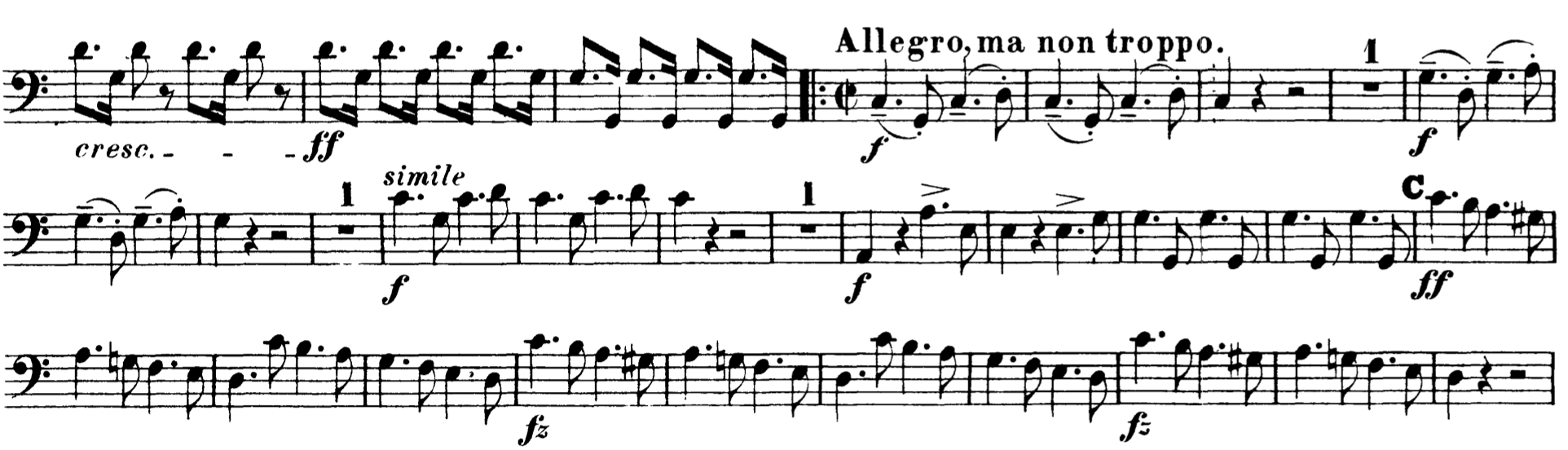
upload_2022-4-2_13-52-23.png


Personally, I am finding the detaché version challenging for this one hour piece at fast tempos. More importantly, the detaché sounds quite different from what I hear on recordings. I am curious if this is a common request? (My conductor says that we will sound "cleaner".) Perhaps this a personal preference by the conductor? Or a criticism of our cello/bass section? Any one have this experience?
 
Sometimes I reject the "ideal" bowings for my section, for exactly the same reason. It's not a criticism, more of an acceptance of reality. That rhythm is vital, and needs to be almost exaggerated to drive the piece. If you play the slurs, any non-professional section will tend after a while towards a triplet feel, which will murder the piece. If the rhythm is more secure detache, I would sacrifice the slurs! Just my opinion...
 
You should play that dotted quarter - eighth rhythmic figure “hooked” down-down, up-up down etc. It’s pretty pervasive in the first movement. If you played that stuff separated (down up down up etc. it would pretty much be a nightmare. The really difficult hooked bowing passages are in the 4th movement because they’re much much faster. Have fun, they don’t call it the “Great C-major Symphony” for nothing.
 
  • Like
Reactions: SAlcott
I've been thinking about this and even went to my old Peters Edition excerpt book.
How are you bowing the 2nd movement? Wouldn't the 16th/32nd phrases have to be bowed
the same as in the 1rst movement? Just asking.
 

Attachments

Hooking rhythmic figures like this (dotted eighth - 16th) and similar is very common in the performance of music from this era. It allows the player to stay in the same part of the bow without having to recover bow on every shorter value. If you played passages like this as it comes the tendency would be to work yourself out to the tip very quickly. Either that or you’d tend to accent the shorter values in order to recover the bow, also not ideal.

You could also use what’s called a “shoeshine” bowing as an alternative in which you start with an up bow on the long note and play down on the shorter note, continuing to alternate.
 
If you must use separate, not hooked strokes then the only way you have a hope of reaching crisp rythm and articulation is to reverse the bowing from down-up to up-down. The second movement is slow enough to articulate hooked strokes clearly and should sound smoother and more musical to contrast the aggressive energy of 1st and last movements.

I would prefer hooked strokes in the 1st and up-down separated in the faster last movement. Before you try and hang everything together I suggest working up the bowing patterns to speed using one note and trying to stabilise short clearly articulated strokes in the "comfort zone" of the hair, near the bow balance point. By short I mean maximum 2 - 3" movements with the bow firmly on the string, not lifting. The length, weight and relaxed arm weight and wrist/bow hold are the minimums to produce crisp articulated notes, hopefully more musical sounding than grunting without pitch. On-string bowing is also needed to produce the loud dynamics.
 
Last edited:
Thank you to asking. I should have sent thanks to all of the great comments I received on BT.
We did have concert...sort of. We don't really have a place to play yet because of pandemic restrictions. The conductor would not relent on the tempo, so I and my fellow bassist started simplifying things ourselves. We just couldn't get to the 215bpm tempo the conductor wanted. Mostly we dropped some of the triplet arpeggios. Also, regarding my original bowing question, we used the hooked bowing from the Urtext version, not the detaché the conductor wanted. We both already had learned this bowing from Beethoven's 7th Mvt I and we could play that bowing more accurately.
I was a bit surprised that we actually played Mvt III (Scherzo) pretty well. All those scale runs, in every key, we actually learned reasonably well. (The Trio is another story.)
All that said, I am very glad there wasn't much of an audience. The trumpets came in a measure early in Mvt IV, which nearly destroyed the ensemble. (I think they were tired for sitting for 50 minutes.)
Interestingly, I found out later that the conductor is a cellist who specializes in Baroque period playing. I think the bowing instructions came from that history.
I guess there is one benefit of being an amateur in a community orchestra. No one docked my pay for not doing the requested bowings. (I realize I may not be welcome for the next rehearsal, though.)
Thank you all of your helpful insight on playing thie piece. It was an adventure.
 
An adventure, yes, but what a great opportunity. I played it first in high school with the Boston Youth Symphony and have nightmares still about having come in a bar early at some point in the finale! Ouch! Just think how much better it will be the next time you play it (which was 40 years later for me). Anyway.... here's another recording: