• TalkBass has been independent since 1998. Add your voice.
    Create a free account to reply to discussions, view embedded media, and browse with fewer display ads.
    Join freeLog in
    Want zero display ads or expanded classifieds tools? Compare plans.

Semi-hollow Bassists

May 16, 2009
60
53
So, I did sound a couple of nights ago (Alex Cuba Band, check them out, seriously) and the bassist was playing a Gibson Midtown bass. I'd never seen one in real life, and we chatted a bit, which led to a discussion of well-known bassists who used semi-acoustic instruments.

So, who used semi acoustics? The only Gibson users I could come up with were Glen Cornick (from Jethro Tull a long time ago) and Andy Fraser (I think). Maybe Chas Chandler? Other brand players include Jack Casady, of course (signature model Epiphone, and Guild Starfires early on), Phil Lesh on a Starfire during the early days of the Dead, and Paul McCartney if we count the Hofner as a semi (it does count, doesn't it?).

Who are we missing here?
 
  • Like
Reactions: wmmj
So, I did sound a couple of nights ago (Alex Cuba Band, check them out, seriously) and the bassist was playing a Gibson Midtown bass. I'd never seen one in real life, and we chatted a bit, which led to a discussion of well-known bassists who used semi-acoustic instruments.

So, who used semi acoustics? The only Gibson users I could come up with were Glen Cornick (from Jethro Tull a long time ago) and Andy Fraser (I think). Maybe Chas Chandler? Other brand players include Jack Casady, of course (signature model Epiphone, and Guild Starfires early on), Phil Lesh on a Starfire during the early days of the Dead, and Paul McCartney if we count the Hofner as a semi (it does count, doesn't it?).

Who are we missing here?
Semi hollow body basses were very common during the 60's, half the mid sixties British invasion bands used one kind or other. Epiphone Rivolis and Gibson EB-2's were very common.
Andy Frasier used a Gibson EB-3 (a solid body), Chas Chandler used both Epi Rivolis and Gibson EB-2's, Cornic used a Gibson EB-2 I think along with many other Gibsons. But many other players used them. Believe it or not Hofners weren't all that common back then.
Epiphone Rivoli - Wikipedia

Gibson EB-2 - Wikipedia
 
  • Like
Reactions: Gizmot
"Who are we missing here?"

Steve Boone used a Starfire early on with the Loving Spoonful as did Chris Hillman with the Byrds.

Paul Samwell-Smith used an Epiphone Rivoli with the Yardbirds as did Jimmy Page when he filled Samwell-Smith's slot in that band.

Barry Oakley played a Starfire and later stuck a Bi-Sonic pup onto his "Tractor" Fender Jazz Bass that he used with the Allman Bros. Band.

Howling Wolf's bassist, Andrew "Blueblood" McMahon, played a Kay H-162.

Stones bassist Bill Wyman played a Framus 5/150 Star Bass back in the day.

Phil "Fang" Volk of Paul Revere and the Raiders played a Hofner Club.

Have also seen footage of Jessie Colin Young playing a Starfire Bass with the Youngbloods on the Dick Clark Show. They appear to be lip-synching, but I assume it was actually his bass.

Les Chadwick of Gerry and the Pacemakers played a Rivoli and a Framus Star Bass.
 
Last edited:
  • Like
Reactions: Gizmot and Axstar
GERRY%20%20THE%20PACEMAKERS_zpsmto0zw31.jpg
 
An interesting thread. For me it is difficult to differentiate between motives here. Do semi-hollow basses have an inherent tone and, if so, did the players choose them because of a perceived tone? For example I've seen it mentioned that Steve Swallow used an EB-2D (albeit modified) because he transitioned from upright bass and he wanted to feel the body resonating against his own as he had done so with the uprights. For me a semi-hollow bass could pretty much be sawn down either side of the central block, and you would be left with a Steinberger. Rivoli basses sound the way they do because there is a high output and low-mids heavy pickup sitting right down at the end of the neck. If Epiphone had had a crystal ball in the early '60s and fitted a PJ pickup pair to the Rivoli then perhaps they wouldn't be so heavily typecast? I do think that of the era when bass cabinets were either shallow and un-ported or (the horror!) open-backed, and your bass amp was 50 watts of guitar amp with a few capacitors swapped out in the tonestack, then those early shortscale semi-hollow basses gave a sort of woofy low-mids tone that gave them an edge over Fenders of the day. When a lot of the bands back then consisted of malnourished British teenagers riding around in the back of a Bedford van, a shorter lighter bass might have seemed the more sensible choice?

One final thought! It seems that in the '60s all that music was viewed as "pop", and there was the notion that it would be dead and buried in years/months/weeks. A lot of those bands in the early '60s dressed smartly, almost in a bid to legitimise their craft. Paradoxically the Beatles were working class rough,but squeezed into tight suits to deliver their work. Perhaps semi-hollow basses, with their more conservative sunburst finishes and ornate F-holes, were seen as slightly classier than Fenders with their solid car-paint colour finishes and chunky cross-head screws everywhere? Some bands wanted to appear more staid, cleancut and respectable than they really were, and having an instrument that looked like a cello probably helped? Pure conjecture on my part.

EDIT: and to answer OP's question, I'm sure Allen Woody had a couple of semi-hollows in his collection:

allenWoodyGuitars%20-%20Equpiment%20page.jpg
 
Last edited:
  • Like
Reactions: kkaarrll
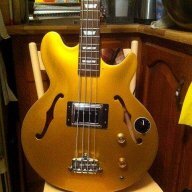
Mine is sunburst over flame maple top, I think its the most attractive of the finishes they offer. The thing plays incredibly good, I was even surprised by that, and it can get a lot of different tones from grindy modern to a more subdued thump. I am going to try some flats on it eventually but for now the rounds seem pretty versatile. I am on the hunt for a hardshell case that fits this thing if anyone has any suggestions.
 
  • Like
Reactions: Axstar
An interesting thread. For me it is difficult to differentiate between motives here. Do semi-hollow basses have an inherent tone and, if so, did the players choose them because of a perceived tone? For example I've seen it mentioned that Steve Swallow used an EB-2D (albeit modified) because he transitioned from upright bass and he wanted to feel the body resonating against his own as he had done so with the uprights. For me a semi-hollow bass could pretty much be sawn down either side of the central block, and you would be left with a Steinberger. Rivoli basses sound the way they do because there is a high output and low-mids heavy pickup sitting right down at the end of the neck. If Epiphone had had a crystal ball in the early '60s and fitted a PJ pickup pair to the Rivoli then perhaps they wouldn't be so heavily typecast? I do think that of the era when bass cabinets were either shallow and un-ported or (the horror!) open-backed, and your bass amp was 50 watts of guitar amp with a few capacitors swapped out in the tonestack, then those early shortscale semi-hollow basses gave a sort of woofy low-mids tone that gave them an edge over Fenders of the day. When a lot of the bands back then consisted of malnourished British teenagers riding around in the back of a Bedford van, a shorter lighter bass might have seemed the more sensible choice?

One final thought! It seems that in the '60s all that music was viewed as "pop", and there was the notion that it would be dead and buried in years/months/weeks. A lot of those bands in the early '60s dressed smartly, almost in a bid to legitimise their craft. Paradoxically the Beatles were working class rough,but squeezed into tight suits to deliver their work. Perhaps semi-hollow basses, with their more conservative sunburst finishes and ornate F-holes, were seen as slightly classier than Fenders with their solid car-paint colour finishes and chunky cross-head screws everywhere? Some bands wanted to appear more staid, cleancut and respectable than they really were, and having an instrument that looked like a cello probably helped? Pure conjecture on my part.

Those bands of the early 60's were coming out of one of the more conservative (culturally and politically) eras that the Western world ever experienced. Looking clean and respectable mattered, a lot. Think of the Ed Sullivan show and how the Stones had to change the lyrics to "Let's Spend The Night Together". Appearance mattered, often much more than the actual substance of anything. I've often wondered how many bands that actually had something meaningful to say but weren't so PC for the time, got swallowed up in the shadow of the Beatles, who wore the suits and played the "silly love songs" game and became bigger than Jesus because of it. Who knows...
 
  • Like
Reactions: Axstar
"Some bands wanted to appear more staid, cleancut and respectable than they really were..."

AKA: "non-threatening" to parents, particularly of teenaged girls. I think parents had a much stronger hand in vetting the music their children listened to than they do nowadays. Very few kids had headphones and there was no internet, so parents had an easier time keeping tabs on their kids' musical diet.
 
Also, it is important to remember that the 50's and 60's was when the music industry really became the music industry. If you didn't conform to a stereotype that sold big and fast and churned out new singles every few weeks like the Beatles did for their first several years, then you weren't going to get anywhere. Jazz was the big exception, as it always has been...

Anyway, to answer the other question: hollow and semi-hollow basses do indeed have a different tonal quality than solid bodied basses, at least to my ears. To me, they have a warmer, more "airy" or resonant tone, more truly like an upright than most solid bodied basses achieve. Especially with flats or tapes.