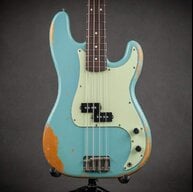
Exactly. Since Squier is owned by Fender, it's not a copy.So....a copy is not a copy if it says Squier on the headstock.

TalkBass has been independent since 1998. Add your voice.
Create a free account to reply to discussions, view embedded media, and browse with fewer display ads.
Join free Log in
Want zero display ads or expanded classifieds tools? Compare plans.
Exactly. Since Squier is owned by Fender, it's not a copy.So....a copy is not a copy if it says Squier on the headstock.


I sold my Jbass a long time ago, you don't need a P and a J. But a P and a T is just fineView attachment 7243216

It's never been a passive P Bass while in my possession. Although I have played stock ones with the Ibanez P4 pickup, and they are as P as any passive Fender.OK, so what didja think about it? Any big difference between it and the usual passive PBass?

Thank You!It's never been a passive P Bass while in my possession. Although I have played stock ones with the Ibanez P4 pickup, and they are as P as any passive Fender.
When I got it in the late 90s, it had the EMG P pickup with V & T controls. Not a typical passive P sound--it has more bandwidth and clarity vs a passive P. I installed the BTS system, still not a typical passive P sound--it could get bigger and brighter, or more mid forward if the controls are cut. Sounded great, very versatile, moreso than a Passive P.
After a few years, since I already had a passive Squier P, a passive Peavey P/J and an active Fender P/J, I had the P thing covered. I then converted this Ibanez into a virtual Peavey T-45, which is P adjacent, like a L1000. Passive, humbucker in the sweet spot, Vol,Tone, Mid Cut (via a Wilde Q filter) and push/pull coil split. It's similar to a Passive P now, but still more versatile and fills a niche in the ol' toolbox. I prefer this over a Passive P.


Yes.Okay... I looked through four pages of posts for the carrots. The carrots are leading in the poll... where are the the freakin' carrots?!


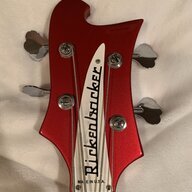
"People say believe half of what you see, son, and none of what you hear."It has been said that every "true" bassist needs both a Jazz bass and a Precision bass.
(Your opinion on this matters not. It is a simple fact of life. Thus sayeth Lord Jaco.)


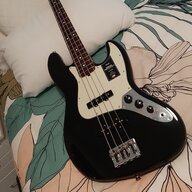
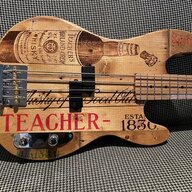


Carrots, of course.Has it been settled, yet?

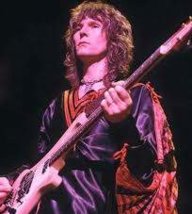
That's exactly what I was thinking as I was reading the posts in this thread. The "norm" prior to Leo's invention was upright basses with no frets. Leo comes along and slaps a bunch of frets on a bass fretboard and he calls it a "precision" bass because the frets provide an "autotune" function. So that would mean all fretted basses are precision basses. But then, Leo copyrighted the name "precision bass" which, at that point, means only Fenders can technically be a "precision bass" per se. From my own personal viewpoint, any FSO (Fender Shaped Object) can be a "p-bass" (not a "precision bass", but a "p-bass") as long as it resembles the form factor and pickup placement that a Fender precision bass has.Carrots:
- Léo called it a precision cause this was the first (or one of the first) bass with frets; which means easier precision when playing note that on a double bass which was the norm before.
- Did the first precision bass have a split coil ?
So all existing fretted bass are "Precision"