• TalkBass has been independent since 1998. Add your voice.
    Create a free account to reply to discussions, view embedded media, and browse with fewer display ads.
    Join freeLog in
    Want zero display ads or expanded classifieds tools? Compare plans.

Short scale bass 30 or 32

If you were to get a short scale bass, do you prefer the “30 scale or the “32 scale? What’s the difference? I’ve never had one and, they seem to be very popular and they look really cool. What’s the pros and cons?
Well, Okay...
My preference? Since I have 12 short scale basses (30">31"), but only one medium scsle (32") bass - out of a total of 28? It would appear that I prefer short scales. But, truth is, I have nothing against medium scale basses at all - other than the fact that very, very few companies make left handed ones. The one I have is a Canadian-made '93 Fury Anthem lined fretless bass. Custom made by a sort of mad genius, who made basses and guitars one at a time - by hand - in his basement. And, for left handed players? That's pretty much still the case for medium scale basses... But, I absolutely Love the one medium scale bass I have... So; with the caveat that my medium scale sample is... very small? Pros and cons:
Medium scale Pros:
-
Not as hard to reach the upper frets as a long scale bass;
- Generally a little smaller, overall, than a long scale bass - and, maybe a little lighter, too;
- I don't recall many people complaining about neck heaviness. Mine certainly isn't. It's very well balanced;
- Generally, the string spacing will not be as narrow as a lot of short scales; and
- Although you won't get all the overtones a long scale bass gets? You will get most of them.
Medium scale cons:
- STRINGS. When you fish in the medium scale string pond? It's a small pond - and there isn't a whole lot there. Some companies just don't make them. And, if they do? The selection is... limited. You'll have better luck if you like rounds - regular rounds; but a company that makes stainless medium scale rounds, for instance, may not make them in nickel. And, if you want things like half rounds, or pressure wounds? Good luck. Flats and tapes? I've managed to find ones that I like - but you may not...
Short scale Pros: Again, with the caveat that there are many exceptions to this list (and I own some examples):
-
Short scale basses are short - and it's easy to reach the upper neck. Usually...
- The necks are usually easy to play;
- Short scale basses are often the lightest basses. But, I have some that are not very light at all...
- Short scale strings are easier to find than medium scale strings. Most long scale string types, are also available as short scale strings - but, not all of them...
Short scale cons:
-
Some shorty necks are very thin and narrow, with the narrow string spacing that comes with that. Some people find those basses pretty hard to play;
- Some people find themselves cramped when they try to play a shorty for more than a few minutes;
- IME, a lot of short scale basses - particularly the hollow- and semi-hollow body ones - are... well, not neck heavy, exactly; more like "exhibits a slight forward weight bias, neck-wise". Especially semi-hollow and hollow body ones. But, there are some that are beautifully balanced; so, it just depends;
- Short scale basses are generally "all about the fundamental note". Not "muddy"; just, little/no overtones. I can get some slight harmonics from a couple of mine. But, it greatly depends on the strings - and how hard I work at it. And, finally:
-Some people will think you look pretty goofy, if you play one. And, you might feel that way, too. Never bothered me - but a lot of people think I look kind of goofy, anyway, so...:yawn: If that matters to you? Something to think about... So;
There you have it. I never started out to have so many short scales; just sorta worked out that way. But, if there had been more medium scale lefty's for me to buy? I might have more of them, 'cause I do like them. I only bought the one I have, because it was a lefty lined fretless bass - not because of the scale...:whistle:
 
Last edited:
Ok that’s fine I will do that. However this thread was to get “Opinions” from players who have short scale basses to give advice and insight for people who want to try them on which one is a better feel between the 30 and 32 scale {emphasis added}. This thread is not asking people about what’s comfortable to play or what my opinion is on what’s more comfortable. It is merely to get information about a territory that I don’t understand or I have never tried.
 
30" will give you more choices for strings, but be careful, if the bass is string-through (e.g. Mustang) you could need 32" strings (or Mustang-specific strings) to set it all up correctly.
I disagree with this because 32” scale can utilize long scale strings so you actually have a lot more choices, not fewer.
 
Last edited:
Note that with some short scale basses the headstock end of the neck is just as far from the body as with 34" scale, because the shorter scale was achieved by positioning the bridge significantly further from the edge of the body than on most 34" scale instruments. So although the fret spacing is narrower, a 30" scale bass can feel as big as a 34" scale bass.

Which is neither right nor wrong, it's just a matter of preference, but if considering switching to shorter scale for ergonomic reasons you need to try the individual instrument for yourself before committing to the purchase.
???????
I’m not sure I agree with this either. I build basses and every 32” or 30” scale neck is shorter than full scale, and when asssembled the headstock on a 32” or 30” scale bass isn’t as much of a reach as full scale.
 
Last edited:
If you were to get a short scale bass, do you prefer the “30 scale or the “32 scale? What’s the difference? I’ve never had one and, they seem to be very popular and they look really cool. What’s the pros and cons?
32" for me. 30" is a considered short scale. For me, the frets are too close together, there's usually narrower string spacing, and the basses themselves are smaller. Short scale basses feel like toys to me.

32" is considered medium scale, but it's the shortest I would go. I'm used to playing 33.25" (Rickenbacker) and 34" (FSO / standard long scale) scale, so 32" isn't that far off.
 
  • Like
Reactions: B-Mac
Note that with some short scale basses the headstock end of the neck is just as far from the body as with 34" scale, because the shorter scale was achieved by positioning the bridge significantly further from the edge of the body than on most 34" scale instruments. So although the fret spacing is narrower, a 30" scale bass can feel as big as a 34" scale bass.

Which is neither right nor wrong, it's just a matter of preference, but if considering switching to shorter scale for ergonomic reasons you need to try the individual instrument for yourself before committing to the purchase.
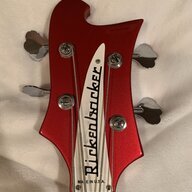
I immediately thought of the Squier Rascal Bass. The bass was about as big as a normal FSO in size, but the frets were too close together. Plus, the bridge is in the middle of the body like on a guitar. If the bridge were in the normal position on the Rascal, it would be a 34" scale.
 
  • Like
Reactions: nnnnnn
Ok that’s fine I will do that. However this thread was to get “Opinions” from players who have short scale basses to give advice and insight for people who want to try them on which one is a better feel between the 30 and 32 scale {emphasis added}. This thread is not asking people about what’s comfortable to play or what my opinion is on what’s more comfortable. It is merely to get information about a territory that I don’t understand or I have never tried.
Sheesh, take a chill pill.

I provided the link for information on 32”. I’m guessing you didn’t look at it?

I own 35” to 23.75” and love the variety.

There’s also the Short Scale Club and the Medium Scale Club here on TB that have lots of info.
 
Last edited:
  • Like
Reactions: PleyswethSqwerl
Sheesh, take a chill pill.

I provided the link for information on 32”. I’m guessing you didn’t look at it?

I own 35” to 23.75” and love the variety.
Sorry wasn’t saying that mean. I hate writing messages. Things can be interpreted by the reader within the tone that except the message I wasn’t offended by your message in any way. Thanks for the link
 
Sorry wasn’t saying that mean. I hate writing messages. Things can be interpreted by the reader within the tone that except the message I wasn’t offended by your message in any way. Thanks for the link

Hey, I didn't have my coffee yet, so all good!:thumbsup:

Here's the thing... Short scale, Medium scale, etc. are often (not always) chosen for the players comfort. I'm not talking about a fast neck or a nut width or opinion or preference, I'm talking about a player's physical hand comfort and arm comfort for the fretting hand.

The necks are shorter so there's less reach, with exceptions due to build. The frets are closer together so there's less finger stretching. However, the frets can feel crowded as you go toward the body.

People of smaller stature will find Medium and Short and Sub-Short (less than 29.75") more comfortable generally. Children starting out will also find them easier as well as old codgers (like me) who have developed some arthritis in their hands.

The sound is often described as 'tubbier' and/or 'thumpier'. Many Hollow and Semi-Hollow basses come in Medium and Short scale.

String tension can be an issue for some players with Medium or Short scale so they have to experiment with string gauges to get a string tension they like.

Sub-Short scale have become more popular.

Then there's the U-Bass that is Ukulele sized with rubber strings.

There's also the 30" short scale known as a Bass VI. They're more like a guitar with 6 strings tuned EADGBE and have string spacing more like a guitar than a bass. A 'normal' 6 string bass is usually 34" and tuned BEADGC or EADGCF.

Scale is measured from the nut to the 12th fret and then multiplied by 2.
 
Last edited:
  • Like
Reactions: PleyswethSqwerl
@theswitchoreo as you can see, there’s lots of opinions. I tried to stay objective. Regardless I’d like to reiterate the importance of knowing your bass’ measurements.- especially at shorter scale lengths we’re discussing. Knowing the distance between ball end and nut, and ball end and tuner, will help you select strings. Get a string that the felt starts between nut and tuner and you won’t have issues.

Part of the reason for so many opinions is the amount of string preferences and scale lengths.

Roundwounds are easier. Other string types don’t like bending around tuner, but some people do it successfully. Ill fitting strings can do weird things.

I bought an AFB200 where the previous owner put standard scale strings on it. It sounded fine, but there was odd things from time to time. I got strings designed for that bass - now she sings. Turned out that since he wrapped quite a bit of string around tuner, the A and D strings would rub on E or G on their way to their tuners from nut. This was the cause of the weirdness. This experience convinced me more than ever that proper fitting strings are very important.
 
Not a fan, no real need for me even though someone once suggested I buy one, but if I had to buy one, I'd buy this, simply because it looks cool and there isn't a regular-scale version.
Italia Cavo short-scale.
View attachment 6984761
So Purdy!!!!!:thumbsup:
 
Sorry wasn’t saying that mean. I hate writing messages. Things can be interpreted by the reader within the tone that except the message I wasn’t offended by your message in any way. Thanks for the link
There’s a good illustration in that link that superimposes a 34”, 32” and 30” over each other to show differences not just in the neck, but also in the body.
 
  • Like
Reactions: PleyswethSqwerl
???????
I’m not sure I agree with this either. I build basses and every 32” or 30” scale neck is shorter than full scale, and when asssembled the headstock on a 32” or 30” scale bass isn’t as much of a reach as full scale.
The Fender Rascal is a prime example of what @nnnnnn is talking about due to where the bridge is set even though the scale is 30".

Short Scale bass but 34" reach to the first fret. Look at one and the light bulb will go on directly over your head.:thumbsup:


There are other examples as well, but this is probably this most well known one.
 
Last edited:
I disagree with this because 32” scale can utilize long scale strings so you actually have a lot more choices, not fewer.
@Queue is mostly referring to short scale (30") Semi-hollow and Hollow basses that have trapeze tail pieces below the bridge where you'll definitely need 32" scale strings for a 30" scale bass.

As the owner of several SS Semi-Hollow/Hollow body basses I can attest to what he is describing. @mrperkolator can also attest to this as well.

No doubt about it.:thumbsup:
 
Last edited:
I also don't notice muddiness from my Fender Junior Jazz (30")
These are hard to come by, even in Japan -
last time I was there, back in January, I tried to check one out.

A guy working at one of the famous shops told me they haven't been made in a while, are popular, and there's a premium on them, He found me a used one locally on the internet, but I didn't have time for taking it any further.

I'll be back in a few weeks and will be looking for them again.

Edit: On thinking on this, I realize these are different things -

I was looking for MIJ Medium scale basses, not MIJ Short scale basses.

I'm not against considering them in 30', and have been wanting a (US, Mexico) Mustang, and if money were no object, a Guild Starfire II,

but thought to consider a quiver of MIJ 32's if they were easy enough to come by, especially with the current USD-JPY exchange rate.
 
Last edited: