• TalkBass has been independent since 1998. Add your voice.
    Create a free account to reply to discussions, view embedded media, and browse with fewer display ads.
    Join freeLog in
    Want zero display ads or expanded classifieds tools? Compare plans.

Short-scale basses are no substitute for long-scale basses?

Can a short-scale bass substitute for a long-scale bass?

  • Yes

    Votes: 322 83.6%
  • No

    Votes: 63 16.4%

  • Total voters
    385
  • Poll closed .
Short scale basses have an inherently different tonal balance to standard scale basses. You can substitute the one for the other, but they will sound different. Whether or not that matters to you is a personal choice.

My short scale bass is a Warwick Custom Shop Corvette Proline, a far cry from a Squier anything. My standard scale bass is an Ernie Ball Music Man StingRay. I would never think these two instruments do the same job.

In all fairness, I also see that the short-scale is fretless. Those two are very different basses apart from being long vs short-scale. My mustang has the same pickups my precision had, and it could definitely be used for anything the precision was used for.
 
  • Like
Reactions: WI Short Scaler
Most people say the opposite: short scales produce less fundamental and more overtones—which is precisely why most people prefer long scale basses, and why some people insist on extra long scale 35-37" scales.

If you poke around here long enough, I think you'll find that majority is definitely in the
"short scales have more fundamentals/less harmonics" camp. Historical reasoning (play an EB0 and a Fender) and Acoustical Physics (I studied that in college) also agree with that camp.
 
Heck, I seldom even hear of another bass player who even knows about them, let along uses and likes them. so I'm excited to hear from you!
I use GHS PWs on one of my 5s and am considering a set for the baby Samick SS. If you think you have trouble buying them, try in an Australian city, let alone the rural area I'm moving to.
 
I find it's all in the amp and EQ. I play a1968 Mustang, a Squire Jaguar, a Taylor GS mini e bass, a Kay upright. The Taylor is a tone monster, and by far my favorite to play on stage. I run it thru an Acoustic Image Contra amp, with Fishman Platinum Pro DI.

Yeah, you can't treat a short scale version of a bass exactly like a long scale of the same bass, a lot of factors change just by changing the scale. The pickups, even if the same and placed in roughly the same relative position, won't be sensing the same movement. The same strings will move differently (lower tension).

You should be able to adjust things to get the same kind of sounds but that may entail EQ changes or even a different approach to playing the instrument. Why? Because it is in fact a different instrument.
 
Because I have a somewhat painful degenerative osteoarthritis at the base of my left thumb I've been playing bass mostly with short-scale basses. However, when comparing the "sound" of my rather ordinary Squier PJ long-scale bass against any of the other half dozen or so short-scale basses of various makes and models I've aquired and played it seems that it's becoming clear to me that any short-scale bass CANNOT substitute for the "sound" of a long-scale bass. What are your thoughts / insights / comments?

Tom Petty, Paul McCartney, Chris Hillman and thousands of others did rather well using Short Scale Basses. :) As you're currently using a Squier I'll respectfully suggest a Danelectro Longhorn based only and respectfully on $$$. :). I own several very high end basses.....but my Longhorn takes a back seat to none of them. It's Bassilicious.
 
  • Like
Reactions: wiscoaster
Having a short scale bass is only one part of a much larger issue when it comes to your tone. Not to mention how YOU play it. But until you try changing strings (different styles & manufacturer), changing electronics (much more expensive) , changing amps (even more expensive but testing if free), eq'ing (tone shaping) you will never really know if it's a long scale vs short scale thing.
Experiment with different setups, and record how they sound. "Record and listen". I'm always amazed when I hear how I sounded recorded. Live sometimes I think I'm too bright and keep the mid and treble down. Then when I listen to it recorded I sound dull and boomy. I've had to train myself to except the fact that my tone that comes through to the audience is different that how I'm hearing it right next to the amp.
Cheers,
Edward
 
Fender Player series Mustang, Sterling Sting Ray, G&L Tribute Fallout, Squier Jaguar, Epiphone EB-0, Sire U5, Guild Starfire. All stringed with flatwounds.

I have a Squier fretless with TI flats and Seymour Duncan Apollo pups in that plays like buttah and sounds great.

All great instrments in their own right but just don't deliver what my Squier (also w/ flatwounds) delivers through the same amp (Orange Crush 50).
 
  • Like
Reactions: Rich_Briere
I have had very good results with short scale bases. I had a Fender Musicmaster that I installed a Jazz Bass pickup and new bridge. Very good sound and playability.
People send way too much time chasing "tone". Most of the sound comes from the fingers.
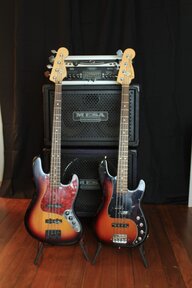
Having said that, a simple solution. I have a Fender P Bass, Fender J Bass and a Mesa M9 Carbine and I never have to think about gear again. (Also some cheap stuff for dive gigs.)
 
Because I have a somewhat painful degenerative osteoarthritis at the base of my left thumb I've been playing bass mostly with short-scale basses. However, when comparing the "sound" of my rather ordinary Squier PJ long-scale bass against any of the other half dozen or so short-scale basses of various makes and models I've aquired and played it seems that it's becoming clear to me that any short-scale bass CANNOT substitute for the "sound" of a long-scale bass. What are your thoughts / insights / comments?

I got a Sterling Sting Ray short scale , 6 months ago, due to arthritis in my left shoulder and and wrist and it sounds as good as any other bass through my Ampeg BA210. I have to always adjust the amp depending on what bass I put through it. I have a Fender Jazz Special, Schecter Stage 4, Sterling Ray34, Schecter Michael Anthony Sig model, Ibanez 5 string something or other. My shorty can keep up with all of those. Along with a couple more laying around here somewhere. No worries for me with any of them. I have ran them clean into the amp and also through my Line 6 Helix or my pedal board going into the amp. Your mileage may vary.
 
  • Like
Reactions: wiscoaster
I've had to train myself to except the fact that my tone that comes through to the audience is different that how I'm hearing it right next to the amp.
A fact that many here still don't seem to get. Or simply refuse to accept.

People send way too much time chasing "tone". Most of the sound comes from the fingers.
Tone is only consistent at the point it's entering your ears, whether it's standing in front of an amp, from your IEM's, or on a recording. It's almost always going to be different to the audience or at the recording console from what you're hearing. The reason I finally went the amp-less/IEM route. I send the FOH a flat tone and let the sound guy tweak it there, send the same tone to my IEM's and use my own tone control at that point (small mixer) to make it sound the way I want it to sound in my ears. MY sound I hear is always consistent and I trust my sound guy to make it sound good out front. Which from the recordings I get sounds good to me there too.

Yeah got off on a tangent, I know...
 
Fender Player series Mustang, Sterling Sting Ray, G&L Tribute Fallout, Squier Jaguar, Epiphone EB-0, Sire U5, Guild Starfire. All stringed with flatwounds.

All great instrments in their own right but just don't deliver what my Squier (also w/ flatwounds) delivers through the same amp (Orange Crush 50).
Maybe change the pickups. That's probably the main difference in their sound.
 
I have a Gretsch G2220 Electromatic Junior Jet II short scale bass. 30.3" scale and I love it! I use stainless steel strings, .044 .064 .084 .108 for drop-D at A=432Hz and the intonation is perfect. Has a really nice growl on that low D.
I played several basses off Guitar Center's wall that day and I chose this one based on the tone, before I realized it was short scale. After buying it, I discovered it was impossible to find stainless steel strings in short scale bigger than .105, aside from paying Newtone strings to custom make them in the UK. Stringjoy makes a nickel-plated .110. Availability of strings is the only thing about this that made me feel I should have gotten a 34". But I like it being easier to play. I have long fingers but they're not very dextrous, and there's some things I can play on the short that I can't on a long.
It's not an active bass, but the Gretsch mini humbuckers sound really good. Just got a Gretsch baritone with them, too, and it sounds great.
 
I voted no to the poll, but I will caveat that a bit by saying that I really meant "Short-scale basses are no substitute for some long-scale basses"

IMO, there is no way you can make a 30" 5 string B sound like a 37" 5 string B. I own a 34" 5 string currently but am building a 34-37" multiscale to get that really rich harmonic content on the 5 string.

Here is a great video by Ian Allison that addresses this:


The interesting thing is he is a huge fan of short scale basses, but he isn't under the delusion that the 32" scale (which is arguably not even short scale) he is reviewing sounds the same as an extra long 37" scale.
 
  • Like
Reactions: Doug4321 and amper
The question seems to imply a long scale bass is "better" than a short scale. If that's what you think, well that's really only your opinion. ...
No, the original question was only about the "sound". There are really so many other variables that the question was never about whether one (in general) was "better" than the other (in general).