I love the suggestion and will definitely consider it for my "wanna" list....I'll respectfully suggest a Danelectro Longhorn based only and respectfully on $$$....


TalkBass has been independent since 1998. Add your voice.
Create a free account to reply to discussions, view embedded media, and browse with fewer display ads.
Join free Log in
Want zero display ads or expanded classifieds tools? Compare plans.
I love the suggestion and will definitely consider it for my "wanna" list....I'll respectfully suggest a Danelectro Longhorn based only and respectfully on $$$....
Yes, I agree. I recorded my sessions with my bass teacher and it was very enlightening listening to my own playing. Excellent suggestion for a bass student..... "Record and listen". I'm always amazed when I hear how I sounded recorded. ...
That's a distinct possibility, and no way I could test it.T... but do we even know if an identical Squier would hold up? He may have lucked out (it happens) and it has nothing to do with scale.
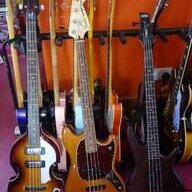


Because I have a somewhat painful degenerative osteoarthritis at the base of my left thumb I've been playing bass mostly with short-scale basses. However, when comparing the "sound" of my rather ordinary Squier PJ long-scale bass against any of the other half dozen or so short-scale basses of various makes and models I've aquired and played it seems that it's becoming clear to me that any short-scale bass CANNOT substitute for the "sound" of a long-scale bass. What are your thoughts / insights / comments?
I agree… I started with a short scale Danelectro, in 62, switched to a used 61 J Bass in 63, and switched to new 65 Gibson EB3, loved it then and still use it currentlyShot scales are what they are. A bass is a bass.
Did you ever display a 30” vs a 34” on an good “scope” to support your harmonics info?You'll (probably) never get a SS to sound exactly like a LS. Each note played on bass (or any instrument) includes a series of harmonics that are predictable ratios of that note. The volumes of these harmonics give an instrument its unique tone, or timbre. When the string length changes, the character of those harmonics change. This difference in tone is due to how the instrument’s scale length affects the harmonics & timbre of the notes. LS has higher string tension & tends to emphasize the mid to high frequencies & typically sound tighter & punchier. SS tends to have lower tension & emphasize the lower (fundamental) frequencies because it doesn't produce the higher frequency harmonics of a LS.
If you poke around here long enough, I think you'll find that majority is definitely in the
"short scales have more fundamentals/less harmonics" camp. Historical reasoning (play an EB0 and a Fender) and Acoustical Physics (I studied that in college) also agree with that camp.
In all fairness, I also see that the short-scale is fretless.
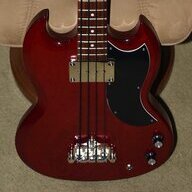
I agree… I started with a short scale Danelectro, in 62, switched to a used 61 J Bass in 63, and switched to new 65 Gibson EB3, loved it then and still use it currently
Bought a “vintage” 64 J Bass a few years for $2200, and a 5 string J for $800 around the same time
Did not like either so I just play the 65 EB3 exclusively and am considering selling the other 2 Js
I have nothing but praise for a 30” scale!! ….. but I had messed with EQ quite a bit, so as has been say before, you can shape so all works
Don’t know or care. That’s their choice and I’m sure they have many varied reasons for that.
Edit: to be fair it’s also the most widely available scale length.
If short scales had more fundamental relative to harmonics, no one would play long scale.