

Enjoy the benefits of a premium membership!
Upgrade Account
-
TalkBass has been independent since 1998. Add your voice.
Create a free account to reply to discussions, view embedded media, and browse with fewer display ads.
Join free Log in
Want zero display ads or expanded classifieds tools? Compare plans.
You are using an out of date browser. It may not display this or other websites correctly.
You should upgrade or use an alternative browser.
You should upgrade or use an alternative browser.
Short Scale Basses. The best thing since sliced bread?
- Thread starter DChalo
- Start date
-
- Tags
- scale short short scale
More options
Who Replied?
Wow.. Plenty of short scale advocates have weighed in here. I won't disparage any instrument as long as it is well crafted, and I certainly would not disrespect anyone based on scale length. Having said that...I started on a 32" medium scale Rick because I was intimidated by a 34" inch scale bass. I got the courage to buy a 34" G&L (4 string) about a year later and have never looked back. And that was in 1981. Best thing I ever did. Especially now that I play 5 string basses almost exclusively. For ME, now, the MINIMUM length of a low B sting is 35." I own a "long-scale" Dingwall with a 37" B string, which sounds and plays even better than a 35". Nothing else I've played even compares. When you are producing low notes on a 5 string, in my experience, longer bass strings win. Look inside a piano sometime. It's a matter of physics.
There aren't any Ricks with a 32-inch scale length that I know of. They are either 33.25-inch (4000 series) or 30-inch (the lesser known 3000 models).

I believe it was a 3000 model so apparently it was 30 inches. It was a long time ago. All I know is that it was shorter than 34" and I don't miss it in the least...There aren't any Ricks with a 32-inch scale length that I know of. They are either 33.25-inch (4000 series) or 30-inch (the lesser known 3000 models).

devnulljp
Supporting Member
Short scale basses are clearly only for kids and beginners ... like this guy

I tell you one thing. As we all are going ever so slowly towards senior age, in my retirement years I am sure going to play a short scale headless, with thin as h*ll strings and no action (very low and Plekked super low) , requiring no effort or force to press down any string, or pluck. The least common denominator. Going "student" again! The detoriation of cartilage, joints, and muscles will just require these setups and basses evetually. Maybe not even looking at the fanned fret thing no matter how ergonomic that is.
But there's still some decades left for tumbling and bulldozing out the low rumble of the tight strings...of a low B at 37"...
The detoriation of cartilage, joints, and muscles will just require these setups and basses evetually. Maybe not even looking at the fanned fret thing no matter how ergonomic that is. But there's still some decades left for tumbling and bulldozing out the low rumble of the tight strings...of a low B at 37"...
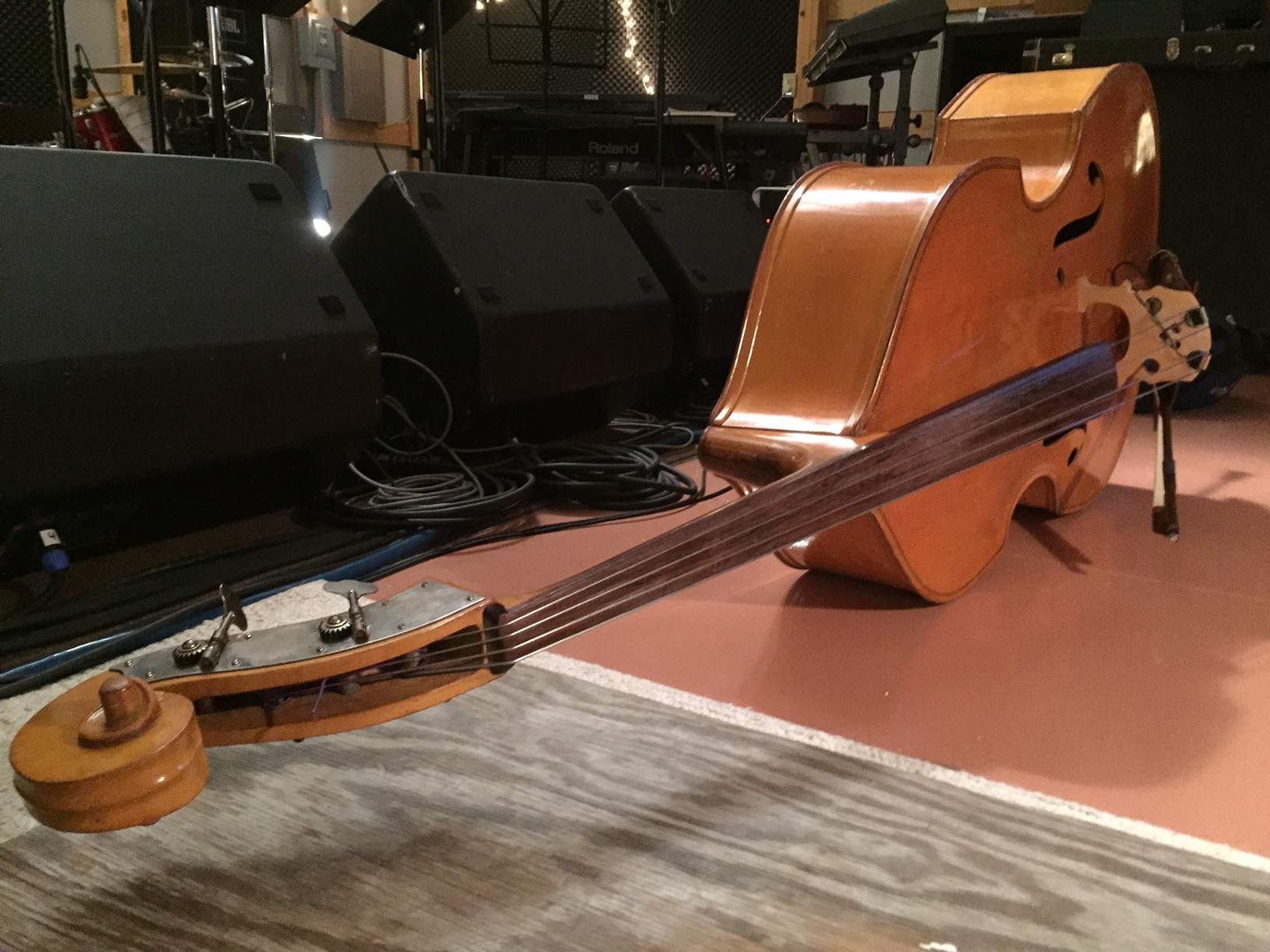
Learn to play a real bass.
Then you won't notice nor care about the scale length on an electric.
Then you won't notice nor care about the scale length on an electric.

Learn to play a real bass.
Then you won't notice nor care about the scale length on an electric.
View attachment 952650
Been there, done that. Huge PITA to gig with and maintain.
There are just to many advantages for me to using this instead...

Last edited:

Learn to play a real bass.
Then you won't notice nor care about the scale length on an electric.
View attachment 952650
If I wanted to play one of those, I would've started playing one of those.
If I wanted to play one of those, I would've started playing one of those.
I'd been playing electric for 20 years before I ever got "one of those". It's a 1941 Kay. I highly recommend it as a good way to expand your horizons.
...You'll have to pay some bucks for a proper pro set-up though, and the dude will probably have it for a couple months. Just part of how things work.
..
Potability is pretty much top of the list for playing BG rather than DB in my book.
I have an EUB, our guitarist keeps saying I must start gigging with it "it would suit a lot of our songs". He is right, it would suit a lot of our songs but it would also mean he would end up with more gear to schlep because my car is already full.
I carry the lights, all the leads (cords) and half the PA as well as my bass gear. To get my EUB in I need to split the back seat and lose a whole load of space. A full sized DB would probably not fit in at all.
This reminds me of a story a guy I worked with told me, he played in a dance band in the early 60's. They consisted of Guitar, piano (all venues had a piano back then), drums and DB. They all travelled to gigs in one very old car.
Loading it was quite an task. First the DB was tied on the roof, then the back seat passengers got in and small items were packed around their legs and various drums and amps were loaded onto their knees. Next the front seat passenger got in and more gear was loaded around his feet and on his knees. Lastly the driver got in and drove away.
One night they had played a gig and 2 policemen were watching the car packing procedure. Just before they drove off one walked up, they were expecting to be in trouble for overloading. He said he'd had a bet on with his buddy as to whether they would get it all in and he had won, thanked them and wished them a safe journey home.
+1Been there, done that. Huge PITA to gig with and maintain.
There are just to many advantages for me to using this instead...
View attachment 952657
Potability is pretty much top of the list for playing BG rather than DB in my book.
I have an EUB, our guitarist keeps saying I must start gigging with it "it would suit a lot of our songs". He is right, it would suit a lot of our songs but it would also mean he would end up with more gear to schlep because my car is already full.
I carry the lights, all the leads (cords) and half the PA as well as my bass gear. To get my EUB in I need to split the back seat and lose a whole load of space. A full sized DB would probably not fit in at all.
This reminds me of a story a guy I worked with told me, he played in a dance band in the early 60's. They consisted of Guitar, piano (all venues had a piano back then), drums and DB. They all travelled to gigs in one very old car.
Loading it was quite an task. First the DB was tied on the roof, then the back seat passengers got in and small items were packed around their legs and various drums and amps were loaded onto their knees. Next the front seat passenger got in and more gear was loaded around his feet and on his knees. Lastly the driver got in and drove away.
One night they had played a gig and 2 policemen were watching the car packing procedure. Just before they drove off one walked up, they were expecting to be in trouble for overloading. He said he'd had a bet on with his buddy as to whether they would get it all in and he had won, thanked them and wished them a safe journey home.
I'd been playing electric for 20 years before I ever got "one of those". It's a 1941 Kay. I highly recommend it as a good way to expand your horizons.
...You'll have to pay some bucks for a proper pro set-up though, and the dude will probably have it for a couple months. Just part of how things work.
I don't really have any desire to play one of those. It has nothing to do with scale length. I'd have to shell out huge money to buy one, huge money to set it up, invest hundreds of hours just learning the basics, all to learn an instrument that in the end doesn't do what I need it to do or sound like anything I want to have.
I've made more money playing an upright whilst wearing a tuxedo than anything else.
Ever.
Ever.
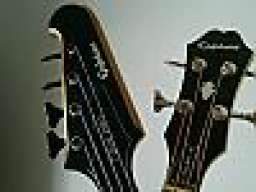
There are some myths about shortscales that have been for the most part overed in this thread. Strings for shortscales vary. The birdsong basses were engineered to be short & sound amazing, the 4 string birdsongs have 17 mm spacing and use longscale strings. this is fact. The fender mustangs string through the body, you use longscale strings, the gibson sg string post are too small for many sets of longscale. I can attest this is fact on these 3 shortscales. i own them.
I've got to say I hated anything but long scale basses for about 47 years because my first proper bass was a Hofner Senator (32" scale ???) with dead flats.
I wanted to sound like John Entwistle and Jack Bruce and it was just wasn't going to happen with that bass. I hated everything about it, the sound, feel, look, and especially the feedback, and couldn’t sell it fast enough. Next I got a P bass, again with dead flats but I put a set of Rotosound round wounds on and never looked back.
Fast forward to 18 months ago and I am in a 60's band (lots of Beatles covers) and think that a violin bass will suit the band image so pick up a used one cheap, put chromes on it and love it to bits. I still like my long scale basses but no longer hate short scales.
I wanted to sound like John Entwistle and Jack Bruce and it was just wasn't going to happen with that bass. I hated everything about it, the sound, feel, look, and especially the feedback, and couldn’t sell it fast enough. Next I got a P bass, again with dead flats but I put a set of Rotosound round wounds on and never looked back.
Fast forward to 18 months ago and I am in a 60's band (lots of Beatles covers) and think that a violin bass will suit the band image so pick up a used one cheap, put chromes on it and love it to bits. I still like my long scale basses but no longer hate short scales.

Can't believe it took so long for the "I've never played a short scale bass but here are the reasons you shouldn't either" dumba$$es to make their presence known.
And as usual spewing their usual brand of vitriol all over the place.
Just go back to sitting on your mom's couch playing your 1st generation Sony Playstation and wanking it to reruns of Super Friends cartoons and let the adults carry on an intelligent conversation.
And as usual spewing their usual brand of vitriol all over the place.
Just go back to sitting on your mom's couch playing your 1st generation Sony Playstation and wanking it to reruns of Super Friends cartoons and let the adults carry on an intelligent conversation.
I'm putting all this nastiness down to the Monday morning blues.....
PLEASE nobody post a clip of the Boomtown Rats....You know which one I mean
PLEASE nobody post a clip of the Boomtown Rats....You know which one I mean
- Jun 10, 2003
- 575
- 139
- 52
- Disclosures
- Senior Product Manager, Akai Professional
She died a couple of years ago and we sold it. Always wondered who bought it from the used, scratch and dent store.
[quote deleted by moderator - troll post..]
Actually all electric basses are compromises regardless of scale. As are pretty much every musical instrument ever invented. More than likely every musical instrument ever built in the history of humankind was a compromise of one thing or another. Just because one person thinks other people's choice in a musical instrument makes it invalid because it's not what he personally prefers does not make his argument a valid one.
Actually all electric basses are compromises regardless of scale. As are pretty much every musical instrument ever invented. More than likely every musical instrument ever built in the history of humankind was a compromise of one thing or another. Just because one person thinks other people's choice in a musical instrument makes it invalid because it's not what he personally prefers does not make his argument a valid one.
Last edited by a moderator:
I've been on many threads with @Humbled and have never seen any indication of troll behavior. He's obviously got an opinion (maybe a strong one) but we all have opinions too.
Personally, I really like my ultra short scale Uke bass, my short scale Gibson and Fender basses, my Medium scale Fender basses and my 34" and 35" scale basses as well. Some day I'd like to get a DB and learn to play that as well. I don't consider any of these different formats a compromise. They are each simply different tools that can be used for advantage in different circumstances.
If I were playing in an orchestra I certainly would not bring my Kala UBass to the gig. It would obviously be the wrong tool for the job. Likewise if I was in a tight coffee bar gig that required low volume and compact gear I'd probably use my Uke Bass or maybe my Acoustic Electric bass. And if I were in a outdoor sweltering heat high humidity gig I'd bring my light weight Bronco or Mustang. In the recording studio I'd be perfectly comfortable with an Alembic short scale Brown bass.
One can choose to use the word "compromise" if they want as long as they are intellectually honest about it and agree that a DB would be a compromise in just as many gig situations as a short scale or long scale bass. I personally don't consider any of them a compromise relative to each other. They are all just different tools.
If available, always use the best tool you have for the job, anything less than that is technically a compromise.
Personally, I really like my ultra short scale Uke bass, my short scale Gibson and Fender basses, my Medium scale Fender basses and my 34" and 35" scale basses as well. Some day I'd like to get a DB and learn to play that as well. I don't consider any of these different formats a compromise. They are each simply different tools that can be used for advantage in different circumstances.
If I were playing in an orchestra I certainly would not bring my Kala UBass to the gig. It would obviously be the wrong tool for the job. Likewise if I was in a tight coffee bar gig that required low volume and compact gear I'd probably use my Uke Bass or maybe my Acoustic Electric bass. And if I were in a outdoor sweltering heat high humidity gig I'd bring my light weight Bronco or Mustang. In the recording studio I'd be perfectly comfortable with an Alembic short scale Brown bass.
One can choose to use the word "compromise" if they want as long as they are intellectually honest about it and agree that a DB would be a compromise in just as many gig situations as a short scale or long scale bass. I personally don't consider any of them a compromise relative to each other. They are all just different tools.
If available, always use the best tool you have for the job, anything less than that is technically a compromise.


