• TalkBass has been independent since 1998. Add your voice.
    Create a free account to reply to discussions, view embedded media, and browse with fewer display ads.
    Join freeLog in
    Want zero display ads or expanded classifieds tools? Compare plans.

Short scale, flatwounds, and a pick

I’ve been playing bass for 42 years, and while I’m no longer a gigging professional musician, I do still gig out regularly. And pretty every time I do play, I do it on a short scale bass strung with flatwounds and played with a pick.

Yeah, I know, kind of a triple heresy for most modern bassists, but hear me out on my reasons why. These have developed over many years of playing in lots of different bands, in varied styles. But first, a few caveats: I don’t slap or pop much, I haven’t played in a really heavy rock band in years, and I rarely play with distortion. If any of those three exceptions are where you live on bass, this probably won’t be too applicable to you.

Short scale: there is something truly magical about a good short scale bass – strong fundamental, slightly diminished harmonic content, and a lovely bendy feel that makes for easier note shaping. Mostly though, in my many years of experience, the short scale basses simply plop down in a band mix just perfectly. A good Precision Bass will also sit perfectly in a band situation, but for most other long scale basses, I usually had to extensively tweak the onboard EQ and/or the amp EQ to get a tone that worked right. With my short scales, it was pretty much always plug in and go.

Flatwounds: this took me longer to accept, but once I got my first set of TI Jazz Flats, I realized I loved the sound of flats, and the super bendy feel of the TI Jazz Flats was a revelation. Still, I used them on only one bass, and assumed I needed roundwounds for most gigs. It was only after 4 different bands said they preferred the bass with the flats did I finally have my epiphany: great flats simply sound better in most band situations and most duos as well. Unless you’re going for that Chris Squire/Geddy Lee trebly snap sound, flats are going to give you a stronger fundamental and sound bigger at the same volume level in a band setting.

Pick: when I play bass by myself, I much prefer the sound of my fingers. In a band, I can no longer deny that playing with a pick makes the note easier to hear. Something about that attack and midrange emphasis really pushes the fundamental of the note to the forefront, which is especially important when playing parts with strong melodies, countermelodies, or unusual harmonic notes. Even my bandmates who instinctively say they prefer bass played with fingers have told me to play with a pick most of the time. Of course, combined with a short scale and flatwounds, the pick doesn’t produce too much treble.

I hope these insights can assist some of you who may be struggling with bass orthodoxy to find what works best for you. Obviously, these choices aren’t going to work for everybody, and probably not even for most bassists, but they sure will work for quite a few. Feel free to experiment, and don’t let ideas of what you’re supposed to do get in the way of what sounds best for you.
What bass are you playing?
 
This thread is speaking to me. I've been a 100% fingers player up until recently. I'm using a pick more and more lately and really enjoying expanding my tonal palette with it.

And I'm in the process of putting together a short scale (30" conversion neck) with a Novak H22 and it will have flats, just deciding on which ones. I have LaBella LTF 760FLs on my P which I love, but looking for something a little different. Front runners are LaBella Low Tension Flats, Rotosound Jazz 77s or TIJF — any comments or suggestions on those or other options? (I currently have TIJF on a 32" Jaguar that I dig)

I'm a huge fan of LTFs on short scales. That said, I'm a recent covert to groundwounds, and GHS Brite Flats are the new hotness.
 
This thread is speaking to me. I've been a 100% fingers player up until recently. I'm using a pick more and more lately and really enjoying expanding my tonal palette with it.

And I'm in the process of putting together a short scale (30" conversion neck) with a Novak H22 and it will have flats, just deciding on which ones. I have LaBella LTF 760FLs on my P which I love, but looking for something a little different. Front runners are LaBella Low Tension Flats, Rotosound Jazz 77s or TIJF — any comments or suggestions on those or other options? (I currently have TIJF on a 32" Jaguar that I dig)
Sadly TIJF's are not available in 30". I have used and liked Chrome Lights, GHS Pressure Wound, Dunlop and the LaBella MUS set on various of my shorties.
 
Adding a small block of foam or sponge at the bridge can be a nice addition to a short scale with flats. This works especially well in rooms with hard surfaces like cinder block walls or metal ceilings. I always keep a couple of different foam blocks in my case just in case.
I do the same thing. The foam that pickups ship in usually works great once cut to size.
 
  • Like
Reactions: Ostie
Your fingers are a tool
Your thumb is a tool
A pick is a tool
If you slap too much, you are a tool

(I really need to work that into a Haiku...)
LOL, and I agree completely. I'm comfortable playing with my fingers, my thumb, and a pick, and all 3 have their uses. It's just that for my current bands (one pop rock trio, one punk/alt rock four piece, and one pop/party/dance five piece), the pick seems to work best most of the time.
 
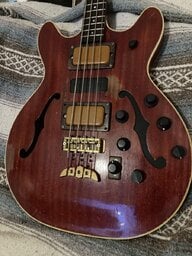
One of mine has flats :)
 

Attachments

  • IMG_3242.jpeg
    IMG_3242.jpeg
    1.6 MB · Views: 18
I’ve come to the same place in my bass journey.
Short scale: check. I own five shorties, and only one standard FB.
Flats: love ‘em, in the process of changing all of them over
Foam mute: a great accessory, I keep one in every case.
Pick: not so much. I learned with a pick fifty years ago, then gravitated to fingers. But now I’m intrigued enough to bust out a shorty and try a pick.
 
  • Like
Reactions: BuzzVerde
Sadly TIJF's are not available in 30". I have used and liked Chrome Lights, GHS Pressure Wound, Dunlop and the LaBella MUS set on various of my shorties.
Good point.

I haven’t pulled the trigger yet on the neck, but I was considering getting a reverse headstock to open up the possibility of using regular (long) scale strings. Not sure if that’ll be enough though. I could also make it string thru, but would rather not.
 
  • Like
Reactions: BuzzVerde
Good point.

I haven’t pulled the trigger yet on the neck, but I was considering getting a reverse headstock to open up the possibility of using regular (long) scale strings. Not sure if that’ll be enough though. I could also make it string thru, but would rather not.

I just chop down long scale strings. Works fine. It would be nice if Elixir made short/medium scale strings but unfortunately not.
 
  • Like
Reactions: BuzzVerde
I’ve been playing bass for 42 years, and while I’m no longer a gigging professional musician, I do still gig out regularly. And pretty every time I do play, I do it on a short scale bass strung with flatwounds and played with a pick.

Yeah, I know, kind of a triple heresy for most modern bassists, but hear me out on my reasons why. These have developed over many years of playing in lots of different bands, in varied styles. But first, a few caveats: I don’t slap or pop much, I haven’t played in a really heavy rock band in years, and I rarely play with distortion. If any of those three exceptions are where you live on bass, this probably won’t be too applicable to you.

Short scale: there is something truly magical about a good short scale bass – strong fundamental, slightly diminished harmonic content, and a lovely bendy feel that makes for easier note shaping. Mostly though, in my many years of experience, the short scale basses simply plop down in a band mix just perfectly. A good Precision Bass will also sit perfectly in a band situation, but for most other long scale basses, I usually had to extensively tweak the onboard EQ and/or the amp EQ to get a tone that worked right. With my short scales, it was pretty much always plug in and go.

Flatwounds: this took me longer to accept, but once I got my first set of TI Jazz Flats, I realized I loved the sound of flats, and the super bendy feel of the TI Jazz Flats was a revelation. Still, I used them on only one bass, and assumed I needed roundwounds for most gigs. It was only after 4 different bands said they preferred the bass with the flats did I finally have my epiphany: great flats simply sound better in most band situations and most duos as well. Unless you’re going for that Chris Squire/Geddy Lee trebly snap sound, flats are going to give you a stronger fundamental and sound bigger at the same volume level in a band setting.

Pick: when I play bass by myself, I much prefer the sound of my fingers. In a band, I can no longer deny that playing with a pick makes the note easier to hear. Something about that attack and midrange emphasis really pushes the fundamental of the note to the forefront, which is especially important when playing parts with strong melodies, countermelodies, or unusual harmonic notes. Even my bandmates who instinctively say they prefer bass played with fingers have told me to play with a pick most of the time. Of course, combined with a short scale and flatwounds, the pick doesn’t produce too much treble.

I hope these insights can assist some of you who may be struggling with bass orthodoxy to find what works best for you. Obviously, these choices aren’t going to work for everybody, and probably not even for most bassists, but they sure will work for quite a few. Feel free to experiment, and don’t let ideas of what you’re supposed to do get in the way of what sounds best for you.

Interesting. I’m glad you found your kismet combination. I would however suggest that the reason you need a pick is because of your EQ. I know, that’s nit picky…. Have a good one.
 
  • Haha
Reactions: BuzzVerde
I would however suggest that the reason you need a pick is because of your EQ. I know, that’s nit picky…. Have a good one.
No change in EQ will make fingers sound like a pick. The envelope of the note is completely different. Both are equally valid and useful.
 

Latest posts