Last edited:

Enjoy the benefits of a premium membership!
Upgrade Account
-
TalkBass has been independent since 1998. Add your voice.
Create a free account to reply to discussions, view embedded media, and browse with fewer display ads.
Join free Log in
Want zero display ads or expanded classifieds tools? Compare plans.
You are using an out of date browser. It may not display this or other websites correctly.
You should upgrade or use an alternative browser.
You should upgrade or use an alternative browser.
Short Scale thougths
- Thread starter DrBnz
- Start date
More options
Who Replied?

Most of the lighter-colored 'rosewood-substitutes' will turn quite a bit darker after they have been oiled a couple times with some suitable fretboard conditioner...
My experience agrees with this. A few applications of Dunlop 65 Fretboard lemon oil and the color usually darkens up nicely.

I agree, my board is Pau Ferro, and I really like it even though I'm kind of an ebony snob.Personally I do not feel or hear any difference between Rosewood and Pau Ferro fingerboards. You can get Mexican Player Mustangs with Pau Ferro.

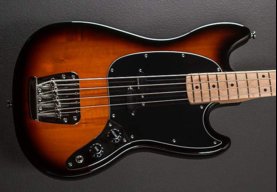
I’m really liking the look of this one with the black hardware… and if pickups are easily changed could be pretty fun.
Yeah, I really like that Sound Gear shape with the matte black open pore Weathered Black finish and black hardware too.
But then again, matte black being my number one favorite finish for basses, I am a bit biased in that regard.
There's just something about the aesthetics of it that gives off a really classy vibe and makes it look like it's not actually a low budget bass at all.
The pickups can fairly easily be swapped, though you need to be aware that the cavity for the bridge J pickup for some reason has been routed ever so slightly shorter than the standard bridge J pickup size, even if the cavities for the mounting "ears" for the pickup screws are positioned to fit a standard J bridge pickup perfectly, so it is just a matter of sanding, filing or chipping off (with respectively either a piece of coarse sandpaper, a file or a hobby knife/scalpel, eventually finishing off with some fine grained sand paper if looks is important) a slight bit of the length in each end of the cover of a standard J bridge pickup to make it fit (we are really talking a quite minor modification), or in case the new J pickup isn't sealed within it's cover just re-fitting it inside the cover of the original stock bridge J pickup.
I sanded the J pickup of the EMG Geezer Butler P/J set to fit the bridge J cavity of my Mikro, back when I also had the J pikcup installed, no issues at all, and took me maybe 5 to 10 minutes to do so.
Otherwise the P pickup cavity fits a standard P pickup perfectly fine.
Further more if you chose the EMG Geezer Butler P/J set you don't even have to solder, as it utilizes a quick connect system that makes the installation a piece of cake (note though that EMG still recommend you to solder the cables to the barrel type jack output socket of the Mikro, as that means you can't use the standard front mounted jack socket that fits the quick connectors, included in the pickup set, but actually I didn't solder that either, if you are able to clean the tabs of the stock barrel jack socket sufficiently from old solder to be able to cram the quick connector plugs down on them, which is what I did, that will actually work perfectly fine, without any need to fear it not holding up).
LOL… that is what I’ve noticed about most short scales, usually the most you’ll get is 19, 20 or (rarely) 21 frets.
Well, there does in fact exist other short scale basses than Fender short scales, where this would be true.
But not true at all in general for short scale basses outside of Fender and Fender style short scale basses.
The Mikro mentioned above got 22 frets, the short scale Musicman Stingray also got 22 frets, Cort Action Jr. got 22 frets as well, the short scale Danelectro Longhorn Bass got whole 24 frets, and the relatively new short scale headless Ibanez bass, forgot the model name, got 24 frets too, just to name a few examples off the top of my head.
Last edited:
Tried these awesome MusicMan Short Scale Stingrays recently. Some of the best sounding basses out there. Also really light but with a big sound.
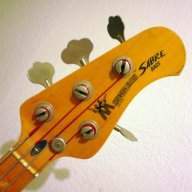

I would also comment here as far as Fender Mustangs go, not all are created equal. The AP version is basically an original plus a J pickup. The latest signature is really close to the original and so is the vintera. The MIM P/J is great but sounds way different than the original(although that might be the route to go as some here have suggested). Just know that the world of Fender Mustangs is one of many options and sounds and that an educated choice would most likely involve trying them all. Thankfully my local GC was very patient and understanding.


IMHO the Fender Player PJ is a very well made instrument but I think that they kind of blew it with single volume and tone and a three way selector switch. That configuration doesn't allow for the kind of variety of sound that makes the bass work really well.
My PJ has been modified and the three way switch has been removed. The volume and tone pots were switched out for a stacked volume/tone for each pick up. (The pick-ups were also changed to Nordstrands). I find that the best sound (for my ear) is with the P set to 60% or more and the J set low at about 10%.
With the original three way switch set to both pick-ups (50%-50%) I didn't think that the bass sounded very good at all and having a single tone control effecting both pick-ups really limited what the bass could do.
It probably wouldn't cost very much, if anything at all, for Fender offer that configuration and make a better product. Why they don't is beyond me.
My PJ has been modified and the three way switch has been removed. The volume and tone pots were switched out for a stacked volume/tone for each pick up. (The pick-ups were also changed to Nordstrands). I find that the best sound (for my ear) is with the P set to 60% or more and the J set low at about 10%.
With the original three way switch set to both pick-ups (50%-50%) I didn't think that the bass sounded very good at all and having a single tone control effecting both pick-ups really limited what the bass could do.
It probably wouldn't cost very much, if anything at all, for Fender offer that configuration and make a better product. Why they don't is beyond me.



If you want light, it's hard to beat a Danelectro since they are hollow bodies. They don't sound at all like a P bass, of course. They do make some long scales these days, but the originals from the 50s and 60s were all short scale.

If money is no object, get one of those Maruszczyk short scales. I have played one belonging to my university professor buddy. He has 2. I forgot what model. Plays real nice. Some people dig it here.

The G&L Fallout Bass is the only short scale bass I have played that has a neck that feels full sized, in terms of width. Most others have a very narrow nut, similar to a Jazz Bass. The Fallout has a 1 5/8" nut width (1.625"), and even though it is only 1/8" or less wider at the nut than most, it doesn't have a significantly narrower heel than your typical full scale bass. The fretboard really feels like a landing strip in comparison to something like a Mustang, Junior Jet, Starfire, or Stingray Short Scale. IME, it's the only way to go if you want a short scale, but don't like the feel of "small" necks.
The pickup can do a decent simulation of a P pickup, as well as having two less weighty settings available, via the toggle switch.
The U.S. and the import models have the same nut width and the same pickup. If you have the budget, go for the U.S. model. The Tributes are decent, and would be a fine choice if that's all you have the money for. But the U.S. model is definitely the nicer of the two, and it comes with a gig bag.
The pickup can do a decent simulation of a P pickup, as well as having two less weighty settings available, via the toggle switch.
The U.S. and the import models have the same nut width and the same pickup. If you have the budget, go for the U.S. model. The Tributes are decent, and would be a fine choice if that's all you have the money for. But the U.S. model is definitely the nicer of the two, and it comes with a gig bag.
Last edited:

To me the whole design concept of the Fallout is weird. Why play a shortie that feels, plays and weights like a full scale?
Why not get a full scale bass?
The joy of playing the neck and the weight of my Jaguar ss and sbmm stingray is why I switched to short scales.
But hey, its about choices, and the Fallout its a very cool bass, but its a very niche instrument.
Why not get a full scale bass?
The joy of playing the neck and the weight of my Jaguar ss and sbmm stingray is why I switched to short scales.
But hey, its about choices, and the Fallout its a very cool bass, but its a very niche instrument.

I really want an EBMM short scale regardless of price, but I had a question. Does it sound like an old school passive Stingray? I don't need or want a pre amp just the passive Stingray sound in a 30 inch scale. If so Ill save up the money.
A few months ago, I had a couple of shoulder surgeries and I bought one of SBMM short scales. Although I hated the way it sounded out of the box, I put a set of Thomastik Jazz Flats on it and made a huge improvement. The bass is very comfortable to play and the workmanship is good enough that I don’t feel like I’m playing a cheapie. Although you can select between series, parallel and humbucking, I only use the humbucking mode because of the poor electrical system where I play (my other basses have noise issues too in these places). In humbucking mode, it’s nice and quiet. The sound quality is pretty good although it doesn’t have big fat lows or super-crispy highs. In short, for what it costs, there is very little to complain about. I’m certain that you could make big improvements in the sound by swapping pickups or by adding a preamp.

I have ESP LTD 87 34" for BEAD and F Mustang PJ 30" for EADG tuning and I love them both. Fender is so easy to play, to haul and vibes good, too. My girlfriend likes the looks as well. It only could have thinner neck to be perfect. Plus less sensitive tuners, i. e. with higher ratio to make tuning-without-overshooting possible.


