Given that you understand that an ABG will need to be amplified in this setting, I think you're on the right track.
A suggestion: a lot of people who are lukewarm about amplified ABG's have never heard a good one through the most suitable amplification. Going direct is a good option, and an FRFR speaker will reproduce the sound of your acoustic in a more natural way than most regular bass amps.
If playing in places where there's no AC power is important to you, the battery-powered options have improved in recent years. The Bose S1 Pro (first gen, or the new upgraded version are both good) is expensive for it's size, but the battery life is good enough for most gigs, and if you're just bringing your acoustic up to the same volume as unplugged acoustic guitars, it's more than powerful enough. The voicing is excellent for guitar-scale ABG's in particular, and I've gotten a lot of complements about mine.
You asked about the odd strings on the guitar-scale models. All the ones I've seen are equipped with excellent onboard electronics, for all the obvious reasons. These are the most common models:
- Cordoba Mini II MH-E
- Guild Jumbo Junior
- Ibanez PNB14E (or the discontinued AVN1BE)
- Martin 000CJR-10E (with cutaway) or DJR-10E (dreadnaught, no cutaway)
- Ortega Traveler D-Walker
- Taylor GS Mini Bass
Replacing the nylon-core strings with steel is not an option. The top thickness, bracing, and intonation are all designed around the nylon. Steel is too stiff to intonate well at these frequencies with such a short scale. Using steel on one of these will give you an odd tone and bad intonation. Depending on how the instrument is built, you could run into other problems, like not being able to get the right neck relief, or having issues with the top.
Given that you preferred the amplified tone of the Guild Jumbo Jr over the B240 (I'm with you!), you'll probably be best-satisfied with one of these basses specifically because of these strings- the tone is mellow and deeper than normal-sized ABG's, specifically because of the nylon rope inner core, and bronze or silver-wrap.
These are essentially slightly shorter, bass-oriented versions of the rope-core, wound strings on a classical guitar. D'Addario originally made the EXPPBB190GS set for Taylor, and now they offer a new XT formulation- the XTB3790GS. Most of the manufacturers listed above ship their basses with the D'Addarios.
Aquila offers the new 310U set. La Bella makes the CB-40BE's, which I've been gigging on my Ibanez and Guild guitar-scale acoustic basses for years. The price from Strings by Mail is noticeably lower than the D'Addarios, which is another plus for the slightly stiffer and bolder-sounding La Bellas.
Pyramid now offers a new set in their Pyramid Gold series, the 639 100. I'd be interested in trying them, but they're around sixty bucks a set!
Martin has their own string formulation, which may be part of the reason for the more mid-heavy tone and short sustain. I can't say for sure, but the strings may be why I'm not a fan of the new Martin basses. The first thing I would do if I had one of the Martins, would be to throw a set of La Bellas or D'Addarios on it.
No need to be nervous about the nylon-core strings- they come up to pitch much faster, and tuning is more stable than the synthetic rubber strings used on Ukulele basses. I find I don't have to change them as often as the steel-core strings on regular ABG's, which is nice.
However, you do have to be willing to slightly adapt your touch to the instrument. The string tension is noticeably lower than a steel-strung ABG, and you can feel the strings roll very slightly under your fingers- just like the difference between a regular acoustic guitar and a nylon-strung one.
Another useful adaptation, is to learn to create your fretting hand vibrato by shaking the string along its length- almost like a fretless bassist, instead of across the fret like most people do on a steel-strung fretted guitar or bass. This is optional, and takes a little getting used to, but it gives you a bigger, more romantic-sounding vibrato.
If you pluck too hard on the nylon-core strings, you'll overdrive them, and the natural tone of the instrument will be drowned out by fret rattle.
As long as you don't mind lightening up a little and letting the amp do the work, you'll be rewarded with a beautiful, rich tone that sits somewhere between an electric bass and an upright. It's very much it's own thing, with much more detail than the dull imitation of an upright that most thump that most Uke basses offer.
I normally gig with a Dingwall 5-string electric worth about $4K. Ironically, when I play my cheap Guild Jumbo Junior to accompany acoustic piano and guitars (especially with hand percussion), I actually get more compliments and questions about the Guild, than I do with my electric slab.



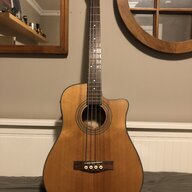

 if you can use my method or find some other way to make long scale strings work, that opens up your options considerably.
 Here’s how: