• TalkBass has been independent since 1998. Add your voice.
    Create a free account to reply to discussions, view embedded media, and browse with fewer display ads.
    Join freeLog in
    Want zero display ads or expanded classifieds tools? Compare plans.

Should I learn on a 4 or 5 string bass?

There is nothing a 4 string bass can do that a 5 string cannot, and there is a lot a 5 string can do that a 4 string cannot. Like playing a fretted low E, Eb, D, Db, C, and open low B, and playing more of the notes of a scale vertically, without changing positions. It's a no brainer. And this is from a guy who learned on a 4 string when 5 string electric basses did not exist. Go 5 string.
 
Don't make things complicated for you. If you find a need for 5 string, take it. I was scared at some point that 4 string may not be enough, and then I ended up playing on A and D string most of the time, using E only when needed.
 
I started out on a 5-string around 16 years ago now, and have tried several times to play a 4-string.... and I just can't do it! I use that low B string way too much to EVER do without it! And I suspect if you get the G&L 5-string and play it awhile, you will find you can't live without it either! :thumbsup:
 
I use that low B string way too much to EVER do without it!

You can always string up a 4 as BEAD if needed. Since they said they are a beginner and it's just a matter of fact that most lesson material whether online or in print is for a four string bass tuned EADG... that's how I went and would again. Only thing I might have changed is instead of getting the P for the sound I would seriously consider something lighter, slimmer or even short scale to cut my teeth on.
 
  • Like
Reactions: dmt
I am an advanced beginning bass player. I have an old Washburn Bantam XB102 PJ bass with a p bass type neck that feels very wide. I'm getting ready to begin lessons with a pro who is a 5 and 6 string aficionado. A local shop with a great reputation is selling a MIM Fender jazz bass and an Indonesian made G&L 5 string with active electronics. Which bass would be best to learn on? I want to play classic rock, blues, and one day jazz. I like the feeling of the jazz bass neck. Would I be better off getting accustomed to a 5 string neck? Both of the basses in the store are used but in excellent shape. My Washburn has developed a crack in the fretboard but has had a set-up. I appreciate your advice.

Back when I started there were no 5 strings. I bought my first one about a year ago. My advice (for whatever it’s worth) if you can play a 5 stringer, there is no advantage to playing a 4 string other than string sets are a whole lot cheaper when only buying 4 as opposed to 5. I would also look at 6 strings as there are some really cool chording things you can do that are not practical on a 4 or 5 string. JMO.
 
You can always string up a 4 as BEAD if needed. Since they said they are a beginner and it's just a matter of fact that most lesson material whether online or in print is for a four string bass tuned EADG... that's how I went and would again. Only thing I might have changed is instead of getting the P for the sound I would seriously consider something lighter, slimmer or even short scale to cut my teeth on.
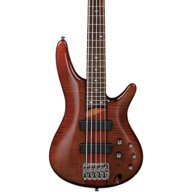
You have a point, but for me, since the Ibanez 5-string neck is hardly any wider than most other brands' 4-string necks, and the string spacing is narrower than many other brands also, the things are so easy to play that I found them a beginner's delight when I first started! I cannot imagine any other brand or style of bass that I would have done better on as a beginner when I was first starting out than my first 5-string SoundGear bass from Ibanez! I tried several other brands later and always returned to the SR-series that I cut my teeth on as they felt the best, sounded great, offered the most bang for the buck, and offered a huge array of choices from beginner models all the way up to $$$$ !

I know the OP was looking at G&L and not Ibanez, but the G&L neck and string spacing is not that dissimilar from the Ibanez SR series, so that is why I would recommend going ahead and jumping to the 5-string now. Just my opinion of course! That and $4.00 will get you a cup of coffee at Starbucks. :D
 
One thing I like about paying 4s exclusively is that I am in no way limited on my options. Not every bass is available in a 5 string. If I played 5s, I'd never had discovered the T-40, nor would there be any vintage gear available for me. 5 strings have their place for sure. I have used them in the studio more than once, but I don't own or play any live. It's a tough choice you are facing. Good luck :thumbsup:
 
From what I've heard from knowledgeable friends, and my take on learning materials, starting out on 4 string is easier than 5. That being said, my first bass, that I still have and use, is much like yours, a Washburn Bantam XB105 P bass. I later bought a Sterling Ray34. Seems to me like the 4 string is easier for method and the 5 is great once you get more into the notes and the music. And no reason not to be proficient on both.

Since your Bantam wouldn't net you much used ($60-$100?) I'd say keep it and get the G&L 5 string. Use both, learn both, have some options!
 
You will have far more future playing opportunities with a 5-string. There are lots of bass parts nowadays written specifically for 5-string.

If a 4-string is all you have starting out that's fine, but it will be harder to adapt to the low B string later on. It's better to go ahead and have it now while you're learning the instrument.
 
  • Like
Reactions: GroveBass
I'd go with the 5er if think at all that at some point you'll be using the low B.

A lot of people like G&L 5ers, but neck is rather large by my standards. There are many other 5ers out there - you might want to go to your local GC, and try them out before making a decision.
 
I don't prefer the width of a 5er...so I took a great feel and playing 4 string bass I liked, adjusted the neck, nut, bridge and strung it BEAD....no biggie...just another thought...
 
There is nothing a 4 string bass can do that a 5 string cannot, and there is a lot a 5 string can do that a 4 string cannot. Like playing a fretted low E, Eb, D, Db, C, and open low B, and playing more of the notes of a scale vertically, without changing positions. It's a no brainer. And this is from a guy who learned on a 4 string when 5 string electric basses did not exist. Go 5 string.


Just because a 5 string can do "more", doesn't mean it's the right tool for everyone. I'd rather play a 4 string and play the crap out of it instead of buying a 5 string and newer touching that low B because for what I play I don't need the extra string. Pick the right tool for the job, not something because it can simply do more, unless the "more" part is something you'll actually use.
 
  • Like
Reactions: GroveBass
Just because a 5 string can do "more", doesn't mean it's the right tool for everyone. I'd rather play a 4 string and play the crap out of it instead of buying a 5 string and newer touching that low B because for what I play I don't need the extra string. Pick the right tool for the job, not something because it can simply do more, unless the "more" part is something you'll actually use.
I respect your counterpoint, but playing more vertically is also an advantage. It's not just about having lower notes, which I love as well in any context. When used sparingly.
 
  • Like
Reactions: TomB
I respect your counterpoint, but playing more vertically is also an advantage. It's not just about having lower notes, which I love as well in any context. When used sparingly.

Some of us here are super serious players who do this for a living and play in all kinds of professional settings, situations, etc. Others like me just play in a $hitty country cover band and don't need a 5 string. Just pick the right tool for the job. Honestly though I think a lot of people just blow it to of proportion making the transition from a 4 string to a 5 string. But then again, I'm a guitar player who also played banjo for a while as well before picking up the bass. It aint that hard to make the switch if you want to later on.
 
  • Like
Reactions: arrowsun
Welcome, OP, and a really good opener that made me go "hmmm". Short answer for TLDR is make "this neck feels right in my hand" a very high priority. I started not only in the days of flint weapons but also as a lefty so a 4-string P copy was the only option. Happily, it turned out that this neck fitted very nicely. Then I got an Aria 4-string with TWO PUPS and ACTIVE! I wet myself with all these options and did loads of gigs (not at the same time. Usually). The Aria had more of a J4's profile but I'd been playing a while by then so it was an adjustment rather than a putoff. Then I got a 5-string WITH A LOW B! I wet myself with all the options. It was all squeezed onto a P4 neck's profile which was perfect. I'm not a slapper and neither is my wife so the close spacing was not any issue at all. Then I bought that bass over in my avatar WITH A LOW B, TWO PUPS and ACTIVE. I have a repeat prescription for incontinence pads.
I've bought other basses with fun features but only one (untried through ebay) has wide spaced strings - I take diuretics with that one. After all this time, how the neck feels in my fretting hand is still very important and (just for me personally) I'm still OK with a J4, prefer a P4, love a close to P width 5 and don't really play the wide one. I know I cannot be convinced by anyone to buy an aircraft-carrier-deck 6-string. Even though the bass player on Alien Ant Farm's Smooth Criminal looks so cool I could put him on a stick and lick him.