• TalkBass has been independent since 1998. Add your voice.
    Create a free account to reply to discussions, view embedded media, and browse with fewer display ads.
    Join freeLog in
    Want zero display ads or expanded classifieds tools? Compare plans.

Should I learn on an EADG bass before stringing BEAD?

As I mentioned back in post #2, calling that note 'C' would be the correct terminology for most classical and jazz musicians, and for circumstances when you are playing with concert-pitch instruments.

On the other hand, if you are playing with like-minded rock or metal guitarists, then it would be very common and perfectly appropriate to call that note 'F.'

Versatile multi-genre bassists typically have both of these skills.
I have never in my life heard of calling 'C' note an 'F'... What is the purpose of that? I mean, you can call it F but the rest of band still plays 'C'? Interesting concept but my head hurts just from thinking of it.. :D
 
Almost nobody is playing BEAD, or at least relatively nobody. It is possible as a self-described "new bass player" that you've come across something that is revolutionary over the 60 year history of the electric bass. But it's also more likely that EADG is a standard for the vast majority for a reason. Fours strings tuned EADG and five strings tuned BEADG make up probably 95% of the players out, if not higher. I'll include those that drop a half step as a band in the same group as that's more of a change of reference pitch than an alternate tuning. When you're new to something, follow the rules before you try to break them. I suspect you'll discover why players use EADG and BEADG as the standard.
 
  • Like
Reactions: swink
Late to the party here, but advice from someone who owned one; at first the missing G is no big deal. Maybe it’s the novelty of it all. To my playing at least, it just got annoying to have that stutter-step that you get when working out new material. You go for the octave on some little run your doing, and there’s nothing but thin air where you want your fretting pinky to go. My option was to just get a pretty decent 5-er and call it good. - This is largely contingent to my playing style, which is to ignore the B string except as to be used as a 5th below accent. It’s not a thumb rest by any stretch, but I can go a few songs before feeling the note choice avail on the low B is right for the 1.
 
I have never in my life heard of calling 'C' note an 'F'... What is the purpose of that? I mean, you can call it F but the rest of band still plays 'C'? Interesting concept but my head hurts just from thinking of it.. :D

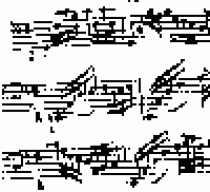
I will explain as clearly as possible: Many rock guitarists call their lowest string 'E' regardless of which pitch it is actually tuned to, because this is a well-accepted style of guitar notation that any guitar teacher might teach their student. For example if you buy a songbook of popular songs that has both piano and guitar chords, the guitar and piano might be notated in different keys, to account for the capo or alternate tuning on the guitar. Here is some professionally-notated sheet music for a famous song. Notice that the piano is notated in the key of C, but the guitar chords are notated in the key of A, because James Taylor put a capo at the 3rd fret for this one.

MN0016643.gif


These guitarists aren't dummies, and they aren't breaking any rules. The miscommunication occurs when they try to use guitar-style notation to teach songs to non-guitarists. They may not be aware that capo or scordatura notation might be totally unfamiliar to non-guitarists, and therefore they are expressing the correct musical ideas, but communicating them poorly by using the wrong type of notation. It would be like handing bass TAB to a tuba player, or something like that.

For whatever reason, early on in my musical education, I decided that "bass guitar is a guitar-family instrument" and I was going to learn to read guitar notation. After a bit of practice, I was able to figure out that, for example, when a guitarist says "chord progression E, A, B in B standard tuning" what they actually mean is concert-pitch B, E, F#. This is a skill I'll have for life, that lets me read from guitar songbooks and jam with guitarists of all backgrounds. I can do these "mental gymnastics" in real time, even with an unfamiliar song, and it will sound good; we are all playing in the same key.

At the end of the day, however, the most important musical skill is having a good ear. Being able to hear that you are in a different tuning or key than the rest of the band, and adjust a few frets up or down to compensate, is a really valuable skill. Doesn't matter if you call it B# or whatever, so long as the whole band sounds good.
 
Having the B string down there isn't really going to make much of a difference. You can just play on the top 3 strings of your bass or play on the B in a higher position. If you think tuning BEAD is the thing that will make you pick up your new bass and play it, you should just do that. Actually playing the thing is more important than the tuning IMO
 
I swap back and forth between standard and BEAD a lot; depends on mood, venue acoustics, and who I’m playing with. Learn the names of the notes you’re playing. Then you can play standard, BEAD, or fiver, and you’ll be OK on any of them.
 
  • Like
Reactions: jbhaugh
Don’t listen to people who say 99% of music is played on EADG because clearly they don’t listen to the music that you do. I think it’s tough for some old timers to understand that the music they grew up listening to and being inspired by sounds like Gershwin and Prokofiev to younger listeners who have no interest in it. I can think of very popular and successful rock bands that never play in EADG. That said, it’s also true that plenty of five string basses have the same string spacing as four string basses.
 
In my opinion, learn EADG.

if you want B, you should buy a 5 string. If you want 19mm spacing, buy one with 19mm spacing.

Even if it has a narrow spacing, you're a beginner, so it's not like you have 10 or 20 years of playing with 19mm.

How long do you play?

The other tunings, CGCF, in my opinion, for you, are just nonsense. You are a beginner and you want to learn with two strings as 5ths and the other two as 4ths?! What for?

You are over complicating things.

Reminds me of a thread some time ago, where a new member (and new to the bass) before buying a bass was already thinking of modding it. New bridge, new pickups, etc..

For me BEAD is not extended range. For me and for the things I play, it would be limited range. I would miss the G a lot.
 
  • Like
Reactions: swink
No matter what turning you use I recommend staying in 4ths - the relationships between the notes (in other words, the patterns made by scales) is something you want to keep consistent. EADG, BEAD, EbAbDbGb, DGCF, GCFBb (yeah, really), once you find one note you know where they all are. Picking up a bass tuned DADG, or DAbDAb (yeah, really) can mess with your head.
 
  • Like
Reactions: funkinbottom
Don’t listen to people who say 99% of music is played on EADG because clearly they don’t listen to the music that you do.

Exactly!

Just off the top of my head, Jimi Hendrix, Black Sabbath, U2, Guns & Roses, The Rolling Stones, and Stevie Ray Vaughn have often used non-standard tunings. That's got to be at least 1.1% of popular music right there, disproving the 99% claim, just with those 6 acts. ;)

Beatles used an alternate tuning on the Ed Sullivan Show. Hendrix used an alternate tuning at Woostock. U2 used an alternate tuning at Live Aid. These are iconic performances. Alternate tunings are here to stay.
 
Last edited:
  • Like
Reactions: lucas303
Honestly, from someone who moves between 4 and 5 string a lot, if I were you, and you think you’ll wanna have a B string, I’d just get a 5 string.

When you’re playing a 4 string tuned BEAD you’ll be surprised how many songs you wanna play that use the G-string.

If string spacing is an issue, there are plenty of bass makers who build 5 strings with wide spacing.
 

Latest posts