• TalkBass has been independent since 1998. Add your voice.
    Create a free account to reply to discussions, view embedded media, and browse with fewer display ads.
    Join freeLog in
    Want zero display ads or expanded classifieds tools? Compare plans.

Show us your 3 pickup basses!

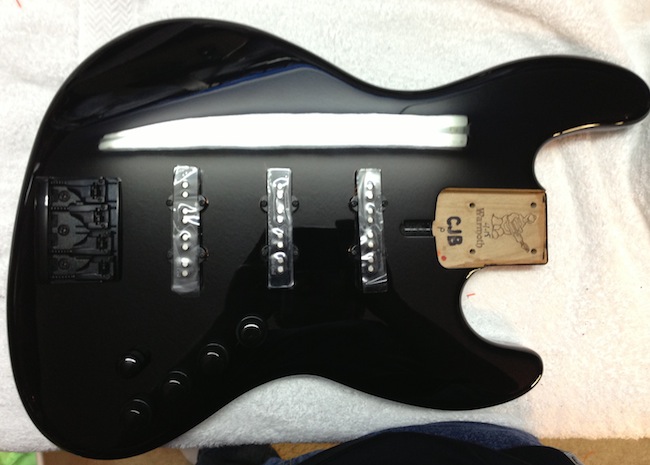
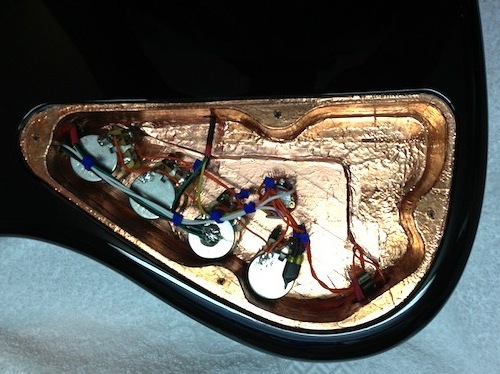
Woohoo! I got a couple pictures from my tone guy, Michael at Turnstyle switch. Looking good so far!

Brozbass_zpsd2c4d3f0.jpg


BrozTone_zps5a35d94c.jpg

Awesome, and what a tidy shielding job, probably the best I have ever seen - looks like the copper is painted on!
 
It's gonna be beautiful! Nice and neat wiring too, I'm a stickler for that. So many guitars/basses look like some small creature nested inside of the control cavity. That looks GREAT inside. The all black outside looks stunning as well.

Good for you! Great new bass coming your way soon! :)

Totally envious here.

Thanks! I'd love to take credit for the neat wiring, but the closest I can get is the credit for choosing the right guy to do it for me. But I will take credit for the all-black look.


Awesome, and what a tidy shielding job, probably the best I have ever seen - looks like the copper is painted on!

Thank you! I put a lot of time and attention to detail in that shielding (I even used dental tools to apply parts of it). And copper. I used a lot of it. I made sure everything was connected to everything. Underneath the bridge, there is a copper foundation that is almost exactly the width and length of the whole bridge grounded to the control cavity. I even used copper tubing in the drilled channels between pickup routes and the control cavity.

Overkill, I know. But I figured if I was going to mess up anywhere, I was going to err on the side of bulletproof.


Looks good, the copperfoil! Is it expensive?

Thanks! I got the copper shielding from China on ebay. Right now you can get a 25m roll of 10mm x 0.1mm self adhesive copper foil for $17, or a 50m roll of 5mm x .06mm for $12.

The nice thing about copper is you can solder it, which allowed me to be both thorough and creative. For example, I did the best I could to be sure the copper foil in the pickup routes was fully connected to the copper tubing between the routes. But just in case, I used a standard ground wire also, soldering both ends to the pickup and control cavity respectively. But I did it as inconspicuously as I could, and then I covered it with more foil. So from the control cavity, all shielding ground wires are completely invisible.

(Is it possible to solder aluminum foil?)
 
As an eBay Associate, TalkBass may earn a commission from qualifying purchases.
I've used adhesive backed aluminum tape on some of my bass buildups ...

IMGP4280.jpg


IMGP4277.jpg

What exactly are we looking at here? It looks like you either foiled over a layer of foam, which you then cut out (presumably to install something of that shape), or you cut all the way through the front of the bass and we're seeing tolex.

Is that your experimental modular bass?
 
Maybe I was using the wrong term. I was referring to the fairly pronounced mid scoop that you get on just about any jazz bass. I was seeking to understand how the scoop frequency would change as the distance between pickups increases.

Your point about fretting is interesting. Usually (maybe always) when I compare control settings to one another I'm doing it with open strings. I'll have to try it with fretted notes too just for grins.

Here's something to consider. There is apparently a "sweet spot" in the control settings for a typical jazz bass, where the volume controls are not set equally. I say "apparently" because I have never achieved it personally.

When I was going back and forth with Michael at Turnstyle, I sent him a link to a jazz sound that I really like. (Tom Wilber, with General Clusterfunk, playing Fire in the House. Such a great example of elegance in simplicity!) Michael explained to me about the sweet spot, and I told him I wanted it incorporated in my build.

Anyway, my point is that the mid scoop on a jazz bass could have to do with the volume control settings themselves as much as pickup placement.


Oh, and I'll be interested to hear if you discover anything interesting doing fingered vs open tone testing.
 
What exactly are we looking at here? It looks like you either foiled over a layer of foam, which you then cut out (presumably to install something of that shape), or you cut all the way through the front of the bass and we're seeing tolex.

Is that your experimental modular bass?
Haahaa ... there's no foam or whatever there. Naw man, that's a black painted wooden bass body with a shielded cavity. The blue stuff is just blue masking tape that I put around the area to protect the painted body from errant tools or slips.

It's a double cut-out cavity, it's a standard rear routed cavity that I cut out a hole in the front for a metal control plate. It makes for a very large control cavity with a very small control plate on the front. This is a rear view where a standard cavity cover is placed over the rear routed hole, like any other rear routed instrument.

With this method you can have a large rear routed control cavity that has a regular cover on the back, and a small metal control plate on the front. It gives you rear access to all of the ~whatevers~ you have in the cavity, and also a metal control plate on the front that can be replaced with different drillings at any time for accepting some sortof new control setup or output jacks setup.

I did not own a router then, so the front hole was cut with a drill press, and handheld keyhole saw and a hacksaw blade that I wrapped tape around and used as a hand-saw. The cover plate is aluminum, hand made, and it completely covers the butt-ugly hole in front. The aluminum tape was connected to ground via a brass-headed tack that has a grounding strap soldered to it (I used desoldering braid as the grounding wire). The tack was pressed through the aluminum tape into the body wood then the head of the tack wass slodered to the aluminum tape via a ~tag~ of aluminum tape that I sortof rolled up into a bit of a terminal. The rear cavity cover also had the aluminum tape on it, and both the front cover and rear cover made solid contact with the shielded cavity tape when installed.

I used braided shielded wire harvested from vintage Hammond organs (it's like braided shield pickup lead) as hookup wire so no shielding was required inside of passage holes.

I suppose that is Tolex that is seen through the front access hole ... I can't remember what it may have been though (speaker cab or something?)

And not the X-bass ... previous build (one of eleven).

Gotta jet, supper's on the table!

:)
 
Woohoo!!! Another update from Michael at Turnstyle Switch!

More good news. I got the neck on it and WHOA does this bass sound good!! These pickups not only sound amazing but work exceptionally well with the Turnstyle switch. Even if these were not noise canceling, they would be worth the price just on tone quality alone. The clarity of them reminds me of the Fralin pickups I have in my Tele.

The BrozTone setting with everything wide open is crazy sweet sounding. Reminiscent of the Seinfeld J-Bass tone but the middle pickup adds a whole new complexity to the tone without even the slightest hint of mud.

For anyone interested, there are three Fender split-coil Super 55 J pickups, two neck + one bridge. The bridge pickup is located in the normal Fender bridge J-pickup position, and the others are spaced 2" apart.

Oh, and "BrozTone" + "everything wide open" = all three pickups on. And all of the tone controls have no-load pots.

Brozbass_zpsd2c4d3f0.jpg
 
"Broz Tone"? Where does that originate from or what does it mean?

I use the term "Bronze tone" to describe that Ric/Geddy/Chris Squire type sound, but I'm not familiar with "Broz Tone".
The Turnstyle switch is something Michael at Turnstyle developed. It's one of a few different options of things like that out there. But the configuration on my bass build is unique and proprietary.

BrozTone is specifically the first position of the switch, where all pickups are available, and controlled by individual volume and tone controls. The tone controls for individual pickups only takes the edge off the highs, they don't have the full range that a normal tone control has. The combined signals then go through the switch and the master volume/tone controls. The master tone control does about half of what a normal tone control does.

So far it sounds fairly basic, but apparently you can't do something like stick multiple tone controls in-line without running into problems (I have been told by several tech-savvy sources). There was a few days during this process when Michael thought he wasn't going to be able to do it, but then he woke up one morning with the answer, and reconfigured the controls to make what I wanted possible.

To answer your question, my last name is Broz. BrozTone will soon be a signature tone setup offered by Turnstyle, and I will be an endorsing artist (with no monetary compensation, that's why I haven't changed my profile).
 
So it's a small rolloff per pickup with a master tone for the mix. Ok.

I have been doing the same thing, but OUTBOARD of the bass. I run each pickup through it's own processing (tone, compression, gain, etc ... pretty much a descrete preamp per pickup) and then run the mix of the pickups through a "master" preamp.

But I think my setup is quite a bit more comprehensive, and only so because it is outboard of the bass (which provides me with a lot more working room and options).

The fact that a smaller version of that idea has been miniaturized and placed inside the bass is pretty cool. It is not something I would use myself (I like POUNDS of freedom, and having the ability to reconfigure the tone controls and gain structure is very important to me) ... however the system you've adopted may be something others might be very interested in.

Good for you! :) Best of luck with that. :)

I feel the need to comment. I find the mindset difference between someone that comes from the synthesizer/keyboard world and the stringed instrument world to be interesting and well portrayed here. Synth players (old schoolers) prefer a lot of control and a lot of ability to reconfigure things, as well as having all of the circuitry separate from the human interface (the "bass" is the interface, just exactly like the "keyboard" is the interface that connects the human's creativity with the technology).

Where the bass players seem to prefer to have all of the circuitry on board the interface.

It's just kinda cool to see how the two mindsets ~view~ the instrument itself. Synth players view the bass as just the interface, with the tonal and gain structure circuitry as an outboard set of units. Where the bass player seems to view the bass itself as the entire device, with a few gadgets (stompboxes, rack goodies) as additions.

I view the bass as just the thing that my hands use to create the musical part of the setup. The tone controls and gain structure circuits are totally a separate thing that can be changed or reconfigured without having to mess with the interface (the bass) at all.

Perhaps it's not so much "keyboard players" that are like I am, but moreso "modular synth" players. I prefer to keep things as modular as possible so that should I decide to change something (or NEED to change something) it will not affect the ~interface~ .... the thing that is so personal in nature, the thing that I become physically attached to and have learned ot use it to help me express myself in a musical way. The thing "my hands use" to create music.

Ok, so I'm done. This submission by Blue Talon just got me to thinking about how there are two definite mindsets here. Obviously mine is the outlaw of the two, the less adopted. But that's actually fine by me. :)

So anyhow, yet another bass configuration that Blue Talon calls his own. Good on ya! :) Hope it works out.
 
So it's a small rolloff per pickup with a master tone for the mix. Ok....

So anyhow, yet another bass configuration that Blue Talon calls his own. Good on ya! :) Hope it works out.
Forgot about that other thing!

For the record, I initially thought this was going to be no big deal, just a little unusual and never asked for setup. I wasn't the one that ran into technical problems and almost couldn't do it, and then had a eureka moment with a technical solution. Apparently it's a bigger deal than I thought it was going to be going in. The final result came from a collaboration... and yes, I'm happy to have my name associated with it. :) But it isn't just about me -- Michael now has a tone setup to offer that he didn't have before, and it needed some kind of tag. Why not Broz? (BTW, rhymes with "rose") Besides, "BrozTone" kinda rolls off the tongue. :D

I don't see this as being any different from any other signature line -- artist wants something a little different, company makes it, company produces it with artist's name.


I have been doing the same thing, but OUTBOARD of the bass. I run each pickup through it's own processing (tone, compression, gain, etc ... pretty much a descrete preamp per pickup) and then run the mix of the pickups through a "master" preamp.

But I think my setup is quite a bit more comprehensive, and only so because it is outboard of the bass (which provides me with a lot more working room and options).

The fact that a smaller version of that idea has been miniaturized and placed inside the bass is pretty cool. It is not something I would use myself (I like POUNDS of freedom, and having the ability to reconfigure the tone controls and gain structure is very important to me) ... however the system you've adopted may be something others might be very interested in.

Good for you! :) Best of luck with that. :)

I feel the need to comment. I find the mindset difference between someone that comes from the synthesizer/keyboard world and the stringed instrument world to be interesting and well portrayed here. Synth players (old schoolers) prefer a lot of control and a lot of ability to reconfigure things, as well as having all of the circuitry separate from the human interface (the "bass" is the interface, just exactly like the "keyboard" is the interface that connects the human's creativity with the technology).

Where the bass players seem to prefer to have all of the circuitry on board the interface.

It's just kinda cool to see how the two mindsets ~view~ the instrument itself. Synth players view the bass as just the interface, with the tonal and gain structure circuitry as an outboard set of units. Where the bass player seems to view the bass itself as the entire device, with a few gadgets (stompboxes, rack goodies) as additions.

I view the bass as just the thing that my hands use to create the musical part of the setup. The tone controls and gain structure circuits are totally a separate thing that can be changed or reconfigured without having to mess with the interface (the bass) at all.

Perhaps it's not so much "keyboard players" that are like I am, but moreso "modular synth" players. I prefer to keep things as modular as possible so that should I decide to change something (or NEED to change something) it will not affect the ~interface~ .... the thing that is so personal in nature, the thing that I become physically attached to and have learned ot use it to help me express myself in a musical way. The thing "my hands use" to create music.

Ok, so I'm done. This submission by Blue Talon just got me to thinking about how there are two definite mindsets here. Obviously mine is the outlaw of the two, the less adopted. But that's actually fine by me. :)

I'm certainly hoping that others may be interested in this system! It would mean good things for Turnstyle, and maybe eventually for me.

I don't know that I would agree with you about the two mindsets, or at least not the way you delineated them. There are lots of bass players who have quite impressive pedal boards (I am not one of them), and it seems to me those players engage in off-board modular control over their sound.

I think it is probably fair to say there are two types of musicians, those who prefer more controls on board their instrument, and those who prefer the majority of their controls to be remote. The way I see it, that mentality crosses all electronic instruments, whether it's keyboard/modular synth players, or bassists with/without pedal boards.

Using your model of a personal interface, I would suggest that the personal nature of the interface has mostly to do with how your left hand interact with the strings and neck, how your right hand interacts with the strings and bridge and pickups, and how the body fits with your own body. The controls are obviously important, but for a guitar or bass that fits you, the controls are the least essential element of the fit. At least, that's how I see it.

By the way, I never meant to compare my project with your project, if anything I have written came across that way. From your use of "I feel the need to comment" and "OK, so I'm done", I kinda get the feeling that I might have done something to piss you off. I had no intent to do that, but if I did do something that offended you, I apologize.
 
Forgot about that other thing!

For the record, I initially thought this was going to be no big deal, just a little unusual and never asked for setup. I wasn't the one that ran into technical problems and almost couldn't do it, and then had a eureka moment with a technical solution. Apparently it's a bigger deal than I thought it was going to be going in. The final result came from a collaboration... and yes, I'm happy to have my name associated with it. :) But it isn't just about me -- Michael now has a tone setup to offer that he didn't have before, and it needed some kind of tag. Why not Broz? (BTW, rhymes with "rose") Besides, "BrozTone" kinda rolls off the tongue. :D

I don't see this as being any different from any other signature line -- artist wants something a little different, company makes it, company produces it with artist's name.


I'm certainly hoping that others may be interested in this system! It would mean good things for Turnstyle, and maybe eventually for me.

I don't know that I would agree with you about the two mindsets, or at least not the way you delineated them. There are lots of bass players who have quite impressive pedal boards (I am not one of them), and it seems to me those players engage in off-board modular control over their sound.

I think it is probably fair to say there are two types of musicians, those who prefer more controls on board their instrument, and those who prefer the majority of their controls to be remote. The way I see it, that mentality crosses all electronic instruments, whether it's keyboard/modular synth players, or bassists with/without pedal boards.

Using your model of a personal interface, I would suggest that the personal nature of the interface has mostly to do with how your left hand interact with the strings and neck, how your right hand interacts with the strings and bridge and pickups, and how the body fits with your own body. The controls are obviously important, but for a guitar or bass that fits you, the controls are the least essential element of the fit. At least, that's how I see it.

By the way, I never meant to compare my project with your project, if anything I have written came across that way. From your use of "I feel the need to comment" and "OK, so I'm done", I kinda get the feeling that I might have done something to piss you off. I had no intent to do that, but if I did do something that offended you, I apologize.
You certainly haven't offended me, I was just making an observation.

The only reason I said "I feel the need to comment" was I was warning the reader that Flux Jetson was going off on yet another unsolicited tangent and sharing things that no-one asked me to share. It was just some self-mockery, making fun of the fact that I tend to run off at the mouth about crap most folks couldn't care less about. Which I why I said "Ok, I'm done" .. to let the reader know that I was done with my nonsensical side trip.

As to those bass players that use lots of pedals .. perhaps they're modular minded. I suppose I drew a less than accurate description of what I had in mind. I'd say yours was more true to life.

Nope ... you have not pissed me off. This world is open to everyone, I know of no "patents" on use of tone controls either in the bass or out of the bass. And even if you WERE "copying" some idea of mine, then it's no-one's fault but my own for posting every single detail about how I've done what I've done. Y'know? I claim no ownership of the systems I've created. It's just a different pile of crap stuffed in a rack than others have used.

I was simply drawing attention to the different mindsets you and I have, that's all. You (and others like you) like tone controls and gain controls in the bass, me (and others like me) prefer the controls in the bass to be no more complex than just a volume control with all of the ~junk~ outside of the bass. It was just an observation.

I still insist that you've come across something different that many bass players will most likely find useful.
 
Got the template, bits and the wiring is all done!

One 3 way switch to select between the two neck pickups and a 3 pole on/off/on which toggles all three pickups between humbucking, single coil and G&L's "OMG mode" which splits the pickups using a capacitor.

I had a custom template made and measured it a little too big so got router bit with oversize bearing to compensate. Pickup is enroute.

IMG_6774_zps2a10b010.jpg
 
  • Like
Reactions: Immigrant
Got the template, bits and the wiring is all done!

One 3 way switch to select between the two neck pickups and a 3 pole on/off/on which toggles all three pickups between humbucking, single coil and G&L's "OMG mode" which splits the pickups using a capacitor.

I had a custom template made and measured it a little too big so got router bit with oversize bearing to compensate. Pickup is enroute.

That's gonna look awesome! What does splitting the pickups with a capacitor do? I like that you have one switch to do the same thing to all three pickups at once.
 
You (and others like you) like tone controls and gain controls in the bass, me (and others like me) prefer the controls in the bass to be no more complex than just a volume control with all of the ~junk~ outside of the bass. It was just an observation.

I still insist that you've come across something different that many bass players will most likely find useful.

I hope you're right about that. The first step will be to see how useful I still think it is after some time to play with it.

It may surprise you to know that my favorite bass ever had no onboard controls of any kind. It was a Rickenbacker with two Carvin humbuckers wired straight to the jack -- which was then plugged straight into a Sunn Coliseum bass amp. Not a lot of tonal variety there, good thing I loved that tone.
 
This was my 3PU- a PRS in the late 80's.
Magnificent bass, Mahogany with Maple Top.... wow! Selling it was the most dumb decision I've ever made. Indeed.

8667957004_782e0246de.jpg
Heheh ... my list of "dumbest things" is long ... very long .... too long.

The one that has been on my mind lately is I once owned an ARP 2600 synth, I sold it in 1987 for $350 .. they sell all day long these days for .... ready for this? .... TEN THOUSAND DOLLARS! Look here ...

http://www.ebay.com/itm/ARP-2600-w-...oards_MIDI&hash=item3f20bc5a29#ht_4644wt_1030

And they are mostly all beat to hell and need work too. Mine was pristine.

Nice bass man. I can see why you regret letting go of it.
 
As an eBay Associate, TalkBass may earn a commission from qualifying purchases.
Just 3 pups? Lol how's this...
JL.jpg
I hear ya ... but the participants here have determined that P-bass "pairs" qualify as one pickup. Otherwise Blue Talon has ya beat, he has a modded Ric that has THREE sets of P-bass pairs.

In any case, your bass looks pretty sick. Provide some details about the humbucker, as well as the mystery knob up there on the lower horn.

EDIT: Woops .. my bad ... turns out after going back to look at it Blue Talon's Ric "only" has a J-pickup and two P-pairs ....

GEDC0118m.jpg


That'll teach me to open my mouth before I spout off (uh .. highly doubt it to be honest!)