Enjoy the benefits of a premium membership!
Upgrade Account
-
TalkBass has been independent since 1998. Add your voice.
Create a free account to reply to discussions, view embedded media, and browse with fewer display ads.
Join free Log in
Want zero display ads or expanded classifieds tools? Compare plans.
You are using an out of date browser. It may not display this or other websites correctly.
You should upgrade or use an alternative browser.
You should upgrade or use an alternative browser.
Show us your 3 pickup basses!
- Thread starter Doner Designs
- Start date
More options
Who Replied?

I'm sure they are, for most people. I have limited mobility in my wrists. From about the 10th or 12th fret down, I have no problems with fanned frets. But north of that, it causes a lot of pain to try to contort my wrist to get my fingers into position to play. I tried to play a Dingwall at Bass Northwest, they're just impossible for me to play.
Playing high on the neck of a Dingwall-type fanned-fret bass requires stressing the wrist for the fingers to be in the correct position. For people with pain free joins and full range of motion, they don't feel any stress, since it's within the normal range of motion. But it's there.
Chording maybe, but playing regularly, for most people, as they bring their fretting hand towards the body the hand angles in the same direction very ergonomic in most cases.
Ah .. I see. Well that changes everything then. Since the fanned fret system is (probably) made for people with fully functioning anatomy.I'm sure they are, for most people. I have limited mobility in my wrists. From about the 10th or 12th fret down, I have no problems with fanned frets. But north of that, it causes a lot of pain to try to contort my wrist to get my fingers into position to play. I tried to play a Dingwall at Bass Northwest, they're just impossible for me to play.
Playing high on the neck of a Dingwall-type fanned-fret bass requires stressing the wrist for the fingers to be in the correct position. For people with pain free joins and full range of motion, they don't feel any stress, since it's within the normal range of motion. But it's there.
Oh well .... ya gotta go with whatever works, right? I mean if ya got 2 left feet ya gotta wear 2 left shoes, no matter how "perfect" someone says a right shoe is for them.
I'm just happy to hear you can play at all! I hope that your situation remains (at the very least) constant so you can keep playing.
I'm sure you've probably already tried this, but I'll ask anyhow ... have you tried playing with the bass sortof straight up, like a stand-up bassist plays? The wrist angle is greatly relieved in that position. Just try setting the bass on a chair or bed and kinda fake it with it balanced in a near vertical position. If you have not tried that already, give it a shot. The worst that can happen is it won't work.
Just trying to help.

It is ... quite .. um .. purple.Here's one from Santa Rosa:
Link Removed
(2010 custom Alembic Elan 5)
Controls:
Link Removed
(3-way Q switches)
- Jun 2, 2012
- 5,784
- 6,819
- Disclosures
- Doner Designs is an alias for Steve Doner
Beautiful! Can you explain a little about the controls? What is a filter? What is a Q switch?
Here's one from Santa Rosa:
Link Removed
(2010 custom Alembic Elan 5)
Controls:
Link Removed
(3-way Q switches)
- Jun 2, 2012
- 5,784
- 6,819
- Disclosures
- Doner Designs is an alias for Steve Doner

Beautiful! Can you explain a little about the controls? What is a filter? What is a Q switch?
Thanx!
This is from the Alembic site (Alembic club faq's)
And I see I forgot to explain the 4-way switch:Basically, the filter control is a low pass filter; as you roll it back it lowers the point at which it passes low frequency signals and blocks high frequency signals. To quote Mica, "the range is from 350Hz-6KHz. Wherever you set the filter, only frequencies below that cutoff point are passed." The Q switch is a 3 position switch and works in concert with the filter. It provides 0, 6db, and 9db of boost at the cut off frequency you've set with the filter. When the switch is off you get a flat response up to the filter setting. Again to quote Mica, "the Q affects mainly the attack portion of the note".
1. P only
2. P with J (from the bridge/neck pan)
3. J only (from the bridge/neck pan)
4. Standby
Filter = tone control. Q = frequency center of tone controls.Beautiful! Can you explain a little about the controls? What is a filter? What is a Q switch?
So, there are tone controls for each pickup, and three "tone caps" for each tone control. The tone caps determine the frequency center (aka "Q") of each tone control.
Essentially "vari tone" for each pickup.
That's my best guess.
EDIT: Woops ... I see that he explained it before I got down far enough to read his reply.
He deserved it!Mr Blue Talon - congratulations on your bass of the week award for your black triple!
Chording maybe, but playing regularly, for most people, as they bring their fretting hand towards the body the hand angles in the same direction very ergonomic in most cases.
I'm not talking about toward the body. I'm talking about toward the headstock. Sorry if I didn't make that clear.
I agree, the frets are very easy to play close to the body. But as you move your hand toward the headstock, the further out you go, the more you have to contort your wrist to get your fingers to line up with the frets. It's anything but ergonomic. The main impetus for the fanned frets was as a means of having a longer scale for the lower strings, and it works quite well for that.
I'm actually a bit envious of the people who can play a Dingwall -- it means they have better joints than I do.
I'm sure you've probably already tried this, but I'll ask anyhow ... have you tried playing with the bass sortof straight up, like a stand-up bassist plays? The wrist angle is greatly relieved in that position. Just try setting the bass on a chair or bed and kinda fake it with it balanced in a near vertical position. If you have not tried that already, give it a shot. The worst that can happen is it won't work.
Just trying to help.
I appreciate the thought. My wrists can handle playing a bass guitar hanging normally on a strap, when the frets are the normal non-fanned variety. I actually have tried to play a bass guitar in a more vertical orientation a few times, but it has always been awkward.
So hopefully, my wrists won't degenerate any more for the next 30 years or so, and I should be fine.
Great bass to play in the rain
Finish looks stunning, hard to capture in a pic. In sunlight it's completely black, this comes pretty close:
Link Removed
Very nice! I like this picture a lot -- much easier to see the pickups.
Mr Blue Talon - congratulations on your bass of the week award for your black triple!
He deserved it!
Thank you both!
Here is a link for anyone interested (it's the bass in my avatar).
I'm not talking about toward the body. I'm talking about toward the headstock. Sorry if I didn't make that clear.
I agree, the frets are very easy to play close to the body. But as you move your hand toward the headstock, the further out you go, the more you have to contort your wrist to get your fingers to line up with the frets. It's anything but ergonomic. The main impetus for the fanned frets was as a means of having a longer scale for the lower strings, and it works quite well for that.
I'm actually a bit envious of the people who can play a Dingwall -- it means they have better joints than I do.
Odd, that's actually the part I like the best when I play my four string Dingwall, doesn't feel like its 36" out there and my hand naturally angles in that direction when I'm out towards the headstock. Everybody'y biology is different I suppose.

Filter = tone control. Q = frequency center of tone controls.
So, there are tone controls for each pickup, and three "tone caps" for each tone control. The tone caps determine the frequency center (aka "Q") of each tone control.
Essentially "vari tone" for each pickup.
That's my best guess.
EDIT: Woops ... I see that he explained it before I got down far enough to read his reply.
They used state-variable filters. The "filter" control sets the resonant (corner) frequency, the "Q" control sets the resonant frequency gain. A friend of mine and I made a similar circuit not long ago. After trying it out, no wonder Alembic uses them all the time - it's active, but sounds and behaves like the ultimate passive tone control.

So it's just standard synth jargon then. I was trying to second guess the use of the terms "filter" and "Q" taking into consideration the source. I should have just gone with what I knew to be standard use of the terms.They used state-variable filters. The "filter" control sets the resonant (corner) frequency, the "Q" control sets the resonant frequency gain. A friend of mine and I made a similar circuit not long ago. After trying it out, no wonder Alembic uses them all the time - it's active, but sounds and behaves like the ultimate passive tone control.
Thanks for clearing it up.
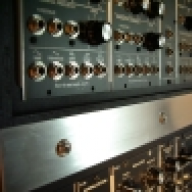
This situation is exactly why I am putting together a bass with no filters or tone controls. I can use any filters that I have on hand to produce whatever effect I am seeking. I have three State Variable VCFs, as well as a dedicated LPF (12db and 24db slope with self oscillating "Q") in addition to a couple of parametric EQs, and of course the Alesis eight channel 31 band digital EQ. There are so many filter schemes that "work" very well that I didn't want to box myself into a corner by chosing any one type as the internal filter (aka "tone control"). With the proper gain modules and whatever filter types I wish to use, I can make my bass "active" or "passive", with any tone control scheme I want to employ.
I suppose all that set of ideas really does is to confirm my OCD/ADHD/Indecision problems. However in the end that setup is quite a bit less expensive than owning a closet full of basses. It works for me, I guess that is really all that matters.
I have this bass
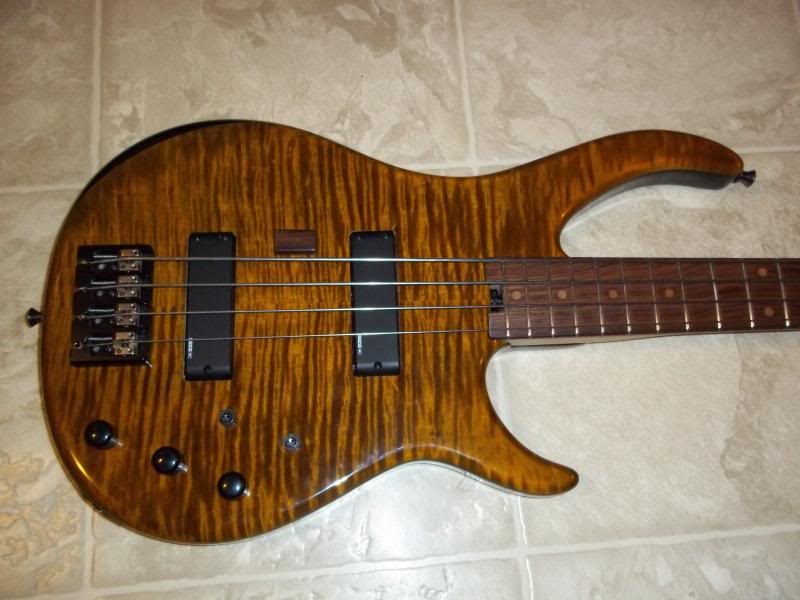
It has two SGD ND3 humbuckers and I'm debating about adding a third in the middle. Do you think there'd be enough tonal variation to make it worth the effort and expense?
If I did this I was thinking of either going with three series/off/parallel switches or a five-way rotary switch.
It has two SGD ND3 humbuckers and I'm debating about adding a third in the middle. Do you think there'd be enough tonal variation to make it worth the effort and expense?
If I did this I was thinking of either going with three series/off/parallel switches or a five-way rotary switch.
I have a six-way rotary switch on mine. Click on the link 5 posts above this one to read about it, if you're interested.
Regarding the tone, you would obviously have a greater spectrum of sounds available if your first two pickups were farther apart, but I believe you would be pleasantly surprised by the additional tonal range if you were to put an additional pickup in there, centered between the other two.
Also, though, it's not necessarily just about the tone. It's also about creating something from an idea, turning it into something real, something unique.
Regarding the tone, you would obviously have a greater spectrum of sounds available if your first two pickups were farther apart, but I believe you would be pleasantly surprised by the additional tonal range if you were to put an additional pickup in there, centered between the other two.
Also, though, it's not necessarily just about the tone. It's also about creating something from an idea, turning it into something real, something unique.