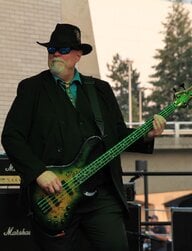
Here's an SG bass I modified for a psychedelic 60's cover band I was in a while back.


Enjoy the benefits of a premium membership!
Upgrade Account
-
TalkBass has been independent since 1998. Add your voice.
Create a free account to reply to discussions, view embedded media, and browse with fewer display ads.
Join free Log in
Want zero display ads or expanded classifieds tools? Compare plans.
You are using an out of date browser. It may not display this or other websites correctly.
You should upgrade or use an alternative browser.
You should upgrade or use an alternative browser.
Show us your 3 pickup basses!
- Thread starter Doner Designs
- Start date
More options
Who Replied?

Nice. I also like the super-shortscale Jazz.Here's an SG bass I modified for a psychedelic 60's cover band I was in a while back.
View attachment 822240
hey guys.. long term TB lurker.
happened upon this thread by clicking on the jagelectro (page 46) pic that showed up in my google image search. sweet looking bass!
thought i'd contribute as well.
here're mine.. well two of them at least. the middle one belongs to a friend.
L to R: ESP PPJ, Atelier Z (not sure of the exact model), Edwards E-T-95BIV
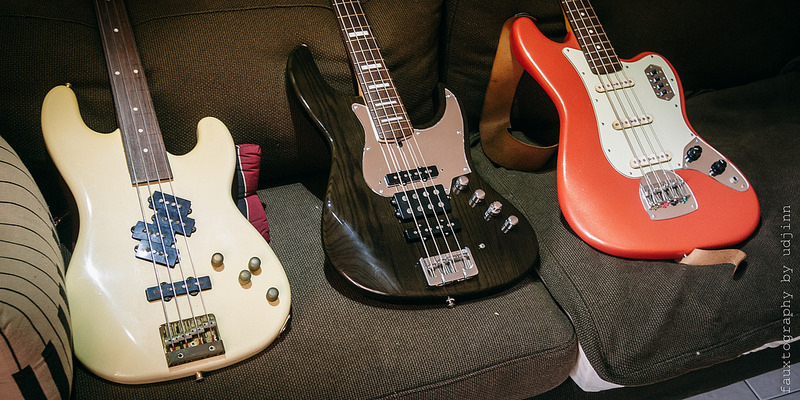 3 by 3 by Eu Gene Udjinn, on Flickr
happened upon this thread by clicking on the jagelectro (page 46) pic that showed up in my google image search. sweet looking bass!
thought i'd contribute as well.
here're mine.. well two of them at least. the middle one belongs to a friend.
L to R: ESP PPJ, Atelier Z (not sure of the exact model), Edwards E-T-95BIV

On that PPJ,
are the P pickups split in an alternating fashion to blend between more neck fundamental and more mid position?
or are they separated to give independent volume control over the EA and DG string pairs?
are the P pickups split in an alternating fashion to blend between more neck fundamental and more mid position?
or are they separated to give independent volume control over the EA and DG string pairs?
the former. (confirmed by testing individual volumes solo-ed)On that PPJ,
are the P pickups split in an alternating fashion to blend between more neck fundamental and more mid position?
or are they separated to give independent volume control over the EA and DG string pairs?
the bass initially came with individual volumes for each pickup, and a master volume. i later had the master volume modded to a master tone.
I'm 90% settled on turning my Warwick Rockbass Streamer LX (a PJ Bass) into a 3x Jazz pickup bass and sticking a pickguard on top to cover the P cavity and my likely horrible pickup routs.
I'm working my way through this thread (on page 15) but figured I'd ask a question or two before I doze off... Or at least jot down the thoughts in my head before I forget them.
I'll likely install 3 split coil DiMarzio Area J pickups. There'll be three volumes, and likely a 3-way switch (off/series/parallel) for each pickup.
Now is when things get hairy. I don't want too many controls, but with all of the added versatility, I'd hate to miss out on something...
The middle pickup will be installed at the 36th fret position, the same position as the Rickenbacker 4001/3 bridge pickup, which is one of my favourite tones. Because of this, I'm also debating adding a capacitor in series with that pickup to mimic the tone of the old 4001's or the new 4003's with the vintage circuit engaged. I'm not a huge fan of push-pulls, because I hate tampering with the volume to flick a switch, but I'd hate to add a second switch just for the middle pickup.
Also, because of my love for the Rick tone, I'm debating adding a TRS output jack and another 3-way switch (mono/neck pickup to channel 1 + middle and bridge pickup to channel 2/neck and middle to channel 1 + bridge to channel 2). I think this setup is pretty smart actually, but my issue now is what to do with tone pots... I was initially going to just have one with a 3-way switch to choose between some different cap values, by if I do go ahead with the two channels then I'd want a tone pot on each channel, and I'd hate to have two tone pots in mono....... Actually... Since one channel will be blend-able between two pickups, maybe I only need a tone pot on the single pickup channel? If I want to lower the treble on the two pickup channel, I can always emphasize the pickup closer to the neck... Wiring this will be nuts though, if I can even do this, and it'd be a real head-scratcher whenever I changed settings... I guess I need to determine if I will actually use the dual channel feature.
Any of you guys use multiple channels? I know Flux probably does (at least he did by page 15), but I often wonder if splitting the mono signal out of the bass would be better as the highs from all pickups will go to one channel and the lows from all pickups will go to the other. Then again there's more control onboard if it's done in the bass, and a Rick-like tone would be better captured, which is the point after all.
Then I need to decide if I want series/parallel options between pickups... It would be pretty sweet, especially if I do the dual channels. The neck and middle in series, clean, with the bridge pickup running through some OD would sound great! I'd also like the ability in mono to do nearly any combination, but man, the wiring and switching of these series/parallel options, especially with the dual channels, is giving me a headache just thinking about it.
Anyways, any thoughts on my rambling? LOL!
I'm working my way through this thread (on page 15) but figured I'd ask a question or two before I doze off... Or at least jot down the thoughts in my head before I forget them.
I'll likely install 3 split coil DiMarzio Area J pickups. There'll be three volumes, and likely a 3-way switch (off/series/parallel) for each pickup.
Now is when things get hairy. I don't want too many controls, but with all of the added versatility, I'd hate to miss out on something...
The middle pickup will be installed at the 36th fret position, the same position as the Rickenbacker 4001/3 bridge pickup, which is one of my favourite tones. Because of this, I'm also debating adding a capacitor in series with that pickup to mimic the tone of the old 4001's or the new 4003's with the vintage circuit engaged. I'm not a huge fan of push-pulls, because I hate tampering with the volume to flick a switch, but I'd hate to add a second switch just for the middle pickup.
Also, because of my love for the Rick tone, I'm debating adding a TRS output jack and another 3-way switch (mono/neck pickup to channel 1 + middle and bridge pickup to channel 2/neck and middle to channel 1 + bridge to channel 2). I think this setup is pretty smart actually, but my issue now is what to do with tone pots... I was initially going to just have one with a 3-way switch to choose between some different cap values, by if I do go ahead with the two channels then I'd want a tone pot on each channel, and I'd hate to have two tone pots in mono....... Actually... Since one channel will be blend-able between two pickups, maybe I only need a tone pot on the single pickup channel? If I want to lower the treble on the two pickup channel, I can always emphasize the pickup closer to the neck... Wiring this will be nuts though, if I can even do this, and it'd be a real head-scratcher whenever I changed settings... I guess I need to determine if I will actually use the dual channel feature.
Any of you guys use multiple channels? I know Flux probably does (at least he did by page 15), but I often wonder if splitting the mono signal out of the bass would be better as the highs from all pickups will go to one channel and the lows from all pickups will go to the other. Then again there's more control onboard if it's done in the bass, and a Rick-like tone would be better captured, which is the point after all.
Then I need to decide if I want series/parallel options between pickups... It would be pretty sweet, especially if I do the dual channels. The neck and middle in series, clean, with the bridge pickup running through some OD would sound great! I'd also like the ability in mono to do nearly any combination, but man, the wiring and switching of these series/parallel options, especially with the dual channels, is giving me a headache just thinking about it.
Anyways, any thoughts on my rambling? LOL!
I'm 90% settled on turning my Warwick Rockbass Streamer LX (a PJ Bass) into a 3x Jazz pickup bass and sticking a pickguard on top to cover the P cavity and my likely horrible pickup routs.
I'm working my way through this thread (on page 15) but figured I'd ask a question or two before I doze off... Or at least jot down the thoughts in my head before I forget them.
I'll likely install 3 split coil DiMarzio Area J pickups. There'll be three volumes, and likely a 3-way switch (off/series/parallel) for each pickup.
Now is when things get hairy. I don't want too many controls, but with all of the added versatility, I'd hate to miss out on something...
The middle pickup will be installed at the 36th fret position, the same position as the Rickenbacker 4001/3 bridge pickup, which is one of my favourite tones. Because of this, I'm also debating adding a capacitor in series with that pickup to mimic the tone of the old 4001's or the new 4003's with the vintage circuit engaged. I'm not a huge fan of push-pulls, because I hate tampering with the volume to flick a switch, but I'd hate to add a second switch just for the middle pickup.
Also, because of my love for the Rick tone, I'm debating adding a TRS output jack and another 3-way switch (mono/neck pickup to channel 1 + middle and bridge pickup to channel 2/neck and middle to channel 1 + bridge to channel 2). I think this setup is pretty smart actually, but my issue now is what to do with tone pots... I was initially going to just have one with a 3-way switch to choose between some different cap values, by if I do go ahead with the two channels then I'd want a tone pot on each channel, and I'd hate to have two tone pots in mono....... Actually... Since one channel will be blend-able between two pickups, maybe I only need a tone pot on the single pickup channel? If I want to lower the treble on the two pickup channel, I can always emphasize the pickup closer to the neck... Wiring this will be nuts though, if I can even do this, and it'd be a real head-scratcher whenever I changed settings... I guess I need to determine if I will actually use the dual channel feature.
Any of you guys use multiple channels? I know Flux probably does (at least he did by page 15), but I often wonder if splitting the mono signal out of the bass would be better as the highs from all pickups will go to one channel and the lows from all pickups will go to the other. Then again there's more control onboard if it's done in the bass, and a Rick-like tone would be better captured, which is the point after all.
Then I need to decide if I want series/parallel options between pickups... It would be pretty sweet, especially if I do the dual channels. The neck and middle in series, clean, with the bridge pickup running through some OD would sound great! I'd also like the ability in mono to do nearly any combination, but man, the wiring and switching of these series/parallel options, especially with the dual channels, is giving me a headache just thinking about it.
Anyways, any thoughts on my rambling? LOL!
I'd skip the series / parallel switches UNLESS you played, heard, and liked a P or humbucking J pickup wired in parallel before. While humbuckers with two coils each covering all strings in a slightly different position sound cool (slightly scooped), side-by-side humbuckers are said to sound thin and weak unless wired in series (cf. S0 switch P bass).
I haven't tried it myself but from what I read it's not something I'd risk if the number of controls is critical.
Yeah, I've never actually heard P or split-coil pickups in parallel so that's probably some good advice.I'd skip the series / parallel switches UNLESS you played, heard, and liked a P or humbucking J pickup wired in parallel before. While humbuckers with two coils each covering all strings in a slightly different position sound cool (slightly scooped), side-by-side humbuckers are said to sound thin and weak unless wired in series (cf. S0 switch P bass).
I haven't tried it myself but from what I read it's not something I'd risk if the number of controls is critical.
I was also thinking too much about it last night and realized I could bring the pickup leads out of the bass to a testing bench and try a multitude of wiring combinations to see what I will actually use, before I drill and mount all kinds of switches through the pickguard.
Last edited:
Yeah, I've never actually heard P or split-coil pickups in parallel so that's probably some good advice.
I was also thinking too much about it last night and realized I could bring the pickup leads out of the bass to a testing bench and try a multitude of wiring combinations to see what I will actually use, before I drill and mount all kinds of switches through the pickguard.
I agree that trying is worth it before committing. On the P pup in parallel mode though, I tried it on my fretless P (with flats) and I LOVE IT for jazz. Takes it closer to an acoustic tone.
Last edited:
I really like this preset idea! I was debating doing a switch to engage a Rick 4001 type of preset, but having a few more options is a great idea....The other control is a 6-way selector switch. In the first position, I have manual control over all pickups with the individual volume/tone controls. If I want one or two or three pickups, I use the individual pickup volume to select/drop/mix each pickup, then I use the master volume/tone to control the mix.
The other five switch positions are tone presets. They are:
P-bass
J-bass
Ric
T-bird
Overdrive
When using any of the presets, the individual pickup controls are bypassed and only the master volume/tone have any effect. Note that the Turnstyle switch is not being used at all as a pickup selector. It can be used that way, but since Michael offers customized tones, and since I have manual control over all pickups in one position, I figured that using the Tonestyle for pickup selection would be a waste of a switch position.
Can you recall how these tones are obtained?
It doesn't look like your pickups are in the exact same locations as some of these basses. You can probably duplicate the tones with the right volume levels, series/parallel options, caps, and other things, but it would take a lot of experimenting, and some great engineering to set everything just right.
Yeah, I could imagine they'd work well in some situations.I agree that trying is worth it before committing. On the P pup in parallel mode though, I tried it on my fretless P (with flats) and I LOVE IT for a jazz. Takes it closer to an acoustic tone.
I'll likely sit down with the bass at a test bench with some terminal blocks and a whole bunch of jumpers, switches, resistors, caps, and other parts (and maybe frequency analyzer software) to try out a whole bunch of options I'll use at some point, and add a few switches to pick between a few different preferred settings.

Not mine, but a friend of mine made this... A Berry Oakley Tractor-tribute in 1969 Ford Mustang "Indian Fire"-finish.
Link Removed
Link Removed
3 pickups?!? Holy Cow! I have my hands full with just the one on my P . . . 

Do all three pickups have to actually work on the same circuit to count?
I'll tell you exactly how I got those tones. I told Michael at [Invalid or Expired Link Removed] what sounds I wanted, and he wired it up. To be a little more specific, I sent him links to YouTube videos, and I had him listen to them at certain points. It was then his job to electronically recreate those tones. Micheal is a self-described electronics and music geek, and views requests like that as a challenge.I really like this preset idea! I was debating doing a switch to engage a Rick 4001 type of preset, but having a few more options is a great idea.
Can you recall how these tones are obtained?
It doesn't look like your pickups are in the exact same locations as some of these basses. You can probably duplicate the tones with the right volume levels, series/parallel options, caps, and other things, but it would take a lot of experimenting, and some great engineering to set everything just right.
I know it's probably not what you are wanting to hear, but I don't have a better answer.
Part of the problem is in identifying what a P tone is, or J, or any other bass for that matter. There is quite a lot of variation within a family of instruments and pickups, so if you are trying to map out what a P sound is, you are going to have an area rather than a point. The way I did it, I gave Michael specific examples of the sounds I wanted, and he did his best to replicate them, using the signal inputs from the three Fender Super 55 J pickups located 2" apart edge-to-edge. Exactly how he did it is his proprietary secret.
Just so you know, the pickup location is completely arbitrary. The pickup arrangement was driven by aesthetics and by the desire to get a pickup as close to the neck as possible. I made no attempt to locate the pickups in any specific location, because I believe it simply doesn't matter much. (I think you could change the sound of a P bass, for example, a lot more by changing the pickup than you could by moving the existing pickup 1/2" in either direction.)
Thanks for the reply.I'll tell you exactly how I got those tones. I told Michael at [Invalid or Expired Link Removed] what sounds I wanted, and he wired it up. To be a little more specific, I sent him links to YouTube videos, and I had him listen to them at certain points. It was then his job to electronically recreate those tones. Micheal is a self-described electronics and music geek, and views requests like that as a challenge.
I know it's probably not what you are wanting to hear, but I don't have a better answer.
Part of the problem is in identifying what a P tone is, or J, or any other bass for that matter. There is quite a lot of variation within a family of instruments and pickups, so if you are trying to map out what a P sound is, you are going to have an area rather than a point. The way I did it, I gave Michael specific examples of the sounds I wanted, and he did his best to replicate them, using the signal inputs from the three Fender Super 55 J pickups located 2" apart edge-to-edge. Exactly how he did it is his proprietary secret.
Just so you know, the pickup location is completely arbitrary. The pickup arrangement was driven by aesthetics and by the desire to get a pickup as close to the neck as possible. I made no attempt to locate the pickups in any specific location, because I believe it simply doesn't matter much. (I think you could change the sound of a P bass, for example, a lot more by changing the pickup than you could by moving the existing pickup 1/2" in either direction.)
It sounds like Michael at Turnstyle is an electronic whiz.
Once I mount the pickups, I'll just need to spend some time trying out a whole bunch of different combinations.
I really like the idea of keeping it somewhat simple, by having a few presets of my top few favourite tones and have a non-preset position where I can adjust all the volumes to my liking.
I know if I have many switches for every combination of series/parallel, different tone cap (trebles cut and bass cut) values, an other things available, then I'll have too much to fiddle with at a gig... I'd much rather invest a few days trying out all of the different possibilities, and find a way to quickly select my favourites as needed.
I hope you don't mind me using your idea though... It is quite genius.
Thank you! I'd be honored. If you're thinking about having a Turnstyle do the same kind of thing on your bass, you can find mine on the Bass ProShop page under the name Sasha.Thanks for the reply.
It sounds like Michael at Turnstyle is an electronic whiz.
Once I mount the pickups, I'll just need to spend some time trying out a whole bunch of different combinations.
I really like the idea of keeping it somewhat simple, by having a few presets of my top few favourite tones and have a non-preset position where I can adjust all the volumes to my liking.
I know if I have many switches for every combination of series/parallel, different tone cap (trebles cut and bass cut) values, an other things available, then I'll have too much to fiddle with at a gig... I'd much rather invest a few days trying out all of the different possibilities, and find a way to quickly select my favourites as needed.
I hope you don't mind me using your idea though... It is quite genius.
Sometimes at gigs I'll turn the switch just to change up the sound a little -- I don't even care which tone I go to, 'cause they're all good and usable. It takes zero time or adjustment.
Cliff Bordwell
Commercial User
Cool stuff here... I have one coming up soon.
Looking forward to it.
Looking forward to it.
- Jun 2, 2012
- 5,784
- 6,819
- Disclosures
- Doner Designs is an alias for Steve Doner
Done yet? Would love to see it with pickups. I've been thinking about doing a double or triple reverse P.

Wonderful takes on classic designs.hey guys.. long term TB lurker.
happened upon this thread by clicking on the jagelectro (page 46) pic that showed up in my google image search. sweet looking bass!
thought i'd contribute as well.
here're mine.. well two of them at least. the middle one belongs to a friend.
L to R: ESP PPJ, Atelier Z (not sure of the exact model), Edwards E-T-95BIV
3 by 3 by Eu Gene Udjinn, on Flickr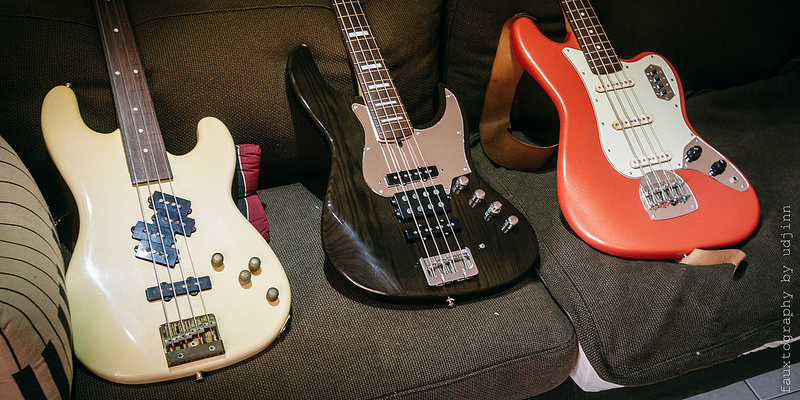
LOOOOOOOOOOOOOVE the beauty to the left. I'd like to know your inspiration (or mind-altering substance of choice) that led you to that set-up.
