
Enjoy the benefits of a premium membership!
Upgrade Account
-
TalkBass has been independent since 1998. Add your voice.
Create a free account to reply to discussions, view embedded media, and browse with fewer display ads.
Join free Log in
Want zero display ads or expanded classifieds tools? Compare plans.
You are using an out of date browser. It may not display this or other websites correctly.
You should upgrade or use an alternative browser.
You should upgrade or use an alternative browser.
Show us your 3 pickup basses!
- Thread starter Doner Designs
- Start date
More options
Who Replied?

The impedance of the pickup is mathematically complex, because the resistance is real and the inductance and capacitance are both imaginary and frequency-dependent. If I recall right, when comparing data, most pickup winders measure them at the 1 kHz point. However, for simple things like matching volume and tone control values, DCR is fine.Also, is the impedance of a pickup measured just as the fixed resistance? Like just measuring how much resistance is seen across the the two leads? Or is it done some other way (like the way electronic devices are measured, y'know with a fixed frequency of like 10khz applied or whatever as well as other things taken into consideration).
Larger-gauge wire or fewer turns, or both. You can also use a transformer to lower the impedance, but it's much more useful the other way around (low-to-high). Of course, a buffer (transparent preamp) also does it.And how do you go about changing a given pickup's impedance from hi to low .. er lowER than it was ... do you use different wire ... different guage so that it takes fewer turns or something (like winding a transformer)? I'm just curious to know, I love learning.
As far as I know, none whatsoever.And another thing (addressing all readers of this thread). Does it make any consequential difference in sound if you place one pickup ahead of another in a series configured setup? Said another way, does it sound any different if the neck pickup is first and the bridge pickup is second, vs the other way around? If so, how are these multi-pickup rigs done up?
Thanks! I was wondering if anyone was going to reply on those questions. Appreciate your time.
Fluxoid
Fluxoid
- Jun 2, 2012
- 5,784
- 6,819
- Disclosures
- Doner Designs is an alias for Steve Doner
Here's mine.
Carvin LB75PF
the piezo pickup also serves as GK 13 pin pickup so it is almost a 4 pickup bass !
( I also could have posted all my two pickups bass with a GK3 pickup added)

I guess you are counting the MM as two when you say 4?
Those look like really nice basses - I have drooled over them on the Carvin website many times. What's your control setup? Also, what praytell is that multipin jack - separate outs for each coil?? I have been thinking that on a multi rather than installing a bunch of 1/4 inch jacks, though that would look pretty cool.
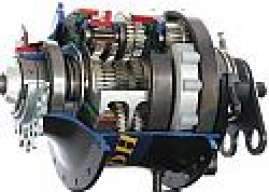
By the way, what is your Avatar, a transmission?
I've had three Carvin basses, a 4 string, a 5 string, and a 6 string. EXCELLENT quality instruments. Best off the shelf action and fretwork of any strnged instrument I've ever owned (27 basses and a dozen guitars).
I currently own two Carvin bass cabs (ported 2x10 and a sealed 4x10). Great sounds, STUPID-good pricing. And I've owned Ampeg cabs, my last one was a 610HLF.
(below) Carvin 6 string, Ampeg SVT-CL head, 610 HLF cab .....
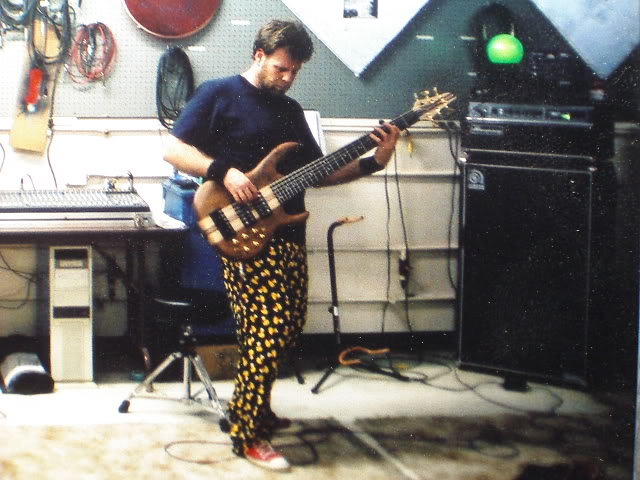
Carvin makes some pretty good stuff. I think they get ignored sometimes because they aren't a "prestigious" name brand. They don't have much "cool factor" and the kewl kidz don't annoint Carvin with their stamp of approval.
I've also had a Carvin 24ch mixer (see it in the background there?) as well as a PA system, an acoustic guitar (made of Koa, that thing was gorgeous). Admittedly there are one or two turds in their lineup, but that is true with nearly any company.
But as far as their basses go (and their bass cabs for that matter) .... totally good stuff Maynard!

I currently own two Carvin bass cabs (ported 2x10 and a sealed 4x10). Great sounds, STUPID-good pricing. And I've owned Ampeg cabs, my last one was a 610HLF.
(below) Carvin 6 string, Ampeg SVT-CL head, 610 HLF cab .....
Carvin makes some pretty good stuff. I think they get ignored sometimes because they aren't a "prestigious" name brand. They don't have much "cool factor" and the kewl kidz don't annoint Carvin with their stamp of approval.
I've also had a Carvin 24ch mixer (see it in the background there?) as well as a PA system, an acoustic guitar (made of Koa, that thing was gorgeous). Admittedly there are one or two turds in their lineup, but that is true with nearly any company.
But as far as their basses go (and their bass cabs for that matter) .... totally good stuff Maynard!


I'm a big fan of 3 pickup basses. Was searching for threads and pics of examples out there but its slim pickins. Love to see some pics of customs with three separate pickups. Comments on wiring and what you like/dislike also would be interesting.
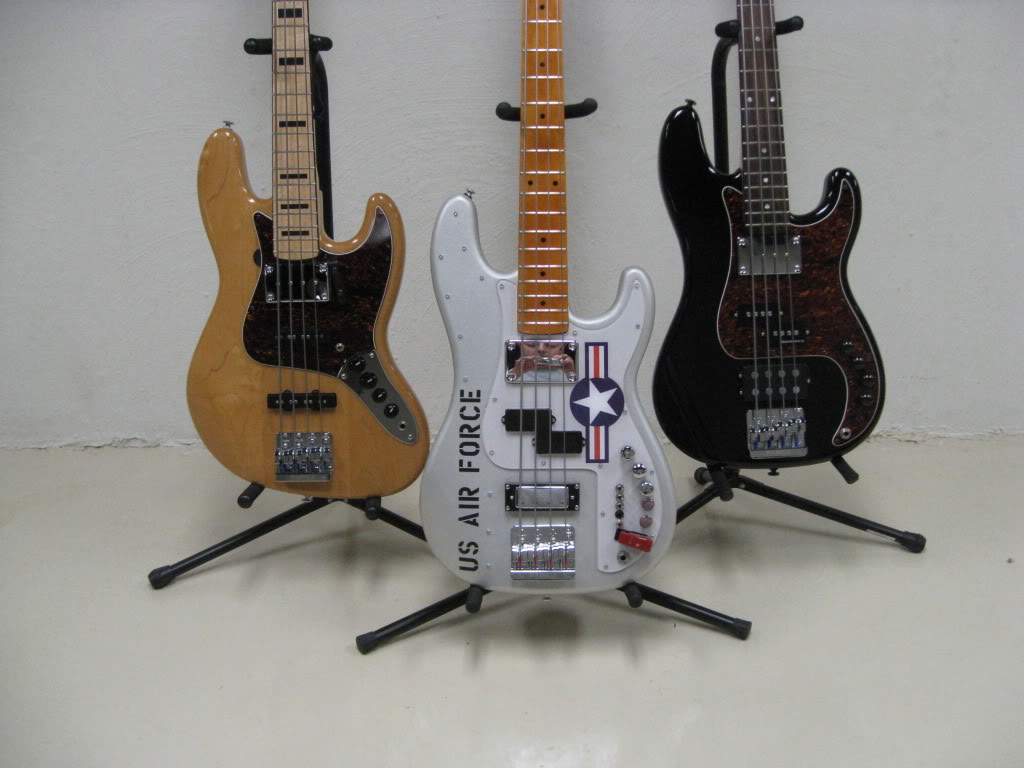
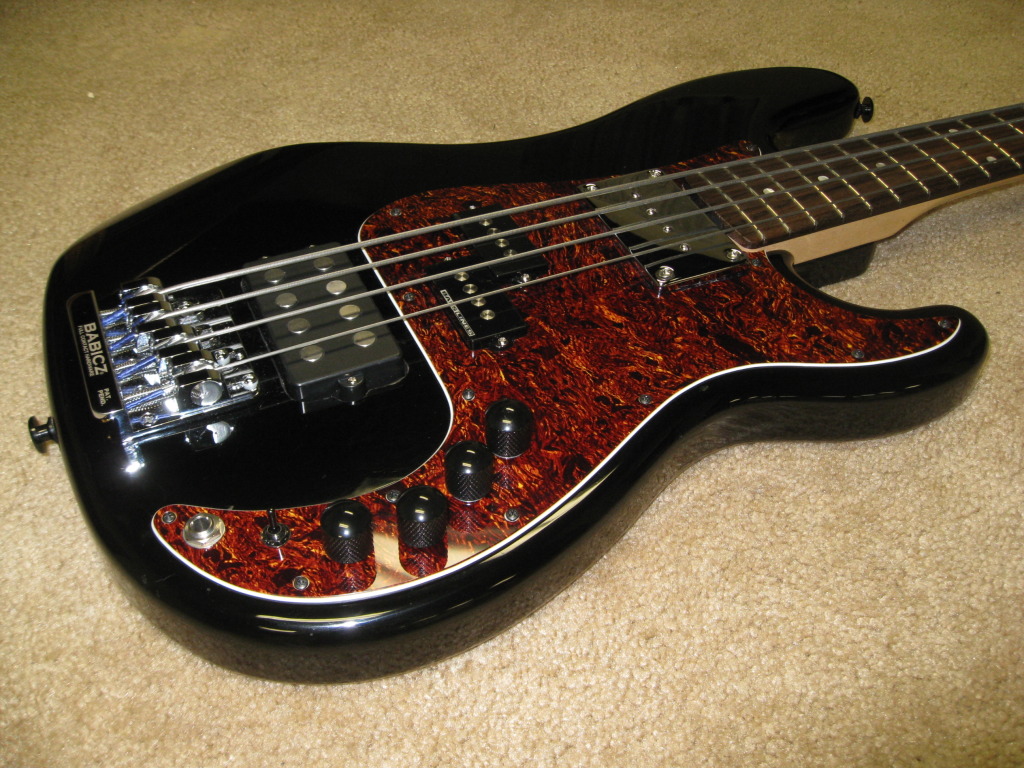
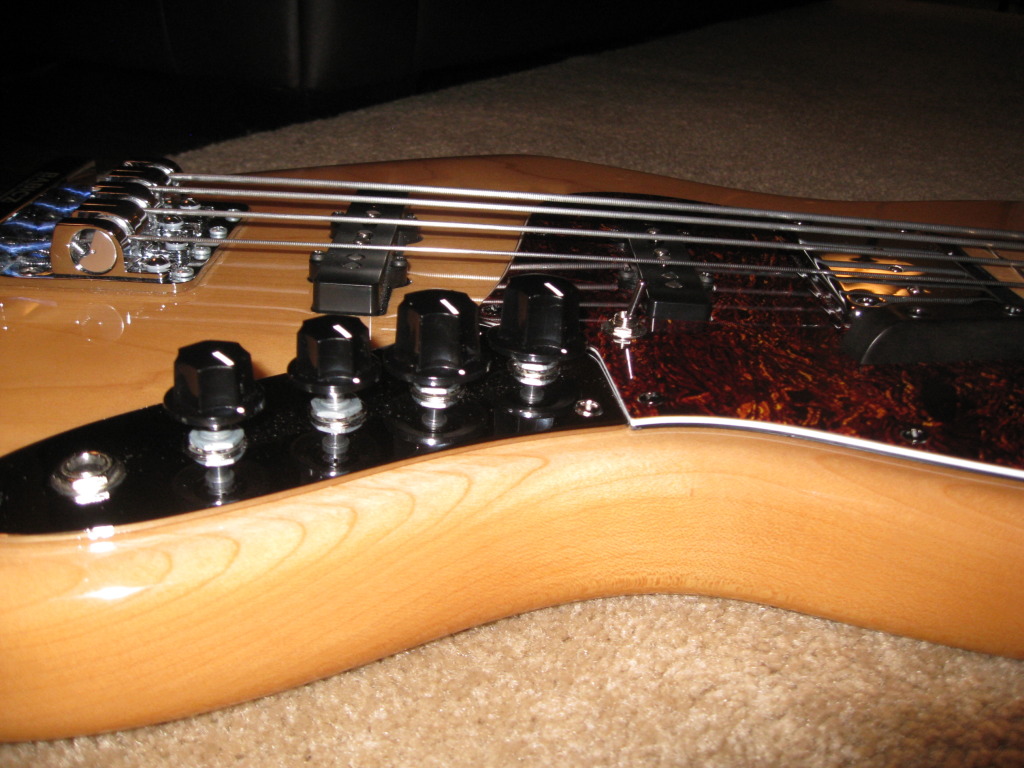
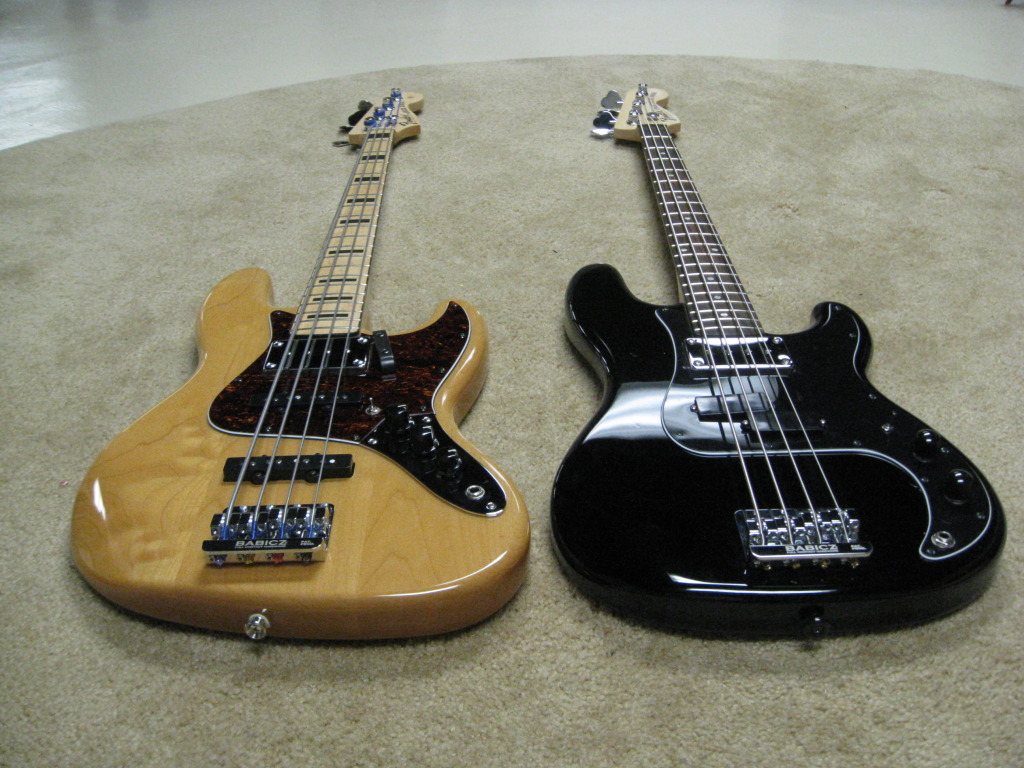
I have built three triples (pictured below). Two use a 3 way switch on the middle/neck volume with a separate volume for the bridge and master passive bass & treble controls.
The J bass also has a series-parallel switching for the two J pickups and phase reversal on the bridge (push-pulls). It pains me to admit, but it currently does not have series parallel switching within each of the split J pickups.
The Air Force Bass has on/off toggles and volume controls for each pickup along with master bass and treble. I like the VVV with three switch config best so far.
Next on the project list are to swap the bridge pickups in the P and the J. The J will get a double J quad coil (I plan to glue two Dimarzio Area J's together). The P will get an 8 wire quad coil MM in the bridge (probably Nordstrand).
Not sure about controls for the redone P and J yet. Would like to do the 10 option wiring thing on the quads which will probably require more routing and a bigger pickguard (to make room for rotary switch and/or 3 way toggle for each coil).
Am also thinking about a new build with three quad coil MM pickups - each with all 10 combos and maybe with 3 separate jacks plus option to route all 3 to a single jack.
Not sure about preamps. The AFB has a Bart TC-3 (boost only - no tone control). With three pickups you get so much tonal flexibility it almost seems unnecessary (did I really just say that).
Unnecessary complexity and overkill is a design objective for me most of the time, so preamps for all (eventually) with bypass switches of course.



Wow; very cool!
I GOT A ROUTER FOR X-MAS!!!!!
Ok, fellas, I just may be able to become an official member here of the ">2 Pickup Club"!
My wife picked out a Bosch 1617EVSPK router package that includes a plunge base and a fixed base, as well as a pretty nice hinged/latched case that holds everything!
I already have 2x4 chunks cut up to be used as practice pieces to learn how to cut out pickup cavities.
Rockin Bone!
The router is a 2/25-HP with both 1/4" and 1/2" collets. She did an excellent EXCELLENT job of selecting the router!
WAHOO DAMMIT! I was up most of the night think up new ways of using it. And what new deadly pickup combos I can use because my wife of 33 years has so well enabled me.
My mind is spinning with which fraught with danger pickup and control cavity insanity I can now employ. Hot dayum!
And now --- ve dahnce ..... shprockets ...

Ok, fellas, I just may be able to become an official member here of the ">2 Pickup Club"!
My wife picked out a Bosch 1617EVSPK router package that includes a plunge base and a fixed base, as well as a pretty nice hinged/latched case that holds everything!
I already have 2x4 chunks cut up to be used as practice pieces to learn how to cut out pickup cavities.
Rockin Bone!
The router is a 2/25-HP with both 1/4" and 1/2" collets. She did an excellent EXCELLENT job of selecting the router!
WAHOO DAMMIT! I was up most of the night think up new ways of using it. And what new deadly pickup combos I can use because my wife of 33 years has so well enabled me.
My mind is spinning with which fraught with danger pickup and control cavity insanity I can now employ. Hot dayum!
And now --- ve dahnce ..... shprockets ...


How well do the buck-standard Precision Bass type of pickups work on their own as a 2-pole pickup? Reason I ask is that I've been wondering about a setup like this ....
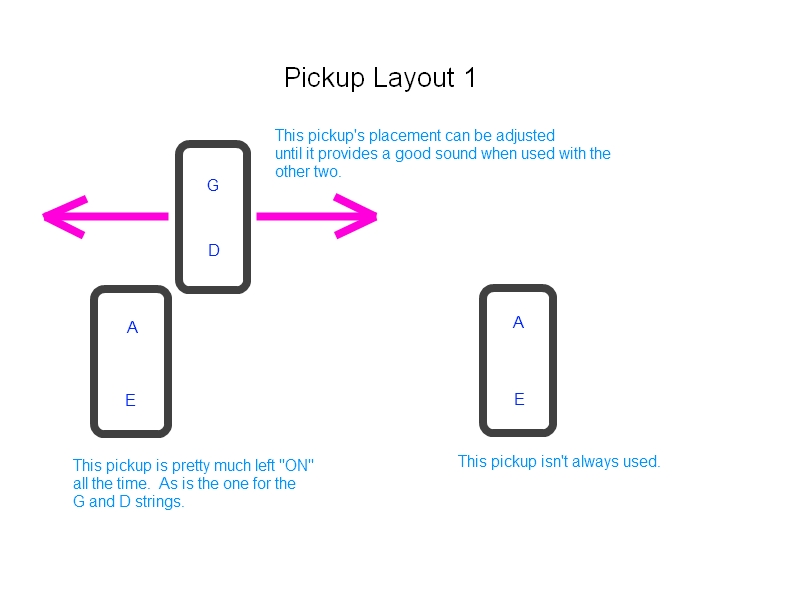
Treat each pickup as it's own entitity and wire each one to it's own set of controls and algorithm switches (various parallel/series arrangements).
The lone pickup on the right is in the bridge position btw. The D/G pickup would (obviously) be left ON all the time. And the arrows indicate moving the pickup in a permanent position, not to imply that it has some way of easily sliding it around (although I have toyed with that idea. I've seen that type of setup employed by several makers).

Treat each pickup as it's own entitity and wire each one to it's own set of controls and algorithm switches (various parallel/series arrangements).
The lone pickup on the right is in the bridge position btw. The D/G pickup would (obviously) be left ON all the time. And the arrows indicate moving the pickup in a permanent position, not to imply that it has some way of easily sliding it around (although I have toyed with that idea. I've seen that type of setup employed by several makers).
I say 4 because the piezo pickup act as a piezo sound AND a GK 13pin output pickupI guess you are counting the MM as two when you say 4??
Roland GK 13pin standard. It's one pickup per string that is processed individually in a GK processor. I use this for a VB99.Also, what praytell is that multipin jack - separate outs for each coil?? I have been thinking that on a multi rather than installing a bunch of 1/4 inch jacks, though that would look pretty cool.
A bicycle internal geared hub. Rohloff Speedhub , 14speeds.By the way, what is your Avatar, a transmission?
I'm a bike maniac trying to get help

In case others aren't aware, it's like fokof said about the peizo processor, in those Carvins that are so equipped the pcb in the bass have trimpots to adjust the volume of each pickup for each string......Also, what praytell is that multipin jack - separate outs for each coil?? I have been thinking that on a multi rather than installing a bunch of 1/4 inch jacks, though that would look pretty cool.
I had three of of Carvin basses that had the peizo option, and to be honest I wasn't very impressed. The sound wasn't something I was able to really do anything with. So while the individual outputs for each string are a mondo cooly idea, and the trimpots permitting volume control of each string, in actual execution I found that the tone wasn't really something I could work with at all. Very anemic and ~weak~ with little character and absolutely no balls whatsoever.
But that's my own opinion of my own experience .... others may have done better things with it than I did. I found that I never ..... I mean never ... used the peizo option. The idea is grand, the fabrication is grand, but the real life execution sounded like ass.

Steve, as far as multipin outs, you can go with the more robust 5-pin DIN ("midi") connectors ...
[Invalid or Expired Link Removed] ... ($0.53 each)
And a right-angle cord connector ...
[Invalid or Expired Link Removed] ... for $9.25 each.
I just rec'd a bunch of the Right Angle males, excellent quality and you can "clock" the 5-pin pattern to suit which direction you want the cable to point when it's plugged in. I also got in a hundred of the 5-pin females ... all good stuff! I'm impressed so far.
OR .. if 5 conductors isn't enough (that's 5+ground) go with the 7-pin DIN connector at $0.70 each ...
[Invalid or Expired Link Removed].
The thing with using 5-pin (opposed to 7-pin) is that any MIDI cable can be used and modified with the installation of the Right Angle connector. Obtaining a 7-pin cable might be tough in a rush. So you'd have to make up a spare one or three just to have in your ~box~. Well, come to think of it, it probably wouldn't hurt to have spares whether you have the 5-pin or 7-pin, y'know?
Then run the multi-conductor cable out to a splitter/breakout box that will allow you to install a buffer to prevent "true bypass tone suckage" due to capacitance issues of signal runs. You can then also send the various pickup signals to discrete processing.
(Speaking of which, keep an eye on my X-thread, I'm testing something you had asked me about
)
These Music Man Big Als are just Thuh Bawlz ... I always seem to miss out on things, I'm always so behind the curve ... friggin mushroom of a man. I love the odd shape and angular lines. The excessive control choices are attractive to me as well.


Please, can someone detail out the controls for me ... tell me the wuddup on them?
Please, can someone detail out the controls for me ... tell me the wuddup on them?
I didn't want to distract myself from what I'm doing outside of the bass by getting all into what's going on inside of the bass, but Steve's imagination has spured-on my own imagination. And since I got a friggin ROUTER for x-mas I'm now all about new ideas for the inside of my bass.
At this point I'm ready to shorten the thumbrest down to what I now know I need and begin some forward motion within the bass itself. I can tell the Marcus Miller pickguard will be a must-use piece.

That said, (Steve) you never did tell me what is up with the fiberglass piece inside of the pickguard on the AF bass. And also, talk about that Babicz bridge too, I see you tend to use them.

NOTE: I just caught the fact that I've been mispelling your company name ... I'll make efforts to get that right here forward. I'd guess it's something you've dealt with ever since you were tagged with that last name. My name is Brian, it's commonly mispelled as "Brain" by others my whole life. It's actually a nickname of mine by some folks ... "Brains" ... a sortof play on words and a shout-out to the character "Brains" from the 1960s marionation kids' show called The Thunderbirds.
Ramble ramble bla bla ramble.
At this point I'm ready to shorten the thumbrest down to what I now know I need and begin some forward motion within the bass itself. I can tell the Marcus Miller pickguard will be a must-use piece.
That said, (Steve) you never did tell me what is up with the fiberglass piece inside of the pickguard on the AF bass. And also, talk about that Babicz bridge too, I see you tend to use them.
NOTE: I just caught the fact that I've been mispelling your company name ... I'll make efforts to get that right here forward. I'd guess it's something you've dealt with ever since you were tagged with that last name. My name is Brian, it's commonly mispelled as "Brain" by others my whole life. It's actually a nickname of mine by some folks ... "Brains" ... a sortof play on words and a shout-out to the character "Brains" from the 1960s marionation kids' show called The Thunderbirds.
Ramble ramble bla bla ramble.
These Music Man Big Als are just Thuh Bawlz ... I always seem to miss out on things, I'm always so behind the curve ... friggin mushroom of a man. I love the odd shape and angular lines. The excessive control choices are attractive to me as well.


Please, can someone detail out the controls for me ... tell me the wuddup on them?
Really very simple and intuitive, the first three buttons from the neck to bridge are on/off for each pup while the last button is active (down) /passive (up), when all three buttons are up it gives you the bridge and middle pups in series
( active or passive) and the knob layout is: Volume, passive tone control and the stacked knobs are the pre amp :low mids / high mids and the last stack toward the bridge is bass and treble. Works great and passive tones are huge and bring MM's into P territory big time for the first time with their basses in passive. I don't know what took them so long as this set up is incredible.

Thanks for the tour! Wow ... dang .. whudda bass! WAY out of my pay scale, but still really bitchen! It has officially bumped the Warwick from my dreamer list. Y'know, if I ever won the lottery kinda thing. I suppose I could sell my modular synth ...Really very simple and intuitive, the first three buttons from the neck to bridge are on/off for each pup while the last button is active (down) /passive (up), when all three buttons are up it gives you the bridge and middle pups in series
( active or passive) and the knob layout is: Volume, passive tone control and the stacked knobs are the pre amp :low mids / high mids and the last stack toward the bridge is bass and treble. Works great and passive tones are huge and bring MM's into P territory big time for the first time with their basses in passive. I don't know what took them so long as this set up is incredible.
Oh HELLS no! That would be ten steps back and one step forward! Haha!
While I appreciate the ability to adjust each piezo saddle , I modified my Carvin to add that GK option with a Graphteck kit like these: http://www.graphtech.com/products.html?SubCategoryID=18In case others aren't aware, it's like fokof said about the peizo processor, in those Carvins that are so equipped the pcb in the bass have trimpots to adjust the volume of each pickup for each string.
It's not an output to be used like a standard pickup , I didn't add this to have an output for each string but for a Roland GK processor like these:
http://www.talkbass.com/forum/f36/roland-vbulletin-99-a-514232/
http://www.talkbass.com/forum/f36/roland-vbulletin-99-a-514232/
These only work with Roland's 13pin GK standard
(and there is no individual level adjustments)
You can see the thread I started on the VB99 here:
Invalid Link Removed
I always use the Piezo on my Carvin , sometimes I will put a 20% magnetic in the blend. It gives a very "personal" tone me thinks.I had three of of Carvin basses that had the peizo option, and to be honest I wasn't very impressed. The sound wasn't something I was able to really do anything with. So while the individual outputs for each string are a mondo cooly idea, and the trimpots permitting volume control of each string, in actual execution I found that the tone wasn't really something I could work with at all. Very anemic and ~weak~ with little character and absolutely no balls whatsoever.
An example of a Piezo sound:
(My Carvin has a tone very close to that)
I personaly think it sounds very nice.......
YMMV
Sadly that video refuses to load, I've tried a number of times today and it just won't work. Comes up with "There is a problem, try again later"......I always use the Piezo on my Carvin , sometimes I will put a 20% magnetic in the blend. It gives a very "personal" tone me thinks.
An example of a Piezo sound:
(My Carvin has a tone very close to that)
I personaly think it sounds very nice.......
YMMV
So perhaps another time.
I'm glad the Carvin piezo works out for you, I just couldn't make friends with it on any of the three LB Carvin basses I had. Maybe it was a different version, or perhaps I just didnt know what the heck I was doing (there is ALWAYS that possibility). In any case, it's a good thing that you make it work for you!

- Aug 21, 2008
- 10,386
- 252
- 68
- Disclosures
- Owner, SGD Music Products
David, what is the point of the stagger in a P pickup? Other things being equal, would a "big split" type pickup sound about the same?
I assume Leo did it that way originally because it was maybe cheaper and easier to make that way with no need to worry about signal loss at the edges of the middle strings.
Only Leo knows... but because the coils are very wide, you can't get them right next to each other inline.
I think another thing was that Seth Lover had gotten the patent for the Gibson humbucker, and in that patent was a split coil arrangement.
Leo also got a patent on the split coil pickup, but the patent was for the tonal effects of the off set coils, and not that it was a humbucker. I suspect he did this to get around Lover's patent, since the P pickup is indeed a humbucker.
But also, it was common to angle pickups to make the bass strings deeper and the treble strings brighter, as seen on the Strat and Tele bridge pickups. Ad again, I think they sound better reversed.
Nowadays I suspect its more about the classic look. Am I right? Of course the stagger would cause some slight differential in the tone of each pair of strings because of location (not a good thing IMO).
When I play a regular P, I can hear the change in tone from the bass to the treble pair of strings. But on a reverse P you don't really hear that shift.


