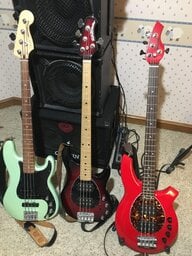
I have an Ibanez with two regular pickups and one piezo. Sorry, doesn't look as cool as the items here on display.

TalkBass has been independent since 1998. Add your voice.
Create a free account to reply to discussions, view embedded media, and browse with fewer display ads.
Join free Log in
Want zero display ads or expanded classifieds tools? Compare plans.


Very tempting. I might try that out eventually. Those are quite expensive switches, but they look solid.Freeway Switch, master volume, master tone.
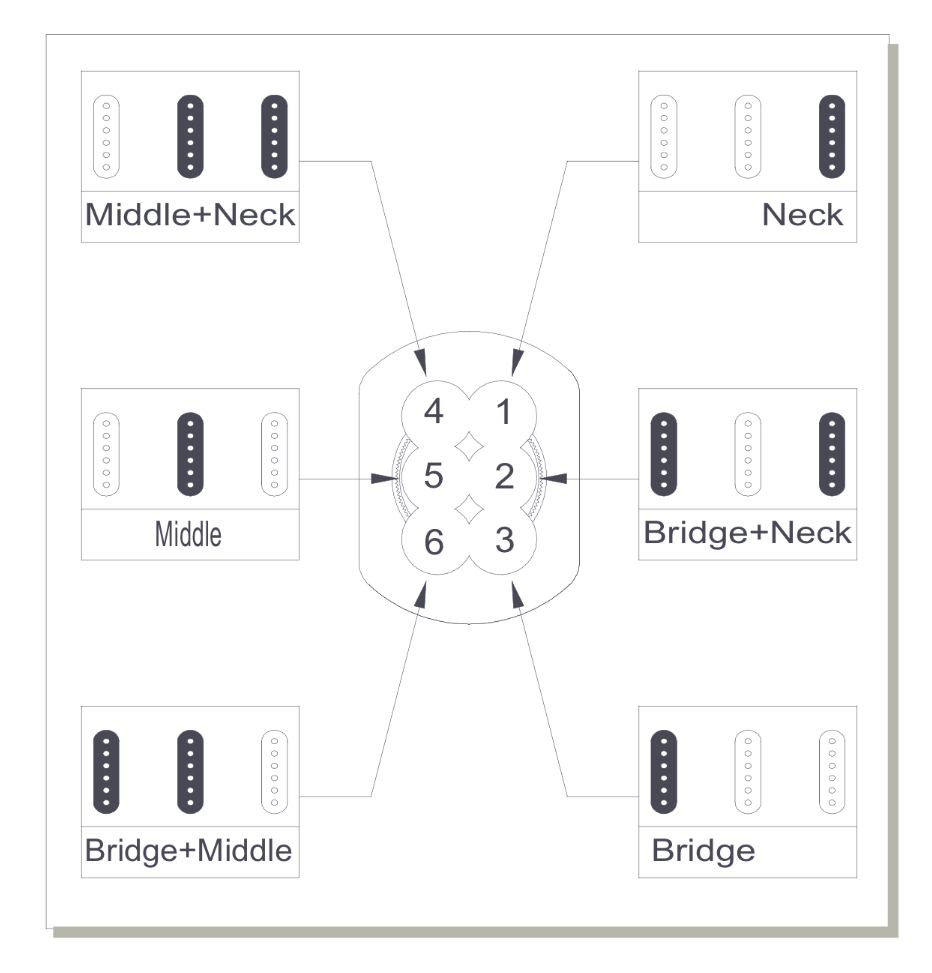


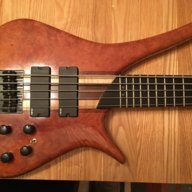
Definitely not 6 pickup. The definition of "a pickup" includes "must sense all strings". So a split-coil P pickup is a "pickup" singular, and not "pickups" plural.Is it a 2 pup, 3 pup, or 6 pup bass? The neck pup is dual coil, the bridge pup is quad coil. One volume for the neck, one for the bridge, but... The bridge coils can be ran in series or parallel, or you can shut half the pup down and run it as a single coil although that coil is still split and is really two coils. So the bass is basically 3 single coils that have all been split into 2 coils each.
View attachment 7360963

Like the "Wild Dog" select knob. How does it sound in comparison to your other 3 choices?'63 Burns of London Vista Sonic med-scale - quite possibly the first 3-pu bass
View attachment 7289546 View attachment 7289547
I was anticipating something interesting, but it turns out the way it's wired it sounds like an anemic chicken! That option is usually a 6-string guitar thing and is not really something useful on a bass. I reversed the ground wires (as shown below) and it sounded much better - like a good Jazz bass. So Wild Dog is the M&B pu's, Treble is the M-pu only, Bass is M&N-pu's, and Contrabass is only the neck-pu and very bassy.Like the "Wild Dog" select knob. How does it sound in comparison to your other 3 choices?
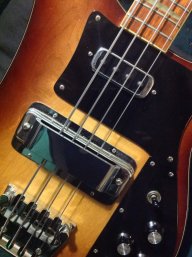
I was anticipating something interesting, but it turns out the way it's wired it sounds like an anemic chicken! That option is usually a 6-string guitar thing and is not really something useful on a bass. I reversed the ground wires (as shown below) and it sounded much better - like a good Jazz bass. So Wild Dog is the M&B pu's, Treble is the M-pu only, Bass is M&N-pu's, and Contrabass is only the neck-pu and very bassy.
View attachment 7367711


I followed @JIO ‘s instructions and made the same wire swap on mine, and it’s really hard to overstate the improvement. (I also took his suggestion and put D’Addario Chromes on, which were also a big improvement over the Rotosound TruBass strings, which I had only put on there because I had read somewhere that they were designed for the Burns Bison.)
When I met him, I asked Dave if he had played for Françoise Hardy but unfortunately, he had no memory of it.This 1967 song by Fraçoise Hardy has a similar sounding bass related to Dave Richmond but I do not know who it is.
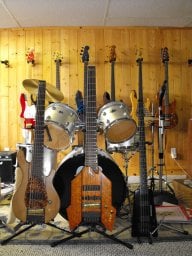

Here's some homemade 4 stringers. All have various switching options for combining coils and pickups.
View attachment 7417651
The bass on the left has 4 push-pull pots, from bridge to neck: Tone control with series-parallel for combining the neck pickup with the middle and bridge pickups, bridge volume with series-parallel for combining the bridge and middle pickups, middle volume with middle coils series-parallel, and neck volume with neck coils series-parallel.Would love to see the switching and EQ options on those basses!
Interesting combinations, they'd be fun to play with!The bass on the left has 4 push-pull pots, from bridge to neck: Tone control with series-parallel for combining the neck pickup with the middle and bridge pickups, bridge volume with series-parallel for combining the bridge and middle pickups, middle volume with middle coils series-parallel, and neck volume with neck coils series-parallel.
The Triple-P has 4 push-pull pots and 3 switches, from bridge to neck: Tone control with inline bridge cap (like a Rickenbacker), switch for middle pickup and neck pickup D-G coils swap (turns the middle pickup into a reverse-P and the neck pickup into an "extended-P"), bridge volume with bridge coils series-parallel, switch for combining the bridge and middle pickups in series-parallel, middle volume with middle coils series-parallel, switch for combining the neck pickup with the bridge and middle pickups in series-parallel.
The Jazz bass has 2 concentric and 1 push-pill pot and 2 switches, from bridge to neck: switch for combining the 2 bridge pickups in series-parallel, switch for combining the 2 neck pickups in series-parallel, tone control with series-parallel for combining the 2 bridge pickups with the 2 neck pickups, concentric volumes for 2 bridge pickups, and concentric volumes for 2 neck pickups. The 2 bridge pickups are opposite polarities and winds (RWRP) - same with the 2 neck pickups - so they hum-cancel when combined. Also, the 2 pickups in the standard jazz positions are RWRP - same with the 2 pickups in the positions closer to the neck than standard - so they also hum-cancel.
The Tele bass has 4 push-pull pots and 4 switches, from bridge to neck, top row: bridge volume with series-parallel for bridge pickup coils, switch for combining the bridge and neck pickups in series-parallel, middle volume with series-parallel for middle pickup coils, switch for combining the middle pickup with the bridge and neck pickups in series-parallel, and neck volume with series-parallel for neck pickup coils. Lower row is tone control with inline bridge cap, switch for bridge pickup coils select, and switch for neck pickup coils select. The bridge and neck pickups are aligned so the hum-cancelling single coil combos are the outer coils combined, and the inner coils combined.
All the volume controls are wired shunt-style, which allows for independent operation in both series and parallel modes. All tone controls use .047 microfarad caps, and the inline bridge caps are .0068 microfarads.
Sounds more complicated than it is, as I think the controls are laid out fairly intuitive. There are a lot of great tone combos available on these basses. And you can always just run 1 or 2 pickups at a time.

Absolutely brilliant! I'd love to take the 4 X single coil out for a spin!Here's some homemade 4 stringers. All have various switching options for combining coils and pickups.
View attachment 7417651