• TalkBass has been independent since 1998. Add your voice.
    Create a free account to reply to discussions, view embedded media, and browse with fewer display ads.
    Join freeLog in
    Want zero display ads or expanded classifieds tools? Compare plans.

Show Us Your Rob Allen Basses Part II

Status
Not open for further replies.
The VLE will probably do more cutting than any active treble control ... when rolled right back it starts to cut at 200-300 ... check the response curves in Invalid Link Removed.

Andy

The cool thing about the VLE is that it is a variable lo pass. So, it cuts the same amount at all levels of the control, but cuts different frequencies, gradually lower as you turn the knob. Pretty cool... turn it on a little, and it eliminates 10K or 8K... a little more, 7K or 5K... a little more, 4K or 1K... all the way down to the lower mids.

Wonderful control, and VERY different from a treble control, that varies the AMOUNT of cut, versus the frequency/fixed cut. Amazing little control!
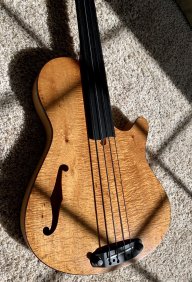
 
The VLE on the Markbass is very helpful in rounding out or taming some sizzle. I've quickly found that just turning down the pot on the MB-2 a little and then using the VLE to taste is producing an very nice full, round tone with a little bite when I need it.
 
What are you guys using for a DI etc? I've tried an MXR M80 and SansAmp BDDI and neither does the trick. I've got a DI on my amp but would like a separate box for when I don't need the amp. A little intrigued by the Fishman DI since it's for acoustic instruments and might accent the acoustic qualities of an RA.

Anyway, just curious what anyone is using.
 
I use a Paradriver. I dial a bit of bass down and mids up at about 350hz. Treble depends on the room and my ears that day. I'm playing a Deep 5 though, so I have onboard bass/treble. I tend to leave those flat though. I have the Paradriver at the end of my small pedal board so when I feed FOH it comes off that instead of out of my amp. I prefer that as some places provide a backline so I don't know what kind of DI signal will come out of those. Feeding from my pedalboard means I'll at least have control of the signal to that point.
 
After trying quite a few things with my Mouse (including the Fishman Platinum Pro but not the Paradriver), I really like the little buffer preamp that TBer FDECK makes for the Double Bass guys. It's cheap ($65 for the deluxe version) but very high quality. It is a simple plastic box with a variable high pass filter, a phase inverter switch and a volume control. There is no DI, but it works perfectly to tame the low end and work the gain down to match that of more conventional basses. The box is designed so it can be attached to the tailpiece of an upright bass, so it's a little strange to work with. However, by getting the gain staging and the low frequencies under control, I am finding the onboard treble control to be all the additional EQ I need. The Mouse into this little preamp plugs right into my Berg IP112 (no EQ on the Berg) and sounds amazing. The crispy highs that I have fought in the past are no longer a problem and the boomy low end is completely adjustable.
 
There is no DI, but it works perfectly to tame the low end and work the gain down to match that of more conventional basses.

Most of the time I am switching back and forth from my Mouse to an electric once or twice during a set. Until recently I was using a G&L L2000 with very hot passive output, and active boost if necessary, so there wasn't a big difference between the two. I just got a Lull PJ, which I intend on using as my #1 (with the Mouse) and there's a bigger difference in output. Would the FDECK be appropriate to tame the Mouse' output while maintaining the same "tone"?

Also, how do you have the treble roll-off set on the Fishman matrix?
 
Kai, there definitely is a fair output difference between the Mouse and the PJ. Two ways to go - pump up the PJ or dial down the Mouse. If you like the way that the Mouse interacts with your amp head (ie the input stage likes the level) then I'd think about pumping up the PJ. Something like the Paradriver actually can do either function. If you use it to dial back the Mouse you also gain some eq. You get the same benefit with the PJ as well. I also used a VT to pump up the PJ relative to the RA but that colors the tone more. Something like a Xotic BB pedal can be a little more transparent.
 
Would the FDECK be appropriate to tame the Mouse' output while maintaining the same "tone"?

Also, how do you have the treble roll-off set on the Fishman matrix?

Yes that is how I use it. IMO a High Pass filter is also key to the Mouse keeping it's woody tone while eliminating the boomy part of the signal. My Mouse is a little unusual in that I run TI flats instead of the LaBella tapes. So I have a bit less treble to start with than most. Even so, I keep the onboard control almost all the way down and the volume almost all the way up. I really think the sound of this bass is much more balanced with the onboard volume turned up.
 
Yes that is how I use it. IMO a High Pass filter is also key to the Mouse keeping it's woody tone while eliminating the boomy part of the signal. My Mouse is a little unusual in that I run TI flats instead of the LaBella tapes. So I have a bit less treble to start with than most. Even so, I keep the onboard control almost all the way down and the volume almost all the way up. I really think the sound of this bass is much more balanced with the onboard volume turned up.

+1 While I've never felt the need for a hi pass filter on most of my heads (since most are not overly extended down low in the first place), I do find that a slight cut on a nicely voicing shelving type bass control on an amp (i.e., 40hz or so), really 'unmasks' the beautiful midrange of these instruments.

To the OP, the treble trim pot depends a lot of the amplification system. If you are going to a large front of house systemt with upper treble extension, or use a 'modern' backline cab with a tweeter, you will probably have to dial that down a touch (on my fretless, with my modern cabs, I have it set at noon, on my fretted Mouse... all the way off). If you are primarily playing through a one way cab with no tweeter and gigging with only backline, you won't notice much impact.
 
Kai, there definitely is a fair output difference between the Mouse and the PJ. Two ways to go - pump up the PJ or dial down the Mouse. If you like the way that the Mouse interacts with your amp head (ie the input stage likes the level) then I'd think about pumping up the PJ. Something like the Paradriver actually can do either function. If you use it to dial back the Mouse you also gain some eq. You get the same benefit with the PJ as well. I also used a VT to pump up the PJ relative to the RA but that colors the tone more. Something like a Xotic BB pedal can be a little more transparent.

How transparent (or not) is the Paradriver. I'm really looking for something that retains Rob's great sound through my amp.
 
How transparent (or not) is the Paradriver. I'm really looking for something that retains Rob's great sound through my amp.

If the Paradriver is similar to the previous model (I think it was called the Bass Driver), it is very, very voiced. If it is the same basic design (looks like the same unit as the previous model), you must engage the 'speaker/tube' emulation control to use the EQ, and that control really impacts the tone.

Again, assuming the Para Driver works the same as the old Bass Driver and Acoustic Driver that I owned.

The RA's have very hot output, but the volume control on the RA's is very transparent (i.e., tone doesn't really change at different volume levels). So, very easy to just set the RA's output to match your magnetic pickup instrument.
 
If the Paradriver is similar to the previous model (I think it was called the Bass Driver), it is very, very voiced. If it is the same basic design (looks like the same unit as the previous model), you must engage the 'speaker/tube' emulation control to use the EQ, and that control really impacts the tone.

Again, assuming the Para Driver works the same as the old Bass Driver and Acoustic Driver that I owned.

The RA's have very hot output, but the volume control on the RA's is very transparent (i.e., tone doesn't really change at different volume levels). So, very easy to just set the RA's output to match your magnetic pickup instrument.

Actually that isn't quite correct. Maybe this is part of a redesign, but there is a small blend pot on the front that is a mix between the "sansamp sound" and just the eq/di. You can set that with zero sansamp effect and still get the benefit of the eq and gain. There is a little coloration, but no more than any typical eq. I usually dial in about 10% of the sansamp to get just a tad of color to the tone.
 
Actually that isn't quite correct. Maybe this is part of a redesign, but there is a small blend pot on the front that is a mix between the "sansamp sound" and just the eq/di. You can set that with zero sansamp effect and still get the benefit of the eq and gain. There is a little coloration, but no more than any typical eq. I usually dial in about 10% of the sansamp to get just a tad of color to the tone.

ah, that is a good thing then. A little of the sansamp emulation sounds good... I agree.
 
It actually ends up being a pretty versatile pedal. You get 3-band eq with sweepable mid, and you also can dial the sansamp vibe up and down with control over how much drive you want. So you can crank the drive but only dial in a bit of the sansamp, or crank in more sansamp at a lower drive, etc. While I don't like the overdrive sound as much as the VT Bass, you can get close if you want that, and the EQ is much more transparent and you have the DI built-in.
 
It actually ends up being a pretty versatile pedal. You get 3-band eq with sweepable mid, and you also can dial the sansamp vibe up and down with control over how much drive you want. So you can crank the drive but only dial in a bit of the sansamp, or crank in more sansamp at a lower drive, etc. While I don't like the overdrive sound as much as the VT Bass, you can get close if you want that, and the EQ is much more transparent and you have the DI built-in.

+1 I had the 'acoustic driver' for a while that I used as a buffer and tone control for an EUB I had that just had a raw piezo with no buffer (that is a wonderful thing that Rob includes that nice active buffer as part of his design).

It sounded very nice.
 
I use Sansamp Para quite a but (phantom powered from my AI Clarus). Dont dial much of the "sansamp" or "drive" function--just a little bit of flavor.

Wow, I just tried that. Didn't realize I could do that. Didn't really add anything for me that would justify having to lug another piece of gear around (I'm a Keep it Simple Stupid guy when it comes to gear on a gig). I have been playing with the notch filter on the Clarus though and that has promises.
 
Status
Not open for further replies.