• TalkBass has been independent since 1998. Add your voice.
    Create a free account to reply to discussions, view embedded media, and browse with fewer display ads.
    Join freeLog in
    Want zero display ads or expanded classifieds tools? Compare plans.

Show what your cabs look like on the inside

So, I'm a curious guy. I'm in to DIY, but wondering how "the pro's" do it. I think in many cases they cut corners for a fast cheap build, that you could do better yourself with some time and effort.

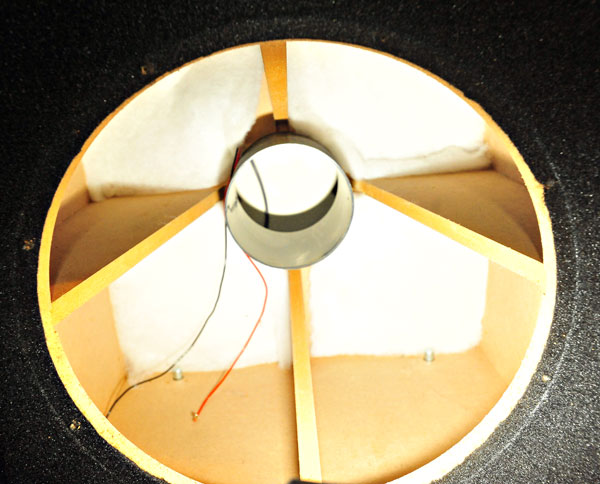
Anyway, I removed the grille and speaker from my Gallien Krueger Backline 1x15 and here's how it looked inside:
gkbacklineinside.jpg


Anyone else who has pictures of a cab "opened" or is curious to find out, please post pictures!

 
Here is an EV TL806 built by a local builder (who erred on the side of extra strength!)
P1010321.gif


a PV small pa cab called the column 210 I snagged at a garage sale
P1010076.gif


Same cab after/during I did a very low cost (but very worthwhile!) mod transforming it into a 110 bass cab.
P1010031.gif


I deleted the ampeg210, hartke(s), and schroeder(s). Very revealing. Some not flattering.
 
Anyway, I removed the grille and speaker from my Gallien Krueger Backline 1x15 and here's how it looked inside:
gkbacklineinside.jpg

What's the cylindrical thing? - a port?

Nice to actually see some bracing though! What's the material thickness and type on the four struts there? Could be densely airline drilled (see plan in my sig) without losing any essential rigidity. When I have some pics I'll get 'em here.
 
the point is that in a sealed cabinet the speaker will "see" the cab as being larger in volume then it really is, so you can get away with a smaller cabinet. this way you can effectively tune the cabinet to properly extract all the effiency out of your driver that you can.

Insulation if that is what is is however should never be used as if there is the slightest airleak in the cabinet it will force out minute particles that can harm your repitory system or irritate your skin and eyes.
 
Use mattress topper from Walmart to line your cabs. It is cheap, non-itchy, and works perfectly for the intended use.

The intended use is suppressing internal high frequencies that will radiate out ports, the driver vent, and the cone itself.

If you measure it as with/without lining, the resulting plot is quite revealing. The response without the lining is very ragged.

o15lb-2008.10.28-04T.jpg


This is an Omni15 Lowboy with mattress topper lining.
 
What's the cylindrical thing? - a port?

Nice to actually see some bracing though! What's the material thickness and type on the four struts there? Could be densely airline drilled (see plan in my sig) without losing any essential rigidity. When I have some pics I'll get 'em here.

Yep, it's a port. Big enough for my cat to crawl in :D The cabinet seems to be tuned to around 40 Hz. The bracing is the same material as the rest of the box, 19mm (3/4") MDF.