• TalkBass has been independent since 1998. Add your voice.
    Create a free account to reply to discussions, view embedded media, and browse with fewer display ads.
    Join freeLog in
    Want zero display ads or expanded classifieds tools? Compare plans.

SHOW YOUR DISTRESSED FINISHES!

Now you're barking up my tree! My first (very used) black '86 Kubicki Factor was owned in the days before easy pic-taking so I don't have documentation. It wasn't this worn but was very played (probably owned by a professional as these were expensive when there weren't a lot of expensive basses) I stripped the finish off eventually and it was a real chore. I considered it to be likened to a Mercedes paint-job! (from back then, not now as there isn't a difference anymore!)
Ok then,.. I'd show them all what I found about her at once :D

timthumb_003.jpg


timthumb_010.jpg


timthumb_008.jpg


timthumb_009.jpg


timthumb_007.jpg


timthumb_004.jpg


And...the bill, sir... :D

"Back in 2010 Mr.Kubicki went over this bass very thoroughly to make it 100% “right ” . Please see the pic of the receipt listing this work."

timthumb_005.jpg
 
Last edited:
Do you remember the first year or two of those???? Man, the first EPA friendly stuff would check SO bad and lot of times, curl up like the desert floor along all the check lines??? I had a red trans that checked bad, didnt curl though, and a black Strat that did both...A LOT, and got milky white along the curled up check lines too.

Only know by ones I've seen in person and pics on-line. (as on this thread) I always wondered if where they 'lived' had influence - like were they mostly in a hot/cold environment as heat and cold has affect on thick coatings. All coatings are elastic to one degree or another, so the thinner the coating the less tectonic shifts occur as it moves. The already thin nitro finishes from the 50's-60's got thinner over the decades adding to their fragility. The coating 'shrinks'.

Optimally the varnish used on violin/cello/double basses is only there to seal and protect the wood and their formulas were very coveted secrets. Much debate goes into solid body basses concerning the tone potential of one slab of wood over another. It's far less critical than for an acoustic instrument, but can not be discounted - the wood (what type, density, age/dryness, overall form/shape/thickness, chambering, layering AND coating) makes a tone difference. So these very hard very thick finishes are like putting a coating like that on strings - I've never done it but I'm quite certain it will deaden the potential of the strings. Everyone and their brother stripped their finishes off in the late 60's/early 70's. (including me on my 3 yrs old EB-3) Part of that was the 'return to nature' (natural wood) mentality of that era, but it was also to free the wood for maximum tone potential. So there's 2 camps - those who want their flawless perfect new finish to last forever and those who realize that the 'perfection' they seek is in the tone dept, not the cosmetic dept. Every super distressed bass over these pages was very played meaning it sounded great and got better over the years because it was played a lot. Seems like a safe bet anyway.
 
Last edited:
  • Like
Reactions: God's Favorite Bass
Ok then,.. I'd show them all what I found about her at once :D

View attachment 545872

View attachment 545869

View attachment 545870


View attachment 545874

View attachment 545871

View attachment 545875


And...the bill, sir... :D

"Back in 2010 Mr.Kubicki went over this bass very thoroughly to make it 100% “right ” . Please see the pic of the receipt listing this work."

View attachment 545873

What a bargain to get his awesome bass back up to snuff! - I have my own hand written receipts/correspondence from Phil as I had a few Factors and he did work on them over the years. I first sent him my beat-up black one to work on and he called and asked if I wanted him to fill the fingernail gouge at the neck pu. Even back then, I liked the 'mojo' associated and said, no thanks Mr Kubicki, to which he added "if only he would have trimmed his fingernails - it wouldn't have happened" It made me smile because this was his baby! ;)
 
  • Like
Reactions: bluesdogblues
Only know by ones I've seen in person and pics on-line. (as on this thread) I always wondered if where they 'lived' had influence - like were they mostly in a hot/cold environment as heat and cold has affect on thick coatings. All coatings are elastic to one degree or another, so the thinner the coating the less tectonic shifts occur as it moves. The already thin nitro finishes from the 50's-60's got thinner over the decades adding to their fragility. The coating 'shrinks'.

Optimally the varnish used on violin/cello/double basses is only there to seal and protect the wood and their formulas were very coveted secrets. Much debate goes into solid body basses concerning the tone potential of one slab of wood over another. It's far less critical than for an acoustic instrument, but can not be discounted - the wood (what type, density, age/dryness, overall form/shape/thickness, chambering, layering AND coating) makes a tone difference. So these very hard very thick finishes are like putting a coating like that on strings - I've never done it but I'm quite certain it will deaden the potential of the strings. Everyone and their brother stripped their finishes off in the late 60's/early 70's. (including me on my 3 yrs old EB-3) Part of that was the 'return to nature' (natural wood) mentality of that era, but it was also to free the wood for maximum tone potential. So there's 2 camps - those who want their flawless perfect new finish to last forever and those who realize that the 'perfection' they seek is in the tone dept, not the cosmetic dept. Every super distressed bass over these pages was very played meaning it sounded great and got better over the years because it was played a lot. Seems like a safe bet anyway.

Yes, I am in the thin-is-in camp as well. A lot of the refinishing I've done over the years for myself and others has always been acrylic lacquer, which seems to be the best of both worlds. You get the same thin coating but it doesn't check like nitro and ages well but will still develop a road worn patina over time. Although there is something attractive about checking on some things like the music man above, but it wasn't so with the early EPA friendly polys lol.
 
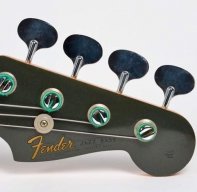
As for a while, the headstock a were painted in a nitro clearcoat. That's why they're more amberized.

It's very possible the necks were done in poly and after the sanding/buffing was done they applied the decal and shot a thin coat of nitro w/little need for further dressing. I don't know this as a fact but it would explain the discrepancy you pointed out. I've seen some with very dark amber faces and the maple on the neck & back/sides of the hs are very pale.
 
As far as I know, fender still shot just the faces of the headstocks (only) with nitro thru the 70s. I'm trying to find where I got this info from, but not sure at the moment. Just something buried in the cobwebs of my brain. But since you guys mentioned it, I figured I'd add in that I've heard this at least a few times.

Also, about half of the custom colors Fender offered in the 60s were acrylic, but the clear was always nitro (but not all colors got a clear coat always, so some custom color 60s Fender bodies were all acrylic).

I've never heard that the "thick skin" poly finishes of the 70s got a nitro clear, but it's possible. I've had some really heavily checked 70s Fenders.
 
As far as I know, fender still shot just the faces of the headstocks (only) with nitro thru the 70s. I'm trying to find where I got this info from, but not sure at the moment. Just something buried in the cobwebs of my brain. But since you guys mentioned it, I figured I'd add in that I've heard this at least a few times.

Also, about half of the custom colors Fender offered in the 60s were acrylic, but the clear was always nitro (but not all colors got a clear coat always, so some custom color 60s Fender bodies were all acrylic).

I've never heard that the "thick skin" poly finishes of the 70s got a nitro clear, but it's possible. I've had some really heavily checked 70s Fenders.

Thanks for weighing in w/your knowledge Brian - but isn't it possible (thin nitro on the hs face over the decal) considering how night-&-day the amber/pale difference is? Have you ever read a Fender-authorized explanation for that discrepancy?
 
Squier

Hiya, i got a vintage modified with added classic vibe neck, and pup´s.

changed the bridge to a Fender American Deluxe Bass Bridge, changed the controle plate, knobs, and did a road worn finish to the body.

[Invalid or Expired Link Removed]

[Invalid or Expired Link Removed]

[Invalid or Expired Link Removed]

[Invalid or Expired Link Removed]


[Invalid or Expired Link Removed]

[Invalid or Expired Link Removed]

[Invalid or Expired Link Removed]

[Invalid or Expired Link Removed]

[Invalid or Expired Link Removed]


proxy.php?image=http%3A%2F%2Fmembers.chello.at%2Fgrand-royal%2Fverkleinert%2F2.png


proxy.php?image=http%3A%2F%2Fmembers.chello.at%2Fgrand-royal%2Fverkleinert%2F6.png


proxy.php?image=http%3A%2F%2Fmembers.chello.at%2Fgrand-royal%2Fverkleinert%2F7.png


proxy.php?image=http%3A%2F%2Fmembers.chello.at%2Fgrand-royal%2Fverkleinert%2F12.png


Nice Relicing job
 
  • Like
Reactions: JIO
Thanks for weighing in w/your knowledge Brian - but isn't it possible (thin nitro on the hs face over the decal) considering how night-&-day the amber/pale difference is? Have you ever read a Fender-authorized explanation for that discrepancy?

It's definitely possible, I'd say almost surely. I just can't remember where I've gotten that info from in the past. It's definitely a thinner, flakier, and darker finish on the front of the HS compared to the rest of the neck (or the body for that matter). I would be really surprised if it wasn't nitro over the decals... I mean, what else could it be? I've even had late '70s necks that were as thick and pale as ever, except the HS finish is flaking off!
 
By special request from our OP, I'm going to share some pictures of Zelda, a Mocha 1974 Jazz. I'll also include peeks at JoJo, a 1965 refin Precision with super sweet neck wear, and Carly, a late 70's fretless P that survived an attempted murder.

Here's Zelda. We've been together since 1984. She came with the buckle rash and the pick gouge above the E string. The rest was me.

IMG_8301_zps7301aea5.jpg


BassesII005_zps8ae7c736.jpg


Next, here is JoJo's neck. I got her with an LPB refin that I'd like to replace someday.

IMG_6256_zps8c86b59a.gif


As for Carly, here she is. Pretty girl, looks fine, right?

IMG_8556_zps3a14b4cb.gif


Well, "distressed" doesn't even begin to describe it.

IMG_8563_zps772c82a6.gif


She's never told me what happened, and I've never asked. In spite of this, or maybe because of it, she sings like an angel. Gorgeous, classic, P-bass tone; think Carol Kaye with a pick playing fretless.

IMG_8582_zps4431d29c.gif