• TalkBass has been independent since 1998. Add your voice.
    Create a free account to reply to discussions, view embedded media, and browse with fewer display ads.
    Join freeLog in
    Want zero display ads or expanded classifieds tools? Compare plans.

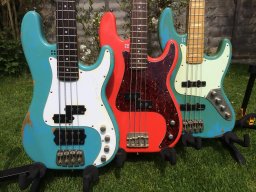
SHOW YOUR DISTRESSED FINISHES!

1984 fullerton '57 Reissue, lots more wear where that came from just dont wanna spam the thread to much:)
View attachment 686555

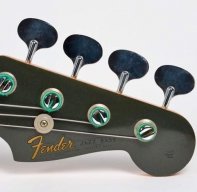
Nice - the Fenders that launched the retro movement. I notice it has the fine-thread vintage RI tuners. When I acquired my '66 P I replaced the orig fewer threads tuners with a relic'd set of the fine-thread RI tuners. (saving the originals in a nice safe place of course) A better functional design for more nuanced tuning. Like the lollypop tuners, Fender never did an authentic RI of the fewer threads tuners. (at least none that I'm aware of)

IMG_6237_zpszy2o2ofg.jpg
 
That checking is very nice. Fender I dont think ever made the divots for the tuners deep enough on reissues so the tuners would sit with a little gap on the back of them, maybe they have corrected that by now but shown here is very little of divots compare to yours'.

View attachment 686577

Yah, those double impressions are from force-fitting tuners with tabs into the wood. I always drill a countersink when I install vintage-type Fender tuners. Maybe FCS owners could confirm if their RI's have the more authentic countersunk divots. Seems like details that are easy enough to replicate - makes one wonder if it's deliberate so as to keep someone from attempting to pass it off as original vintage. The non-authentic tuners are more understandable as it would cost a lot to re-tool for a niche retro market.
 
Here's another interesting little detail. These are the relic'd Fender RI tuners I replaced the originals with. Notice the small scallop on the lower side/corner of the plates. (compare to my 66's - scallop not present) Also, the hole position is ever so slightly off, so that I could only install 3 of the 4 screws in the existing holes. I just left it out so as not to mare the original's hole pattern - and functionally it doesn't matter.

IMG_6786_zpsmmkj0kco.jpg
 
  • Like
Reactions: BassGreaser and ICM
Yah, those double impressions are from force-fitting tuners with tabs into the wood. I always drill a countersink when I install vintage-type Fender tuners. Maybe FCS owners could confirm if their RI's have the more authentic countersunk divots. Seems like details that are easy enough to replicate - makes one wonder if it's deliberate so as to keep someone from attempting to pass it off as original vintage. The non-authentic tuners are more understandable as it would cost a lot to re-tool for a niche retro market.


I know my 2000 '57 USA RI P has counter sunk holes in the headstock, there not like your's though they have 2 smaller divots.

Here are my 1984's tuners in full view, I think these older reissues were nickel platted unlike modern ones that are chrome platted, thus they have gotten that patina gray look newer ones never seem to match. Its weird that every reissue they cant ever get all the details correct in 1 year but as you said maybe its to deter counterfits, much like how the roadworns are stamped roadworn or custom shops.

here 122.jpg
 
Fender didn't start drilling the countersink divots in the headstocks until 1964. The reverse Kluson tuners did not sit flat on Jazzes or Ps before '64, so it's actually a period correct feature on the reissues.

Those little "scallops" can be found on the real vintage Klusons too, but not always. Sometimes they were machined off (most likely when they were doing the final clean-up grinding/polishing while the tuners were being made). I've had/have real ones that had them very pronounced, some that had no scallops, and some that were in between with just little "nubs". Sometimes they'll even have a top scallop, but no bottom one.

On a side note, the later '60s/early '70s tuners base plates are not always shaped indentically either.. I've had some that were ground down a bit more and there will be small gaps between the plates, others that butt up right against eachother tightly, and some that were rounded on the edges more than others. Ahh, the good ol days when people still worked with their hands.. not just machines cranking them out. :)
 
Fender didn't start drilling the countersink divots in the headstocks until 1964. The reverse Kluson tuners did not sit flat on Jazzes or Ps before '64, so it's actually a period correct feature on the reissues.

Those little "scallops" can be found on the real vintage Klusons too, but not always. Sometimes they were machined off (most likely when they were doing the final clean-up grinding/polishing while the tuners were being made). I've had/have real ones that had them very pronounced, some that had no scallops, and some that were in between with just little "nubs". Sometimes they'll even have a top scallop, but no bottom one.

On a side note, the later '60s/early '70s tuners base plates are not always shaped indentically either.. I've had some that were ground down a bit more and there will be small gaps between the plates, others that butt up right against eachother tightly, and some that were rounded on the edges more than others. Ahh, the good ol days when people still worked with their hands.. not just machines cranking them out. :)

All very good info Brian - yes, real handworked products and nobody buying/playing those instruments back then really cared about such details! :laugh:
 
Last edited:
A lovely road-warrior '63 J with many pics on Reverb which can't be dislodged - so if interested you can view though the link. The deep gouge above the pg reminds my of my '66 P - owner also engraved his name on the neck plate. A google search lead to his recent obituary. With all due respects - the man behind the bass being offered for sale.

Kenneth “Kain” Palermo, age 73, of Cottonwood Falls, KS, died Saturday, March 28, 2015, at his home in Cottonwood Falls.The son of Ernie and Susan (Kramer) Palermo, he was born December 11, 1941, in Chicago, IL.He graduated from Linden High School in Chicago.He and Jeanette Grevich were married February 14, 1969, in Chicago.

Kain’s first job was with the Chicago Gas Co. as a driller.He was a musician, truck driver, and home restorer.He was an electric bass studio musician who played both a 4- and 5- string bass guitar.He had several groups of his own and was associated with Ronnie Dio, The Door’s, and Richie Blackmore Rainbow groups in Los Angeles, CA.In New York, he played with Atlanta Georgia Jazz and George Sessum.

just found a pic I could capture on another site - here's the gouge I mentioned
11351818_1474472412870830_1159578907_n.jpg


Fender Jazz Bass 1963 Sunburst | Reverb
 
Last edited:
A lovely road-warrior '63 J with many pics on Reverb which can't be dislodged - so if interested you can view though the link. The deep gouge above the pg reminds my of my '66 P - owner also engraved his name on the neck plate. A google search lead to his recent obituary. With all due respects - the man behind the bass being offered for sale.

Kenneth “Kain” Palermo, age 73, of Cottonwood Falls, KS, died Saturday, March 28, 2015, at his home in Cottonwood Falls.The son of Ernie and Susan (Kramer) Palermo, he was born December 11, 1941, in Chicago, IL.He graduated from Linden High School in Chicago.He and Jeanette Grevich were married February 14, 1969, in Chicago.

Kain’s first job was with the Chicago Gas Co. as a driller.He was a musician, truck driver, and home restorer.He was an electric bass studio musician who played both a 4- and 5- string bass guitar.He had several groups of his own and was associated with Ronnie Dio, The Door’s, and Richie Blackmore Rainbow groups in Los Angeles, CA.In New York, he played with Atlanta Georgia Jazz and George Sessum.

just found a pic I could capture on another site - here's the gouge I mentioned
11351818_1474472412870830_1159578907_n.jpg


Fender Jazz Bass 1963 Sunburst | Reverb

Holy crap, did he have a hook for a hand or something too? How does someone wear that much wood away, even with 51 years of play?
 
  • Like
Reactions: JIO
Here is my Sandberg, it looks even better than in the pics. I know it's not an original Fender but it ticks all ththe boxes for me.
image.jpg1_zps1jam1eji.jpg

image.jpg2_zpstl2pbiyd.jpg

Yes, Sandberg does very respectable relicing and they produce a nice product all around - your bass is a beaut! :thumbsup:
 
  • Like
Reactions: DJ '65
I can't show this one off enough.
Class_0013.jpg

Class_0010.jpg

Class_0009.jpg

However here's a couple more...
IMG_20150914_195148.jpg

92_1.jpg

93_1.jpg

The Jag belongs to a friend and actually got a pretty nasty ding right where his arm would set so we opted to sand and polish it out. It's kinda funny that it's something people might look at and associate with "fake ware" but in this case it's actually there for a very good reason.
The CAR p bass is a Hondo I got for a whopping $35, put a few parts on it, played it, sold it. It had some interesting wear on it though.

I got to look through my hard drives and see what else I can find, unfortunately in a lot of photos the wear just doesn't show but I'm sure I've got some goodies floating about.
 
  • Like
Reactions: JIO
This is a fun one, I found this scattered all about the road walking to get coffee at five in the morning some years ago.
View attachment 717409

It'd be cool to assemble it to be playable but look just like that. However.., it wouldn't be the most comfortable guitar to actually play. :rolleyes: