• TalkBass has been independent since 1998. Add your voice.
    Create a free account to reply to discussions, view embedded media, and browse with fewer display ads.
    Join freeLog in
    Want zero display ads or expanded classifieds tools? Compare plans.

SHOW YOUR DISTRESSED FINISHES!

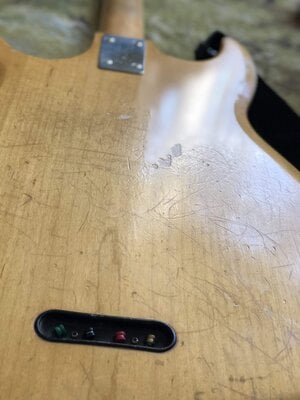
I palm mute a lot - which has my right hand resting over the bridge while picking. I also favor plucking and picking over the bridge pu in general. No mystery how wear can occur down there. Not the first time I've seen that kind of wear in that location. It's the cool thing about individual style - it can be all over the map.
Ah, okay. I never palm mute, and generally play more towards the middle of the body or the neck when playing with a pick.
 
  • Like
Reactions: JIO
OK, I'm way over due to get in on this thread... Some awesome mojo floating around! Here's my '76 Grabber.
It was built on April 2nd 1976; 12 years later on the same say I was born. not quite a birth year, but pretty cool!

All original except for added Dunlop strap locks and strings. Missing bridge cover when I had this shipped from Germany in mint condition 16 years ago. I can count on one hand how many shows this one has missed. Even Blue is a fan.
IMG_5093.jpg

IMG_2342.JPG IMG_5085.JPG IMG_5086.JPG IMG_5087.jpg IMG_5088.JPG IMG_5090.jpg IMG_5093.jpg IMG_5095.jpg
 
OK, I'm way over due to get in on this thread... Some awesome mojo floating around! Here's my '76 Grabber.
It was built on April 2nd 1976; 12 years later on the same say I was born. not quite a birth year, but pretty cool!

All original except for added Dunlop strap locks and strings. Missing bridge cover when I had this shipped from Germany in mint condition 16 years ago. I can count on one hand how many shows this one has missed. Even Blue is a fan. View attachment 3015227
View attachment 3015221 View attachment 3015222 View attachment 3015223 View attachment 3015224 View attachment 3015225 View attachment 3015226 View attachment 3015227 View attachment 3015228

A couple of old friends! :) Thanks for posting! :thumbsup:
 
Posted this (my '66 P) on another thread so thought I would post it here also, primarily to show the chequing. I installed relic'd Fender RI reverse-wind tuners on it because they have more worm-gear threads for more nuanced tuning as the bass is a player. The originals are securely stored. These have a slightly different hole pattern (and that little cut-in at the bottom edges) so I left off one screw as to not distort the original holes.

fullsizeoutput_f84.jpeg


Stock Custom Shop Relic JB Electric Bass Guitar Eged Bass Guitar Sunburst 6651582087220 | eBay
So I'm posting this for a couple of reasons. Here is an example of an attempt at a "distressed" finish. (MIC) It in no way looks real/authentic by any stretch of the imagination. An obvious scraping tool was used to cross-hatch marks on it in area's prescribed by "scratch here" orders. So to be fair, I'll offer the good and bad aspects as an objective critique.
First the bad; as noted, nowhere near accomplishing a facsimile of the intended 'look'. Pretty much anyone could do this exact thing to their new bass and it would look pretty much the same. (not good) The orders from above were most likely; "those who play this type of bass like when it is scratched-up - so scratch it in these places and it will sell".
The good; I'm being generous here, but what I actually like about this attempt at 'distressing' is the way the marks are done. Each bass was individually 'marked' in an individual 'style' of marking - by an individual. Like handwriting and to an elevated degree, drawing - each person has a unique way of making their marks. So it would be interesting to see a number of these done in that shop by different workers with the same orders to mark that bass in these places. As much as each individual would strive to make them 'the same' - each and every one would be different/unique and each one would show how that worker's mark subtly showed how that person's mark was different from another's mark. Fenders Road Worn basses are done by some sort of machine process. Two next to each other are nearly identical. Of course, this is more efficient and cost saving for Fender. The MIC version - cheap labor = individual hand-work. Sort of ironic right? Only a FCS bass would get that kind of treatment (one-off hand-detailing), but of course with a high level of skill.

And finally, one other note/observation/rant - this bass costs $325.89 shipped. It looks like a Fender Jazz bass. The same company has many other basses posted that look like EBMM Bongo basses, Dan Armstrong Lucite basses, Hofner basses - etc. 'Look like' is only the start - they also have those labels on them. The Bongo even has Ernie Ball Music Man printed material on the hs back - pretty much lifted from an actual EBMM Bongo hs. You could buy that bass and anyone looking at it would assume it is a EBMM Bongo. (for $325.89) Curiously enough, they do not show the front of the hs, and a couple (like this Fender J copy) do not show the hs at all, probably because it has the registered Fender shape and badging. I know there are a lot of rants about this on tb - but I just want to weigh in with my own personal take on this; it's criminal and it should be prevented for all the obvious reasons. And furthermore, those discounting the obvious criminality of producing/selling these POC instruments because "they're cheap and I have a right to pay my good money for it" obviously are not being effected by this kind of thing in their own businesses, and if they were they would understand why it is bad. I could go on but when I run across this it just reminds are of how far off track the world has become - in the name of "cheap" products. It's not only garbage - it's criminal.
 
Last edited:
As an eBay Associate, TalkBass may earn a commission from qualifying purchases.
I tend to agree with most of that. I think that the neck plate “F” logo and the absence of headstock pics/info should qualify this as counterfeit...or shady at the very least.
What stands out to me is the accuracy of the burst. The overall color/tone looks pretty legit.
View attachment 3016140

That's awful looking.. First time I've ever said a 'burst looks better without any mojo/relic'ing!
 
  • Like
Reactions: Axstar and JIO
I tend to agree with most of that. I think that the neck plate “F” logo and the absence of headstock pics/info should qualify this as counterfeit...or shady at the very least.
What stands out to me is the accuracy of the burst. The overall color/tone looks pretty legit.
View attachment 3016140

That's awful looking.. First time I've ever said a 'burst looks better without any mojo/relic'ing!

scrape - scrape - scape - scape - scrape ... I can imagine it gets pretty hypnotic after a while. Think about it, all day long scraping paint off of basses.
 
  • Like
Reactions: Axstar
image.jpeg


Here's mine #7 I think, could be #8. I rarely remember to photograph them before selling. BTW- All mine have replica permanently marked in the neck pocket, control cavity, and neck heel. I could spot it as a replica from miles away, but everybody asks at every guitar show 'What year?'

View attachment 2982672 View attachment 2982671 View attachment 2982670


This bass, although a relic, reminds of the typical fenders I would see for sale at San Francisco Pawn in Vancouver's skid row in the '70s. They would be about $150 then. Basses that were played every night, abused, partied with and simply gig worn. But the real thing, not relic'd. They would get traded in for a dif model, pawned after being stolen, or pawned so the owner could pay rent or buy drugs.

Bought a few cool things from that shop, as every gigging bassist and guitarist did here.
 
Last edited:
  • Like
Reactions: GreaserMatt and JIO
That's a beauty and great tort! Is it possible the body is older than '71? I thought Fender had switched to poly finishes by the 70's.
I had my Luthier remove the neck - I actually only sighted the neck date stamp, where as he saw both. My understanding is it is all 1971.

Also, it is an A profile neck, so it's a Jazz width nut. It's great to play.
 
That's a beauty and great tort! Is it possible the body is older than '71? I thought Fender had switched to poly finishes by the 70's.

I had my Luthier remove the neck - I actually only sighted the neck date stamp, where as he saw both. My understanding is it is all 1971.

Here's something I found that "clears" up all the debate about what Fender did or didn't do in the finish dept. Your bass is a good example of what is "covered" (sorry, I can't help but inadvertently pun!) in this article - especially looking at the back of your bass shot.

Fenders Dirty Little Secret - by Jim Cara,, Cara Guitars - USA's Original Hot Rod Guitar Shop
The Plastic Coating of Guitars since 1963

Fact:
All Fender Guitars made since 1963 are Polyester coated. Lacquer is put on top of the poly to satisfy the general publics belief that Nitro Cellulose (nitro) Lacquer finished guitars "breathe", "dry" and generally have become the bottom line for creating great tome. I'm talking USA, Vintage collectable instruments that the general public has bought, traded, and sold for over 50 years. They came from the Fender factory with a hard plastic jacket underneath it. a suffocating wolf, masquerading under a cloak of Lacquer Fender later switched to 100% Poly and UltraViolet cured resin on Squire, Mexican, Japanese, some USA and all other imports till this day.

Fact:
The two-part catalyzed coating named "Fullerplast" (Fuller for Fuller O'Brien, the products creator, and plast for the obvious PLASTIC"), solved all of Fenders finishing problems; encasing the deep wood pores in a self-hardening plastic that wrapped the body in a rock-hard solid coffin. In some cases we have found it to be as thick as a.060 string. Yes, all of the wood moisture and characteristics are sealed in a virtual time-capsule, only to be vented from the body through screw holes and paint fractures. Share this info and be the hit of your next guitar gathering!

Fact:
Fender rarely mentions Fullerplast, or the way it prepares its bodies before applying Lacquer. If they mention it at all
So, when someone tells you that a Fender "nitro-cellulose" or "nitro" finished guitar will sound better, have more warmth, or will dry out... they really don't have the full story.

Ask any seasoned guitar craftsman what happens when you will apply paint stripper to a Fender "nitro" finish. The nitro color comes off within minutes, leaving the guitar with a rock-hard plastic coating that can not be removed with any chemical means. Sandpaper barely scratches this coating, but will remove it with mechanical help. Heat Guns will remove the coating, but not by softening it. Apply heat to the Fullerplast coating and it will remain solid until about 300F, at which time it will crack, and pop off of the guitar.

It's a fact, , its scientific, and it's the skeleton in Fenders closet, that they never want to be seen. They have kept it locked away like a bastard child, allowing players, collectors, and experts to spread the "nitro" legend as the holy-grail of tone!

When did Fender start the plastic coating process, and why?

Most experts agree that Fullerplast was started to be used by Fender in 1963
There are many experts that are willing to share the facts with the guitar community, just as I am.

The most time consuming part of finishing a solid guitar body, is the process of filling the wood pores, and allowing the paint to lay flay, with a gloss found on Grand Pianos, or automobiles. Fender needed a fast and easy solution in order speed up production during the guitar craze of the early 1960s. Encasing the wood in a smooth, hard, "glass" jacket would eliminate up to 20 hours in each body prep. Fender even experimented with a hot dip that resembled a candy apple method. The problem was that the dip mixture would need to be at a temperature that would damage the wood, or cause body moisture to create "steam pops" in the coating

When Fender switched to Alder (from Ash) as it's primary body wood in mid 1956, many books and authorities state Fender started using the product called "Fullerplast" This is a very misunderstood product. For example, there is a picture in Tom Wheeler's American Guitars, page 54 (upper left corner), of a man with long rubber gloves dipping bodies into a tank at Fender in the late 1950's. The description incorrectly denotes the man is applying Fullerplast to the bodies. Most likely, this man is staining the Alder bodies yellow, a process used on Alder from 1956 and later before spraying the sunburst finish.. Thanks to VintageGuitarHQ for this info

Fullerplast is a clear, sprayed chemically curing sealer, unaffected by solvents after it dries. It's invention is often given credit to Fuller O'Brien (but often though to be named after the city of Fullerton, the home of Fender) Whether either is the case, it is now manufactured and distributed by Van Dee

Fullerplast soaks into the wood and creates a seal that prevents following coats from soaking into the wood like a sponge. This means spraying the color coats is easier and the coats can be applied thinner (saving material, money and dry time). Even though alder is a "closed pore" wood, the first few coats of lacquer will soak in like a sponge without some type of sealer coat. Fullerplast dries in 15 minutes, and is paintable in one hour. It is also applied very thin.
Most experts agree the actual product Fullerplast actually started to be used around 1963 at Fender. Prior to that, Fender used other products as their sealer coat, but they did the same thing. The sealer allowed any color coat (be it sunburst or a custom color) to not soak into the wood. Since the sealer is essentially a clear inexpensive primer, less color would be needed (and color costs a lot more money than a cheap sealer).

Another misconception about Fullerplast is it's color. The sealers Fender used including Fullerplast were clear, not yellow. The yellow seen in the unpainted portions of a 1956 and later Alder body is actually a stain or dye applied under the sealer coat. This was used to simplify the sunbursting process. The Alder bodies are dipped in a vat of yellow stain/dye. Next the Alder body is sealed with a very thin coat of clear sealer (i.e. "Fullerplast"). After drying, the sunburst procedure is continued by spraying the translucent red (starting in 1958) and dark blackish-brown on the edges of the body, which completes the sunburst look. Finally a clear coat is sprayed over the entire body to seal the colors. By dipping the alder bodies in a yellow stain first, instead of spraying yellow lacquer, there is one less step of lacquer to mix, spray, and dry. *

By fall 1964, Fender changed the yellow making it more whitish and opaque to better hide flaws in the wood. This allowed Fender to use cheaper Alder with more cosmetic flaws. The more whitish yellow was then sprayed over the sealer coat, as were the red and brown of the Sunburst. That is why the red and yellow now looks much different on late 1964 and later Fenders. This new whitish-yellow bleeds through the translucent red making it more orangish. Note that even though Fender was now spraying the yellow after the Fullerplast, they still continued to stain or dye the bodies yellow before the sealer coat.

Current use of Polyester and UV coatings on Fender Guitars.
Probably cause for another article is the case of Ultra Violet cured paints and sealers now used by most production guitar manufacturers. UV allows a very thick and durable coating to be applied directly over bare wood without any need for pore filling. UV cures the paint to its hardest state within minutes, not allowing the finish to soak into the wood.

If you have ever chipped an Ibanez guitar, you know what I mean.
Essentially, beneath every vintage Fender is an Ibanez coating in-waiting for you.

WIN A BET,
BUT GET A PUNCH
The next time someone brags about how good their "lacquer" Fender guitar sounds, because it breathes, try this.

Take a cotton swab dipped nail polish remover, and take a wipe at an inconspicuous area on the guitar. Either
1) The finish will remain un-touched, or
2) You will wipe away the color coat, and see the rock-hard, insoluble Fullerplast. (sunburst guitar photo on left)

If all the finish comes off and you get to bare wood, the Fender guitar has been stripped and refinished.
 
Last edited:
I never thought I would qualify to enter, but one "good" shot of my bass, and I guess I can at least try.
ycIQ4y3aY3Q.jpg

And this is not a cropped photo. For some reason someone took this picture, and later on decided it was worth keeping and posting. Well, at least I have a zipper closed.

Sources of distress: an attempt on polishing with "Guitar Care Kit" for ~3 dollars (converted) I grabbed on discount; nasty habit of not washing hands before touching bass; DIY mute made of dishwasher sponge used with "harsh" side facing paint. Special highlight are circular scratches around knobs, those are hand-made by "paper" knife when I was cutting excess duct tape that I used to secure shafts of pots.
Has a matching "bass face" pic of my not-so-good right hand placement and mullet.
isIVgx-ld0s.jpg
 
  • Like
Reactions: JIO
Well I guess it is in how you take care of your bass. My first bass was a Fender P bass that I bought at the end of 1971. Three years later I sold to a friend and bought a new Jazz (what a mistake).

Anyway, friend has kept the bass and plays all the time. The bass has some play time, for a while there I thought he was going to make a living with music.

There are bumps and dents, and on the back lots of rash. But look at the front - still looks nice for its age.

About 2 years ago - I asked for some pics of her and here are some he sent me.

Here are some for your pleasure. I WISH I STILL OWNED HER. I do however have a nice P bass that is really nice, last pic with the amp.

BASS2.JPG bass4.JPG BASS6.JPG BASS7.JPG BASS12.JPG 20180504_113712.jpg
 
Here's something I found that "clears" up all the debate about what Fender did or didn't do in the finish dept. Your bass is a good example of what is "covered" (sorry, I can't help but inadvertently pun!) in this article - especially looking at the back of your bass shot.

Fenders Dirty Little Secret - by Jim Cara,, Cara Guitars - USA's Original Hot Rod Guitar Shop
The Plastic Coating of Guitars since 1963

Fact:
All Fender Guitars made since 1963 are Polyester coated. Lacquer is put on top of the poly to satisfy the general publics belief that Nitro Cellulose (nitro) Lacquer finished guitars "breathe", "dry" and generally have become the bottom line for creating great tome. I'm talking USA, Vintage collectable instruments that the general public has bought, traded, and sold for over 50 years. They came from the Fender factory with a hard plastic jacket underneath it. a suffocating wolf, masquerading under a cloak of Lacquer Fender later switched to 100% Poly and UltraViolet cured resin on Squire, Mexican, Japanese, some USA and all other imports till this day.

Fact:
The two-part catalyzed coating named "Fullerplast" (Fuller for Fuller O'Brien, the products creator, and plast for the obvious PLASTIC"), solved all of Fenders finishing problems; encasing the deep wood pores in a self-hardening plastic that wrapped the body in a rock-hard solid coffin. In some cases we have found it to be as thick as a.060 string. Yes, all of the wood moisture and characteristics are sealed in a virtual time-capsule, only to be vented from the body through screw holes and paint fractures. Share this info and be the hit of your next guitar gathering!

Fact:
Fender rarely mentions Fullerplast, or the way it prepares its bodies before applying Lacquer. If they mention it at all
So, when someone tells you that a Fender "nitro-cellulose" or "nitro" finished guitar will sound better, have more warmth, or will dry out... they really don't have the full story.

Ask any seasoned guitar craftsman what happens when you will apply paint stripper to a Fender "nitro" finish. The nitro color comes off within minutes, leaving the guitar with a rock-hard plastic coating that can not be removed with any chemical means. Sandpaper barely scratches this coating, but will remove it with mechanical help. Heat Guns will remove the coating, but not by softening it. Apply heat to the Fullerplast coating and it will remain solid until about 300F, at which time it will crack, and pop off of the guitar.

It's a fact, , its scientific, and it's the skeleton in Fenders closet, that they never want to be seen. They have kept it locked away like a bastard child, allowing players, collectors, and experts to spread the "nitro" legend as the holy-grail of tone!

When did Fender start the plastic coating process, and why?

Most experts agree that Fullerplast was started to be used by Fender in 1963
There are many experts that are willing to share the facts with the guitar community, just as I am.

The most time consuming part of finishing a solid guitar body, is the process of filling the wood pores, and allowing the paint to lay flay, with a gloss found on Grand Pianos, or automobiles. Fender needed a fast and easy solution in order speed up production during the guitar craze of the early 1960s. Encasing the wood in a smooth, hard, "glass" jacket would eliminate up to 20 hours in each body prep. Fender even experimented with a hot dip that resembled a candy apple method. The problem was that the dip mixture would need to be at a temperature that would damage the wood, or cause body moisture to create "steam pops" in the coating

When Fender switched to Alder (from Ash) as it's primary body wood in mid 1956, many books and authorities state Fender started using the product called "Fullerplast" This is a very misunderstood product. For example, there is a picture in Tom Wheeler's American Guitars, page 54 (upper left corner), of a man with long rubber gloves dipping bodies into a tank at Fender in the late 1950's. The description incorrectly denotes the man is applying Fullerplast to the bodies. Most likely, this man is staining the Alder bodies yellow, a process used on Alder from 1956 and later before spraying the sunburst finish.. Thanks to VintageGuitarHQ for this info

Fullerplast is a clear, sprayed chemically curing sealer, unaffected by solvents after it dries. It's invention is often given credit to Fuller O'Brien (but often though to be named after the city of Fullerton, the home of Fender) Whether either is the case, it is now manufactured and distributed by Van Dee

Fullerplast soaks into the wood and creates a seal that prevents following coats from soaking into the wood like a sponge. This means spraying the color coats is easier and the coats can be applied thinner (saving material, money and dry time). Even though alder is a "closed pore" wood, the first few coats of lacquer will soak in like a sponge without some type of sealer coat. Fullerplast dries in 15 minutes, and is paintable in one hour. It is also applied very thin.
Most experts agree the actual product Fullerplast actually started to be used around 1963 at Fender. Prior to that, Fender used other products as their sealer coat, but they did the same thing. The sealer allowed any color coat (be it sunburst or a custom color) to not soak into the wood. Since the sealer is essentially a clear inexpensive primer, less color would be needed (and color costs a lot more money than a cheap sealer).

Another misconception about Fullerplast is it's color. The sealers Fender used including Fullerplast were clear, not yellow. The yellow seen in the unpainted portions of a 1956 and later Alder body is actually a stain or dye applied under the sealer coat. This was used to simplify the sunbursting process. The Alder bodies are dipped in a vat of yellow stain/dye. Next the Alder body is sealed with a very thin coat of clear sealer (i.e. "Fullerplast"). After drying, the sunburst procedure is continued by spraying the translucent red (starting in 1958) and dark blackish-brown on the edges of the body, which completes the sunburst look. Finally a clear coat is sprayed over the entire body to seal the colors. By dipping the alder bodies in a yellow stain first, instead of spraying yellow lacquer, there is one less step of lacquer to mix, spray, and dry. *

By fall 1964, Fender changed the yellow making it more whitish and opaque to better hide flaws in the wood. This allowed Fender to use cheaper Alder with more cosmetic flaws. The more whitish yellow was then sprayed over the sealer coat, as were the red and brown of the Sunburst. That is why the red and yellow now looks much different on late 1964 and later Fenders. This new whitish-yellow bleeds through the translucent red making it more orangish. Note that even though Fender was now spraying the yellow after the Fullerplast, they still continued to stain or dye the bodies yellow before the sealer coat.

Current use of Polyester and UV coatings on Fender Guitars.
Probably cause for another article is the case of Ultra Violet cured paints and sealers now used by most production guitar manufacturers. UV allows a very thick and durable coating to be applied directly over bare wood without any need for pore filling. UV cures the paint to its hardest state within minutes, not allowing the finish to soak into the wood.

If you have ever chipped an Ibanez guitar, you know what I mean.
Essentially, beneath every vintage Fender is an Ibanez coating in-waiting for you.

WIN A BET,
BUT GET A PUNCH
The next time someone brags about how good their "lacquer" Fender guitar sounds, because it breathes, try this.

Take a cotton swab dipped nail polish remover, and take a wipe at an inconspicuous area on the guitar. Either
1) The finish will remain un-touched, or
2) You will wipe away the color coat, and see the rock-hard, insoluble Fullerplast. (sunburst guitar photo on left)

If all the finish comes off and you get to bare wood, the Fender guitar has been stripped and refinished.
Good read.

I've always found the nitrocellulose fetishism on TB to be pretty annoying. I chalk it up to nostalgia and "nitro" being a cooler sounding word than "poly." And it and other unscientific woo bleeding over from guitar players.
 
  • Like
Reactions: JIO
Good read.

I've always found the nitrocellulose fetishism on TB to be pretty annoying. I chalk it up to nostalgia and "nitro" being a cooler sounding word than "poly." And it and other unscientific woo bleeding over from guitar players.

I was sucked into this, most likley because it was squarely targeted at me. (my age demographic...) But now, in an era of "fact-check", "urban myths" and "fake news" - time to call the bluff. Take the dawn of Poly... yes, Fender CBS slathered it on in an attempt to create a durable finish (as in, address the product complaint that the thin (nitro) finish easily wore through) and so early thick layer versions were 'not good'. (as in - heavy, buried under a thick clear-coat and less like the instrument made of WOOD that we like to play!) A problem not solved well. Today - most every bass/guitar is finished in poly AND.., you pay MORE for thin nitro. Hello people - if you can't see marketing at it's best here ... there are tons of other biz's that would LOVE to sell you something unique, amazing and only here! ;)
 
  • Like
Reactions: Korladis

Latest posts