
Enjoy the benefits of a premium membership!
Upgrade Account
-
TalkBass has been independent since 1998. Add your voice.
Create a free account to reply to discussions, view embedded media, and browse with fewer display ads.
Join free Log in
Want zero display ads or expanded classifieds tools? Compare plans.
You are using an out of date browser. It may not display this or other websites correctly.
You should upgrade or use an alternative browser.
You should upgrade or use an alternative browser.
Signature Basses
- Thread starter iriegnome
- Start date
More options
Who Replied?
hdracer said:Yeah but at least it is the only place on the bass that has it. You cant even read it from a couple feet away. It just looks like a pearloid block.
If they are that close and say something about it, kick them in the face.
True
I haven't met any hostility regarding it. Everyone i know likes it.
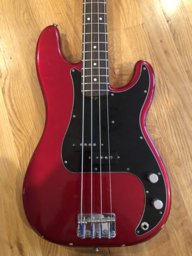
Sweet bass. I like the old fashioned ones. It came with an sd antiquity2 too. And it was only 475. I put labella flats on it; it purrs. Rather, I purr.
bri450r said:I just bought a Jackson CBX-V Dave Ellefson model...I don't mind giving Dave $20 because I have learned a ton from him.
That bass is tight. How do you like it? Is it very hot?

I have no real complaints yet. I really like the feel of the neck but it could use more clearcoat to be smoother.
iriegnome said:I would like to know what is up with signature basses. Never in a thousand years would I play someone else's signature bass. IMHO, I just don't know why someone would. Of course I realize that there are specifics to the bass that make it special (At least I think that is what it would be), but really, why would you play a signature bass? It isn't going to make you play like that person. It is not going to give you that person's sound. It will not give you their vibe. So, humbly, I ask, Why would you play a signature bass? And please no haters.
Check out this video on YouTube:<br/><br/>Invalid Link Removed
I beg to differ...some actually have the vibe and play like the artist.

In my 47+ years of playing bass, I have only ever owned three "signature" basses (other than the one that I completely designed to my own specifications and had custom-built for me), and I still own two of them .... a Fender Mark Hoppus model -- although I guess that it is no longer truly a Hoppus signature bass, because I have a Seymour Duncan Quarter Pounder and a Badass II bridge on it, and my totally-custom Birdsong "Double Fusion" that I commissioned and had built to my spec's. The others that I owned were both Fenders -- a first-generation Jaco Pastorius Fretless, circa 1987, and a Roscoe Beck IV. All of these were/are excellent basses, and I think that my Hoppus Bass is one of the best bargains in a bass that I have ever owned.
I picked up a used Geddy Lee jazz a few years back simply because I wanted a badass bridge and the store was out of them. Turned out to be my number 1 bass for 5 years now. The neck is easy on my old hands. Only just now I found a jazz special mia with a nearly identical neck but with rosewood, and I've been playing that also. But I wouldn't pay more for a bass just for a signature.

It's all about a distictive feature set not found on the typical, common production models. Sometimes, the features add up just right and you get a Superbass.
Examples;
Reverend Brad Houser 5: Take an already terrific sounding Rumblefish 5L, add two twin-jazz pickups w/coil taps, a Hipshot Type A aluminum bridge, widen the neck width, install Hipshot Ultra lites...voila, Superbass.
Fender Roscoe Beck: Arguably the best bass Fender has ever built, with a sweet set of features, including an assymetrical neck profile. Superbass.
Conklin GT Rocco Prestia: Too many unique features to list, this aint yer average Groove Tools. Superbass.
Apart from Rocco Prestia, I'm totally unfamiliar with Beck's or B. Houser's work. So really, it doesn't have to be about trying to emulate a famous artist's style. More about using a particular combination of features to help create Your Own style. Isn't that the end goal? I think it is.
Nicely said.
Signature instruments are often looked down on because many offer little change from a standard instrument from the same maker -- sometimes nothing more than a custom color. However you've cited some great examples.
The Roscoe Beck 5 is a signature instrument done perfectly. It's not a P or J clone, in fact it's unique. Okay, one of Roscoe's goals was a five string that was a tonal match for his vintage J-bass, but given the double-coil humbuckers and versatile switching options you get so much more than J-bass. And I wish every manufacturer offered the asymmetric neck profile option, I find it more comfortable than symmetrical.

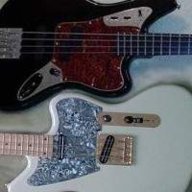
Come now, would you not even be slightly tempted by a guitar that looked this damn cool?
Link Removed
Link Removed


Scott in Dallas
Commercial User
- Aug 16, 2005
- 2,084
- 27
- 55
- Disclosures
- Builder and Owner: DJ Ash Guitars
I would like to know what is up with signature basses. Never in a thousand years would I play someone else's signature bass.
Clearly, you've never seen the Lemmy bass.

because this bass is freaking awesome looking. If they make one like this that is not a signature i'd take it, but I don't even care at this point.

The Sting Fender sig is an excellent signature bass. The Geddy Lee is well, of course.
The Mike Dirnt Fender is one of the best deals around - although, I'm not much a fan of the color scheme and the neck.
The Mike Dirnt Fender is one of the best deals around - although, I'm not much a fan of the color scheme and the neck.

I bought an Epi Allen Woody not because I am a fan of his or want to sound like him. In fact he probably never recorded or performed with this model. The Woody is a unique Bass design which I feel has something different to offer rather than being a copy of a well-known model with some famous player's choice of neck size, pickups, and other appointments. It is a refinement and combination of design elements borrowed from certain vintage Basses but is not a variant of a specific model from Fender, Gibson, Rickenbacker, Hofner, etc.


