That’s why I keep 5 strings around: makes it easier (for me, at least) to deal with revoicing on the fly. If I were more skilled, I’d just do it with a 4. It’s just part of the job, isn’t it?

Enjoy the benefits of a premium membership!
Upgrade Account
-
TalkBass has been independent since 1998. Add your voice.
Create a free account to reply to discussions, view embedded media, and browse with fewer display ads.
Join free Log in
Want zero display ads or expanded classifieds tools? Compare plans.
You are using an out of date browser. It may not display this or other websites correctly.
You should upgrade or use an alternative browser.
You should upgrade or use an alternative browser.
Singers changing key: how much is too much?
- Thread starter Rottie Roo Roo
- Start date
More options
Who Replied?
I think it is rediculous for a singer to think the song has to be in the original key. I've played with many that "play guitar" fumbling around with capos because a song is in a flat or sharp key.
What's worse is a singer trying to sing in an original key in a range they cannot hit. The original singer picked that key because it was comfortable and sounded best for their voice.
I remember one singer coving Rod Stewart song in Bb, it was a little out of his range and I suggested lowering it and he smuggley replied "I only sing in original keys, so I had to inform him he definitely needed to change the key because it was originally done by Van Morrison in E.
Many singers have to alter keys as they age, the voice usually loses range. Chronic illnesses can cause this as well.
It's a drag having to relearn a bunch of songs, and some things don't sound quite like you'd expect. You just have to adapt it and make it work.
By all means if one can do it, keep it in the factory key, but the only reason to be inflexible is if it's a tribute band, otherwise pick the best key for the on singing the song.
What's worse is a singer trying to sing in an original key in a range they cannot hit. The original singer picked that key because it was comfortable and sounded best for their voice.
I remember one singer coving Rod Stewart song in Bb, it was a little out of his range and I suggested lowering it and he smuggley replied "I only sing in original keys, so I had to inform him he definitely needed to change the key because it was originally done by Van Morrison in E.
Many singers have to alter keys as they age, the voice usually loses range. Chronic illnesses can cause this as well.
It's a drag having to relearn a bunch of songs, and some things don't sound quite like you'd expect. You just have to adapt it and make it work.
By all means if one can do it, keep it in the factory key, but the only reason to be inflexible is if it's a tribute band, otherwise pick the best key for the on singing the song.
Last edited:

Occasionally a problem for riff-based songs that rely on open strings, but most of the time it's not a big deal to change the key - that's what 5-string basses are for.
It gets annoying when the singer keeps changing their mind about what key they want though, especially without warning. A pro needs to be able to take this in their stride, but in a hobby band it can be a bit obnoxious.
It gets annoying when the singer keeps changing their mind about what key they want though, especially without warning. A pro needs to be able to take this in their stride, but in a hobby band it can be a bit obnoxious.

They sing in what key they need to. Having done Country, Blues and other projects covering some real/fake book stuff, key changes are common. Better to play in a key that the singer can work in then have crappy vocals. The crowd can't tell the key. For changed cover tunes I shrug, make a transposed version of the song in the requested key in Garage Band to play along to and off I go. One of the many, many reasons I play a 5.

The only advantage I see in sticking to the key in the recording is that it's easier to practice along with the recording. Otherwise, who cares what key a song as in, as long as it works.
I always remember something my bass teacher told me about bass lines, and it holds for keys too. What you hear on the studio recording is just what was played at that moment. The bass line isn't carved in stone and neither is the key. Plenty of artists play their own stuff live in a key different from what they recorded in the studio.
I always remember something my bass teacher told me about bass lines, and it holds for keys too. What you hear on the studio recording is just what was played at that moment. The bass line isn't carved in stone and neither is the key. Plenty of artists play their own stuff live in a key different from what they recorded in the studio.


I’ve never been one to play covers anywhere near “note-4-note”; Im not a cd-player. 
For me, part of the process of a band learning to cover a song is finding the key that works best for the performance.
That includes working with whatever instrument might be doing a solo to make sure you are choosing a key they are comfortable soloing in.
Ever wonder why so many jazz standards are in Bb?
For me, part of the process of a band learning to cover a song is finding the key that works best for the performance.
That includes working with whatever instrument might be doing a solo to make sure you are choosing a key they are comfortable soloing in.
Ever wonder why so many jazz standards are in Bb?

How many key changes in this song?
This, too.
There is, of course, a mind-bendingly difficult version by Charles Mingus called "All The Things You Could Be By Now If Sigmund Freud's Wife Was Your Mother."
Every now and then I get into a thing where I start singing a lot of standards to keep my voice in shape (or get it into shape) and, really, key changes are a given in that sort of world. I remember once picking up a little winery gig with a couple of guys and asking for key changes from their version of the Real Book, and they didn't like it much. I didn't like it much that they didn't like it much. Have they never done this with a singer before? There are people with chops and there are people with pretend chops and all it takes is calling a key change to figure out who is who.

The singer really rules as far as I am concerned. I don’t play in bands any more but I do record and when I write something and hire a singer , the first thing we do is determine what key makes them most comfortable. In my situation, there’s no reason not to work this way.

Overall it never bothers me to change the key of a song and find it easier to do so on a 5 string bass as the reach on a 4 can make for some strange fingerings sometimes to the point of feeling like you are learning a whole new song as you improvise the changes around the fretboard. On the other hand, changing the key can seriously change the timbre of the vocal itself and lose the feeling of the original song arrangement so its important to listen to how the song is going to sound in the new key and sometimes the vocal sound makes it a no-go IMO if it just don't sound right.

Our female lead singer doesn't change the key too often, but sometimes one step down. We have a relatively new guitar player who is a good singer, but some tunes he drops a 5th. He does Fooled Around and Fell in Love, which of course Micky Thomas sang pretty high. I worked on that for a while to get the right position/sound in the different key. Stuck in the Middle I just moved it down a string (I play a fiver) and try picking it closer to the bridge and maybe boost the treble a bit so it doesn't sound too muddy.
Years ago I played with a guitarist/singer who tuned down a half-step and also dropped a lot of songs by a 5th.
I sing most of mine in the original key, but I pick songs in my range (baritone). But, sometimes I lower the key.
We had a guy with us for awhile that wanted to do Joy to the World and he said original key and he was singing it an octave down. We worked on getting it into a usable key.
So I am flexible on key changes.
Years ago I played with a guitarist/singer who tuned down a half-step and also dropped a lot of songs by a 5th.
I sing most of mine in the original key, but I pick songs in my range (baritone). But, sometimes I lower the key.
We had a guy with us for awhile that wanted to do Joy to the World and he said original key and he was singing it an octave down. We worked on getting it into a usable key.
So I am flexible on key changes.
Sometimes I hear resistance from horn players because "the instrument is in Bb." Because I don't know how to play a horn, I don't really understand the entirety of the complication there, but it does seem to me that an instrument that can play twelve tones could probably be played in any western key, since you have all the required notes. I'm sure it's a more complicated issue with fingering or something. But I'm pretty certain that not all music with horns was written in Bb.Sometimes I think what this topic is really about is the reluctance of some people to play in Eb.
I’m the singer, and bassist, and I do my best to not to change never a key. I’m an average singer, but I noticed that many times when you change the key the sound of the song changes too, not always in a good way. The whole band agreeds with this.
I'd also add that coming to Nashville and working around town where the 'Number System' is the local dialect really tended to break me of thinking in 'favorite' keys. They'd call out this or that song in A-flat, for instance, then you're looking at a numbers chart or someone throwing the numbers at you and you really quit thinking in terms of keys and just moving the fingering shapes up and down the fretboard, made far easier for me with a five-string.

The bands I work with both tune down 1/2 step so all our material is 1/2 step lower and easier on the voice
One band I help out from time to time rips a whole step.
As I bassist I use a Digitech Drop pedal to avoid floppy strings
My advice have the band tune down
Duke
One band I help out from time to time rips a whole step.
As I bassist I use a Digitech Drop pedal to avoid floppy strings
My advice have the band tune down
Duke
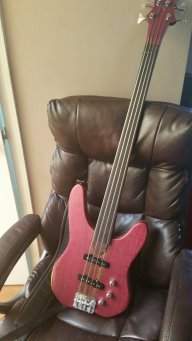
Yeah, i play 5 string with as few open strings as possible for this exact reason. Ive never worked with a singer who didnt demand key changes. While the guitarist is crying bitter tears and digging in his bag for a capo, the rythm section just moves on. I feel like anything transposed over a whole step from the original key becomes an interpretation and should be handled as such.
While the guitarist is crying bitter tears and digging in his bag for a capo, the rythm section just moves on.
I got really spoiled, as the first guitar player I ever worked with was schooled well enough on classical guitar that he could play anything in any key and didn't even own a capo; he could transpose in his head on the fly and just play the appropriate chords. I had a rude awakening about guitarists when he and I stopped working together after a decade or so.
One of the first things I do when starting a new project is finding out where the vocalist naturally sits and adjust tuning to accommodate. I would much rather play in a different key than have the singer out of key. I've had guitarists refuse to change tuning because "I wrote that song in E so that's what we play it in!" then throw a fit because the vocalist can't hit the notes as well.
It depends on the song. For some songs, the high vocal is part of the song's appeal.
Don't go dropping the keys of Journey, Whitney, Michael Jackson, Outfield, Police, etc. The vocal tone makes the song.
The appeal is not the absolute note being hit but the sound of the human voice at the top of it's register. It conveys emotion and power. You get that same feeling from a lower voice in a lower key provided the voice is still hitting it's upper range.
Unless the goal is to photo-copy the original song rather than have your version of it.


