• TalkBass has been independent since 1998. Add your voice.
    Create a free account to reply to discussions, view embedded media, and browse with fewer display ads.
    Join freeLog in
    Want zero display ads or expanded classifieds tools? Compare plans.

Single String Headless Tuner Design

michaelwayneharwood

Builder of the Wastelands
In Memoriam
Commercial User
May 1, 2014
2,494
2,341
56
Colorado
michaelwayneharwood.blogspot.com
Disclosures
Owner Melodious Resonance Constructs
After an exhaustive search, and not being able to find a single string tuner that meets the specifications of several bass designs I am working on, I decided to create one. I was looking for a very small profile single string headless tuning system that did not include a bridge. This kind of tuner could be recessed into the top of a bass or guitar and covered with a plate to conceal the mechanism. I also wanted something that lacked the large barrel tuners at the end of the device and used a tuning key of some sort.

I am sharing this with the community at large so that if anyone finds it helpful they can use it for their own projects. The design is being released under a creative commons Attribution-NonCommercial-ShareAlike license. I did a ton of patent searches, and although I am not an expert in patent law or research I believe that this design is unique even though it builds upon several existing ideas and implementations.

I have attached a .pdf to this post with the main design elements and measurements, and if you desire the .svg please PM me and I will be happy to email it to anyone who wants it. I am working on getting a set of prototypes machined to kick the tires, and will post my results here as well.

EDIT: I have a CAD file created with the FreeCAD application that I cannot upload to this post - PM me your email address if you are interested in the file and I will be happy to email it anyone who wants it.

The design overview is as follows:
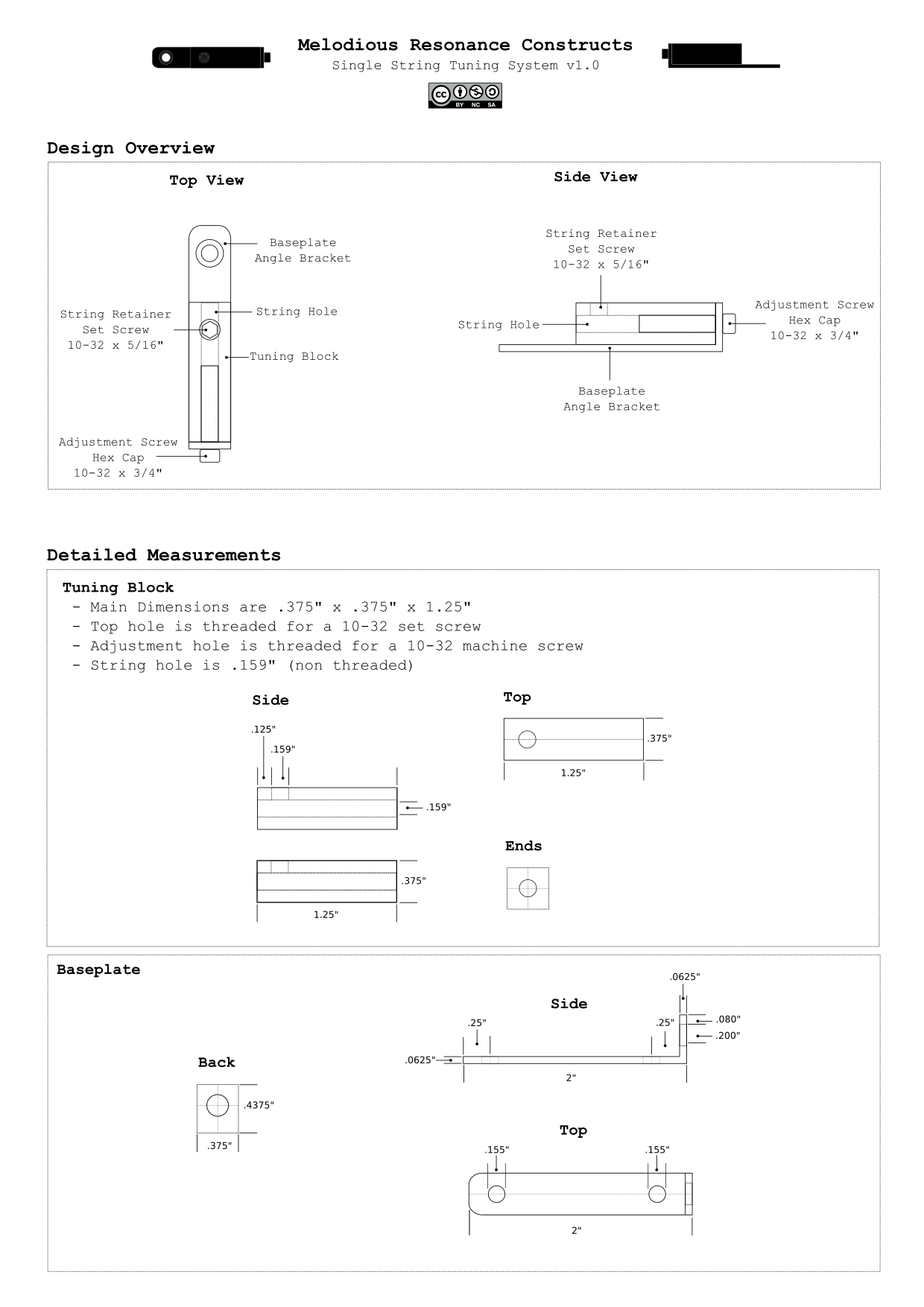
  • Single string headless tuner without a bridge
  • String retention is accomplished via compression by a set screw
  • Tuning is accomplished using a hex wrench (allen key) rather than barrel knobs
mrc-headless-tuner.png
 

Attachments

Last edited:
I had a string adapter that attached to the nut for my old Steinberger XP to accept single ball strings. It had hex set-screws to hold the ball-less string end, and what kept happening was that the set screw would bite into the roundwound wrap and weaken it enough that it would slip around the string core, so the string would fail. It may have had something to do with the angle, or type of hex screw. Have you tried the string retainer under full tension with few string types?
Steinberger Megathread | Page 7 | TalkBass.com
 
I love your spirit of invention Michael! Who is machining for you?
Thanks! My in-laws have a full machine shop with CNC's and lathes, and I am talking with them about producing a set of prototypes. It will be a few weeks before I will have anything in hand.
Have you tried the string retainer under full tension with few string types?
At this point I have not, and the slipping issue is something I am concerned about as well.
 
That does allow for a very sleek minimalist design. Maybe incorporate a hex key tuner with a wood handle integrated into the body somehow? I wouldn't want to be scrounging around for a small hex key on a dark stage. My XP-2 takes forever to go out of tune, so maybe it doesn't matter.
 
That does allow for a very sleek minimalist design. Maybe incorporate a hex key tuner with a wood handle integrated into the body somehow? I wouldn't want to be scrounging around for a small hex key on a dark stage. My XP-2 takes forever to go out of tune, so maybe it doesn't matter.
My thoughts exactly. One of the other things I like about this particular design is that it allows for the string ball ends to be restrained at the end of the neck with a very simple head piece. I love the head piece design I have been using for the piano tuner basses and want to be able to do the same on other headless designs.

One other point to mention is that the tuner size is small enough to be used in a dual-course configuration. That was the initial driving motivation to do this design. I needed something I could use in a headless 10 string dual-course bass that wasn't overwhelming the lower side of the body, and making them small enough to be able to hide them under a wooden panel provides a lot of options.
 
  • Like
Reactions: Hamish MacCleod
I had a string adapter that attached to the nut for my old Steinberger XP to accept single ball strings. It had hex set-screws to hold the ball-less string end, and what kept happening was that the set screw would bite into the roundwound wrap and weaken it enough that it would slip around the string core, so the string would fail. It may have had something to do with the angle, or type of hex screw. Have you tried the string retainer under full tension with few string types?
Steinberger Megathread | Page 7 | TalkBass.com
Would this be alleviated by putting a metal plate between the screw and the string?

Michael, can you show us the head piece design you are speaking of?
 
Would this be alleviated by putting a metal plate between the screw and the string?
+1
Like the electrical connectors that have a flat strip to distribute the screw load.

The only concern I have is that there is nothing to stop the string clamp lifting away from the base plate if the string pull is not straight or down (hope you follow what I mean).

A countersunk slot in the base plate with a countersunk screw into the string clamp would stop it lifting but the machining is starting to get messy.
 
  • Like
Reactions: Robert Canfield
I spoke with the machinists today and we changed a few things to make life easier on them, and it ended up being a simpler design that should work. Once I have everything cleared through their expertise I will update the first post with the updated design.
 
1. What about provision for constraint side-to-side?
2. You need to either countersing the holes in the baseplate to allow use of flat head screws, or remove material in the underside of the tuner block to allow for a round head screw sticking up
3. At only 1/16 thick, the angle bracket is pretty flimsy if aluminum, fine if steel, probably OK if brass. That sharp inside angle you show though is too sharp for a bent plate, so that would mean hogging out of a solid block unless you radius it, which would require a matching relief on the tuner block if you need to maintain full travel rearwards.