Man, your ideas always get my own wheels turning, looking forward to the outcome here.

TalkBass has been independent since 1998. Add your voice.
Create a free account to reply to discussions, view embedded media, and browse with fewer display ads.
Join free Log in
Want zero display ads or expanded classifieds tools? Compare plans.

This could be alleviated by routing the pocket used to recess the tuners...at an angle down & away from the bridge ...pretty much the same angle as a headstock. This would make the strings dive down into the body on a nice consistent angle, to disappear under the concealing plate.The only concern I have is that there is nothing to stop the string clamp lifting away from the base plate if the string pull is not straight or down (hope you follow what I mean).

1. What about provision for constraint side-to-side?
2. You need to either countersing the holes in the baseplate to allow use of flat head screws, or remove material in the underside of the tuner block to allow for a round head screw sticking up
3. At only 1/16 thick, the angle bracket is pretty flimsy if aluminum, fine if steel, probably OK if brass. That sharp inside angle you show though is too sharp for a bent plate, so that would mean hogging out of a solid block unless you radius it, which would require a matching relief on the tuner block if you need to maintain full travel rearwards.
Thanks man!Man, your ideas always get my own wheels turning, looking forward to the outcome here.

That's true. Being more of a metalworker than a woodworker I visualised the tuner assemblies fitted to a flat top rather than having and angled route.This could be alleviated by routing the pocket used to recess the tuners...at an angle down & away from the bridge ...pretty much the same angle as a headstock. This would make the strings dive down into the body on a nice consistent angle, to disappear under the concealing plate.
One other point to mention is that the tuner size is small enough to be used in a dual-course configuration. That was the initial driving motivation to do this design. I needed something I could use in a headless 10 string dual-course bass that wasn't overwhelming the lower side of the body, and making them small enough to be able to hide them under a wooden panel provides a lot of options.
The Steinbrger 12 string tractuner system is definitely a cool design!Talking about double course reminded me of the old Steinberger 12 string guitar bridge.
Something similar, ie the captive tuning key that moves to engage each string could be appropriate here.
The Steinbrger 12 string tractuner system is definitely a cool design!


I'd join that Kickstarter campaign!Are these available for pre-order?
Very cool!
Are these available for pre-order?
Very cool!
I'd join that Kickstarter campaign!


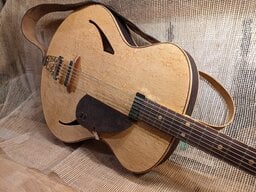
Your design is awesome! Can you tell me what your experiences are with using a hex wrench for tuning? The grounding would be handled in the same way you would handle grounding with any single string bridge, which is either a single wire going underneath each tuner, or a single wire to a single tuner in combination with a zero fret / brass nut that completes the circuit.Hey Michael. I've had to come up with something similar, but not for single strings. Check out Invalid Link Removed on TDPRI.com. The design that I used starts at post # 11. Maybe I'll have to do another $100 build.
Edit - what do you plan to do about grounding?
That is actually one of the changes that was made to the original design. Updated design docs will be provided when I have them completed.Nice work.
I think you might need something more robust than a #4 screw to do the heavy lifting part of the tuning.
Using fine threads is a good idea for precision, but if I'm seeing it correctly, 10-32 might be in order.
I used whatever 8-32 screws that I had around, and being Canadian, that usually means "red Robertson". That translates to a "square head screwdriver". We love them. Nobody else gets it.Your design is awesome! Can you tell me what your experiences are with using a hex wrench for tuning? The grounding would be handled in the same way you would handle grounding with any single string bridge, which is either a single wire going underneath each tuner, or a single wire to a single tuner in combination with a zero fret / brass nut that completes the circuit.
I actually love the square head screws, and have wondered why they are adopted more widely. I like your idea on the multiple tuning locations. PM'd.I used whatever 8-32 screws that I had around, and being Canadian, that usually means "red Robertson". That translates to a "square head screwdriver". We love them. Nobody else gets it.
What you can expect from touching a metal implement to a metal screw head during tuning is a resounding "tinnnggggg" sound to come through the amp. Other than that, it holds tuning very well.
For the ground on my unit, you can see a little red electrical connector beside the high E tuning screw that connects to the common aluminum angle.
Here's one more idea for you... I have bought a box of 1-1/2" long 10-32 NF thumb screws. I'll send a picture tonight after I get home. I haven't built them into a bridge yet, so I can't vouch for how easily they turn under tension, but I'll trade you a dozen of those for some of the piano tuning pegs, if you have any to spare. With tuning pegs at the headstock for coarse adjustment and screw tuners at the tailstock, we would never run out of room for adjustment.