• TalkBass has been independent since 1998. Add your voice.
    Create a free account to reply to discussions, view embedded media, and browse with fewer display ads.
    Join freeLog in
    Want zero display ads or expanded classifieds tools? Compare plans.

Single String Headless Tuner Design

I have decided that if I am going to do this I need to learn me some CAD. Here's a quick start after a short learning curve with FreeCAD.
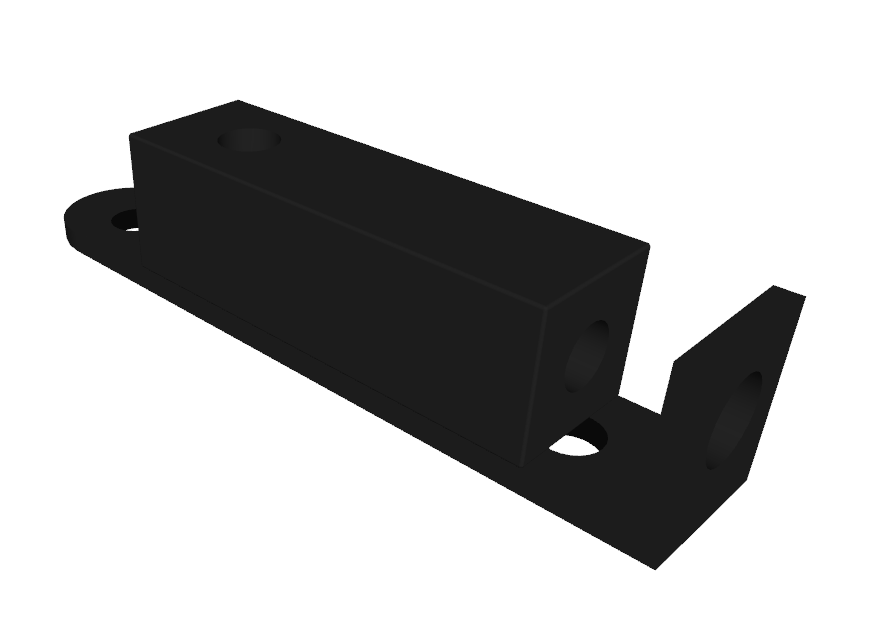
test.png
 
I am getting this CAD thing figured out in stages. Having a lot of Blender experience has helped a great deal. I still need to tweak some things, and I highly doubt that my CAD layout is optimal, but here is the latest rendering using the Luxrender engine. I think this captures the spirit of what I am shooting for well. Once I get the 2D specs sheet hammered out I will upload that to the initial post.

templates.Scene.00003.png
 
Suggestion: If using aluminum for the angle, unless high-strength alloy or thick, you'll need a gusset inside the angle, or use a piece of 'structural' angle milled for the block flat, drilled, then cut to width. "Structural' angle has more mat'l inside the angle and the mat'l thickness tapers to distribute the stress from the corner.
 
Thanks for all the feedback guys! This particular design is the first pass, and I am sure changes will be needed once I see how it works in real life. In no specific order:

1. A lip might prevent side to side motion, but will not prevent the block from moving vertically when strings are at an angle. I am not sure how much vertical and horzontal movement is going to present itself, so I am waiting to see what I see and will address the challenges as I come across them.

2. These are specifically designed to not accept ball ends, but a second "model" could easily be designed that accepts ball ends rather than using a compression fitting for string retention.

3. I am going to plan on a .125" thick base plate rather than the .0625" thickness shown to alleviate string tension stresses.

4. Using 10-32 thumb screws in place of the hex cap screws will be experimented with to see if that is a viable option, and what style of thumb screws will work.
 
Last edited:
  • Like
Reactions: mapleglo
Michael...if you wouldn't mind another piece of input....
Isn't the above thumb screw getting rather close to the configuration of the Hipshot bridge which you intended to depart from?
The beauty of the socket head cap screw was the ability to completely conceal the units entirely (within the body, under a plate.) Thus creating the elegance of minimalism.
I personally feel that if the units were dropped into an angled pocket to alleviate any upward string pull, ....
And, if they are arranged closely against each other with the sides of the pocket supporting the outer two...I wouldn't think you would need any horizontal supports.
But I have confidence you will come to the conclusions that suit you best.
Just my "dos centavos" ;)
 
Isn't the above thumb screw getting rather close to the configuration of the Hipshot bridge which you intended to depart from? The beauty of the socket head cap screw was the ability to completely conceal the units entirely (within the body, under a plate.) Thus creating the elegance of minimalism.
To a degree. What I am trying to do is implement a single string tuning mechanism that does not include a built in bridge component, and that has a thinner horizontal footprint that will allow closer string spacing and dual-course designs. I was not able to find anything even close from Hipshot, ETS, ABM, or any other manufacturer in my research. If I could have found a single string bridge that I could just swap out a machine screw or two to scratch my itch I would have done that....though it would not have been that simple.

The ABM style single string headless bridge unit has a barrel with a threaded hole. A screw is screwed in through the barrel so that the end of the screw is flush with the inside of the cylinder, and the screw is then attached to the tuning block. The tuning block is moved by twisting the barrel, but the screw is pulled back through the center of the barrel requiring it to be long enough to keep the screw head out of the way. Just replacing the machine screw would not work as I would like. I want the tuning screw to move the block backwards and forwards without having to extend further out of the back of the unit.

;)

I am trying to make the design generic enough so that any 10-32 screw will work for pulling the tuning block back, and the reason I am including thumb screws in my thought process is to see what other options are possible. For the builds I have in mind the hex cap screws will be perfect, but there may be a reason to include thumb screws for other builds. I like having the options available.

I personally feel that if the units were dropped into an angled pocket to alleviate any upward string pull, .... And, if they are arranged closely against each other with the sides of the pocket supporting the outer two...I wouldn't think you would need any horizontal supports.

I think you are right. For the first prototype I am intentionally avoiding adding sides to the baseplate (no offense @mapleglo), or any other remediation to combat potential tuning block movement. I want to get the units on a bass and see what I can see. If after that I need to address some design flaws I can cook up another set of prototypes.
 
Here are four different takes on the tuner. All four use the same tuning block and baseplate, and depending on your application you could choose a variety of tension screw options.

In other news I am very much enjoying learning FreeCAD, and when I get the Drawing module figured out completely I will be able to generate much nicer drawings with specs and measurements to give my machinist friends.

tuners.png
 
  • Like
Reactions: Hamish MacCleod
Michael,
For a multi-course bass have you determined the minimum distance between string pair center-lines? Just wondering.
Rondo
My understanding is that for a standard octave based dual-course 8 string it's approximately 4mm between the main string and it's paired octave string. Adding the low B in for a 10 string adds some complexity, and for non standard tunings (such as 4ths or 5ths) using thicker strings it gets even more interesting. I am still working it out, but I do have a head start on the layout. It's not anywhere near done though....
 
  • Like
Reactions: Hamish MacCleod
My understanding is that for a standard octave based dual-course 8 string it's approximately 4mm between the main string and it's paired octave string. Adding the low B in for a 10 string adds some complexity, and for non standard tunings (such as 4ths or 5ths) using thicker strings it gets even more interesting. I am still working it out, but I do have a head start on the layout. It's not anywhere near done though....
Very cool, just asking...
Rondo
 
Very cool, just asking...
Rondo
It's a good discussion on a potential practical implementation of these bridges:
  • 10 String multi-course tuned in 5ths
  • String gauges as follows based on super light gauge strings:
    • Course 1
      • (root) B - 125
      • (fifth) F# - 95
    • Course 2
      • (root) E - 95
      • (fifth) B - 75
    • Course 3
      • (root) A - 75
      • (fifth) E - 60
    • Course 4
      • (root) D - 60
      • (fifth) A - 40
    • Course 5
      • (root) G - 40
      • (fifth) D - 40
  • Spacing at bridge is a 75" spacing, with the center of each course hitting the mark
  • Individual course spacing at the bridge:
    • Course 5 - 4mm between string centers
    • Course 4 - 4mm between string centers
    • Course 3 - 5mm between string centers
    • Course 2 - 5.5mm between string centers
    • Course 1 - 6mm between string centers
  • Nut spacing is still being worked out
Here's what the tuners and bridge (still in development) look like with that spacing:

aleph-multicourse-35.png
 
Last edited:
  • Like
Reactions: Hamish MacCleod
I just attempted to upload the FreeCAD file to the original post, but the extension is not allowed, nor is a .zip file of it. If anyone is interested in the FreeCAD file for this design PM me and I will email it to you. Sharing is caring. ;)
 
  • Like
Reactions: Hamish MacCleod