
Enjoy the benefits of a premium membership!
Upgrade Account
-
TalkBass has been independent since 1998. Add your voice.
Create a free account to reply to discussions, view embedded media, and browse with fewer display ads.
Join free Log in
Want zero display ads or expanded classifieds tools? Compare plans.
You are using an out of date browser. It may not display this or other websites correctly.
You should upgrade or use an alternative browser.
You should upgrade or use an alternative browser.
Singlecut semi-hollow body
- Thread starter Jisch
- Start date
More options
Who Replied?

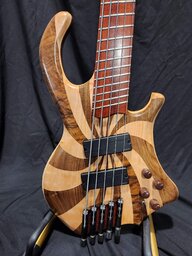
My vacuum bag isn't big enough to do a neck though, I can imagine that being a huge mess (in my hands).
Really i think my problem was the epoxy was too cold and the viscosity was too thick, add to that my inexperience and you get a big mess. I wanted to use it specifically for this wood because it's soft, but it absorbed so much Tru Oil, I'm not worried about it.
I've got two or three coats before it starts building, but it's looking good.
Really i think my problem was the epoxy was too cold and the viscosity was too thick, add to that my inexperience and you get a big mess. I wanted to use it specifically for this wood because it's soft, but it absorbed so much Tru Oil, I'm not worried about it.
I've got two or three coats before it starts building, but it's looking good.

I'm curious, because I've never used True Oil before, but what brand do you use? I think its something I may look into sometime.
I think there's only one: Casey's Tru Oil: https://www.walmart.com/ip/BIRCHWOO...MIvZBQcYggUI3SzslFL5MBrNhtuQNLCxoCZWcQAvD_BwE
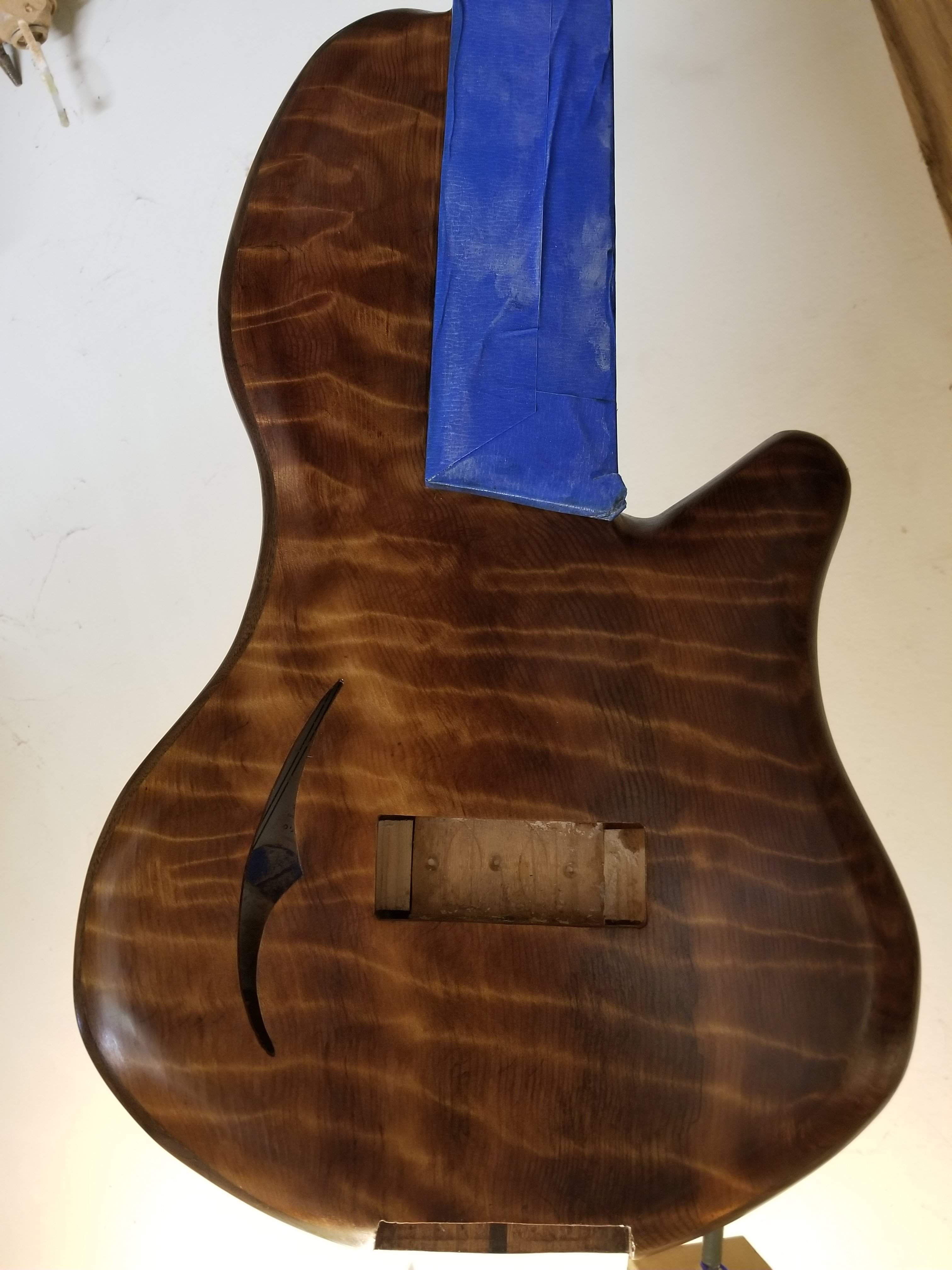
I have been putting coats of Tru Oil on, sanding in between every three or four coats. It's getting close, maybe two more coats. It's not as dark as it looks here - the white background messes with the camera balance. The lighter parts are a honey yellow color.
the neck looks great too.
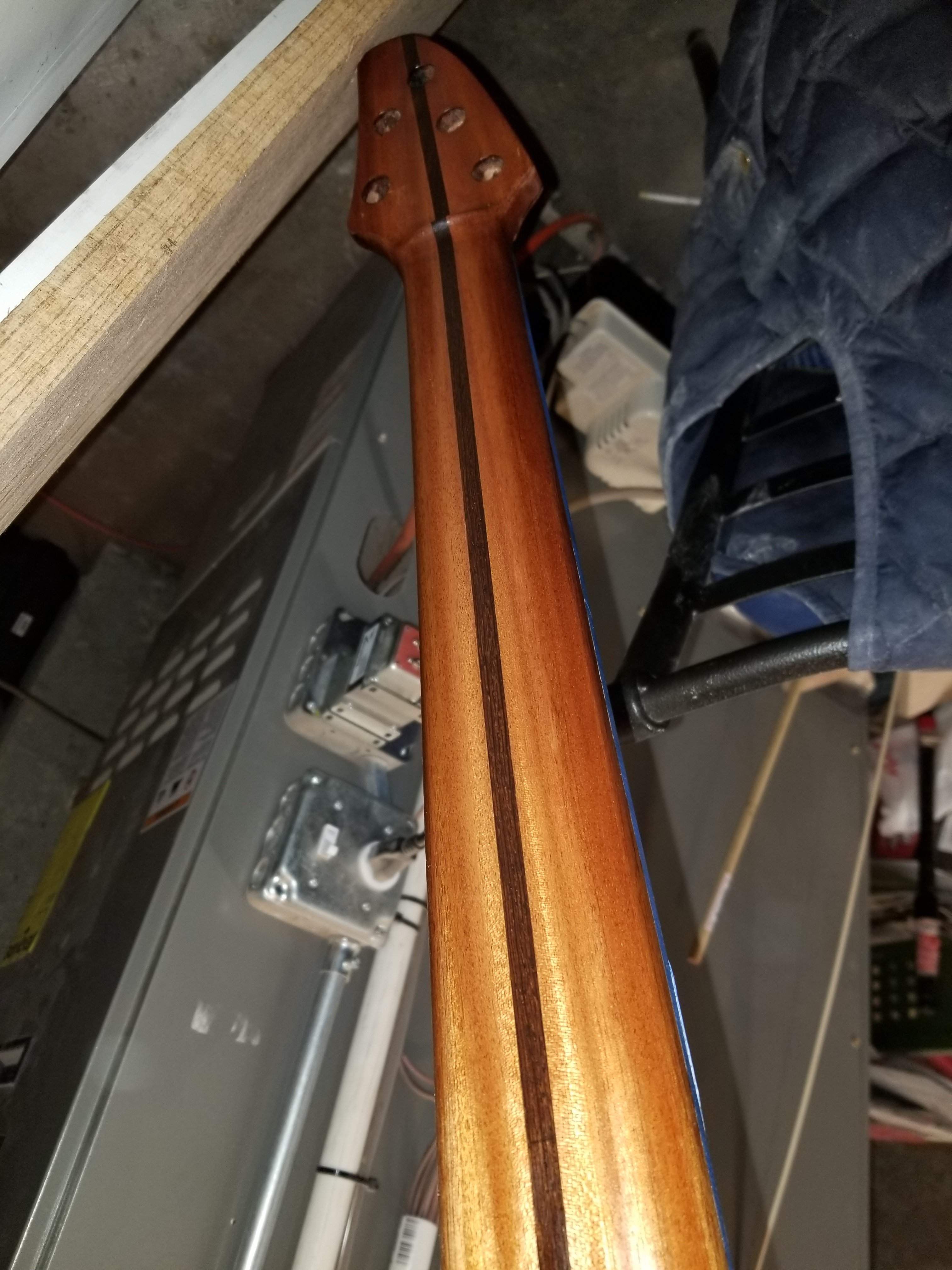
the neck looks great too.
Attachments

I'm not saying I jumped the gun, but notice there are no control knobs (they're inside to control cavity). It sounds great, but massive amounts of set up are required.
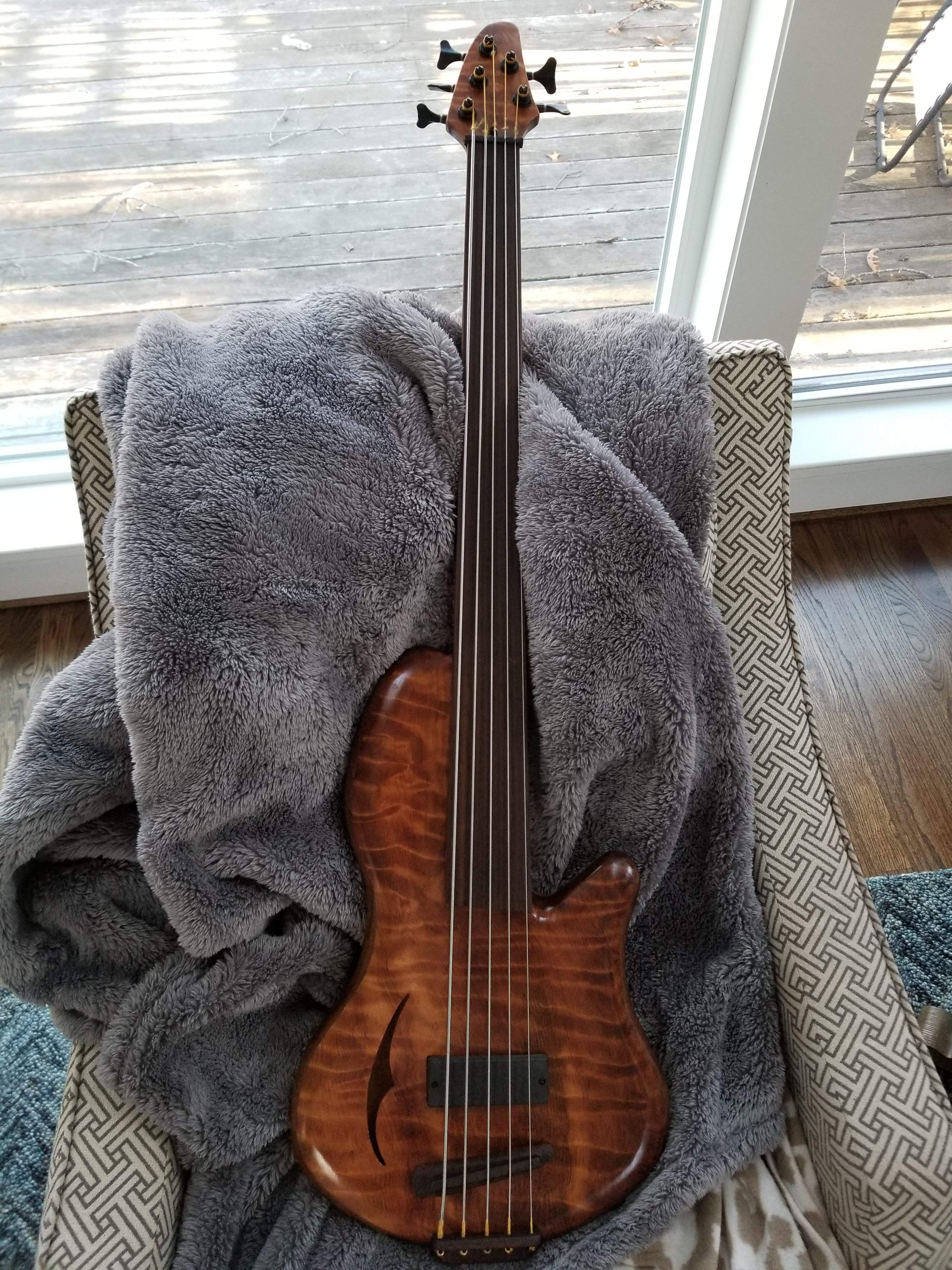

I've got a bit more work to do on it, but from a playability standpoint, it's done. It plays really nice, very well defined bottom on this one, wow, not sure I have a B string that sounds this good on another bass. I did the "knock down the shine, add wax" treatment to the neck, I love that finish, it makes for a very silky neck feel.
I needed to turn the truss rod probably 3/4s turn past tight. I'm always interested to see how far the truss rod has to go, it tells me how strong the neck is.
I cut slots in the string saddle (not sure what to call the parts of this bridge!), the strings were bottoming out on the back end of the bridge itself, so I had to sand down the back of the bridge. This means I have to refinish the bridge, no big deal. I have a high spot on the fingerboard, it's minor, but causing a bit of buzz on a couple fret positions on the D and G strings. I need to make knobs - I'll probably go with wenge knobs, fine sanding on the nut and adding strap buttons are also on the list.
So far though, I'm very happy. As a side note it is definitely louder than a regular bass when not plugged in, it's not going to compete with an acoustic guitar or anything, but the body is definitely resonating to some degree.
I needed to turn the truss rod probably 3/4s turn past tight. I'm always interested to see how far the truss rod has to go, it tells me how strong the neck is.
I cut slots in the string saddle (not sure what to call the parts of this bridge!), the strings were bottoming out on the back end of the bridge itself, so I had to sand down the back of the bridge. This means I have to refinish the bridge, no big deal. I have a high spot on the fingerboard, it's minor, but causing a bit of buzz on a couple fret positions on the D and G strings. I need to make knobs - I'll probably go with wenge knobs, fine sanding on the nut and adding strap buttons are also on the list.
So far though, I'm very happy. As a side note it is definitely louder than a regular bass when not plugged in, it's not going to compete with an acoustic guitar or anything, but the body is definitely resonating to some degree.
I did a quick recording, first part is with high end rolled off, second part is wide open. I didn't ground the strings, that's obviously needed, as you can hear in the second part. It's going to be a tricky with a wooden bridge. I'll have to think about it.
I put on the embedded straplocks on as well, it's slightly head heavy, but it's super light overall.
I put on the embedded straplocks on as well, it's slightly head heavy, but it's super light overall.
I got the strings grounded. I was going to use a piece of copper foil to connect the string balls together, but it was impossible to get it under the ball ends, it's just not rigid enough. I didn't want to risk breaking strings or scratching the bass by trying to work the strings back through the bridge. Idea two was using a piece of stripped wire, which worked out perfectly, but I wouldn't sell it this way as changing strings would mean repositioning the wire. I suppose I could route a thin channel for the wire, but that could weaken the bridge. I think I'm going to make a copper plate to permanently install under the ball ends.
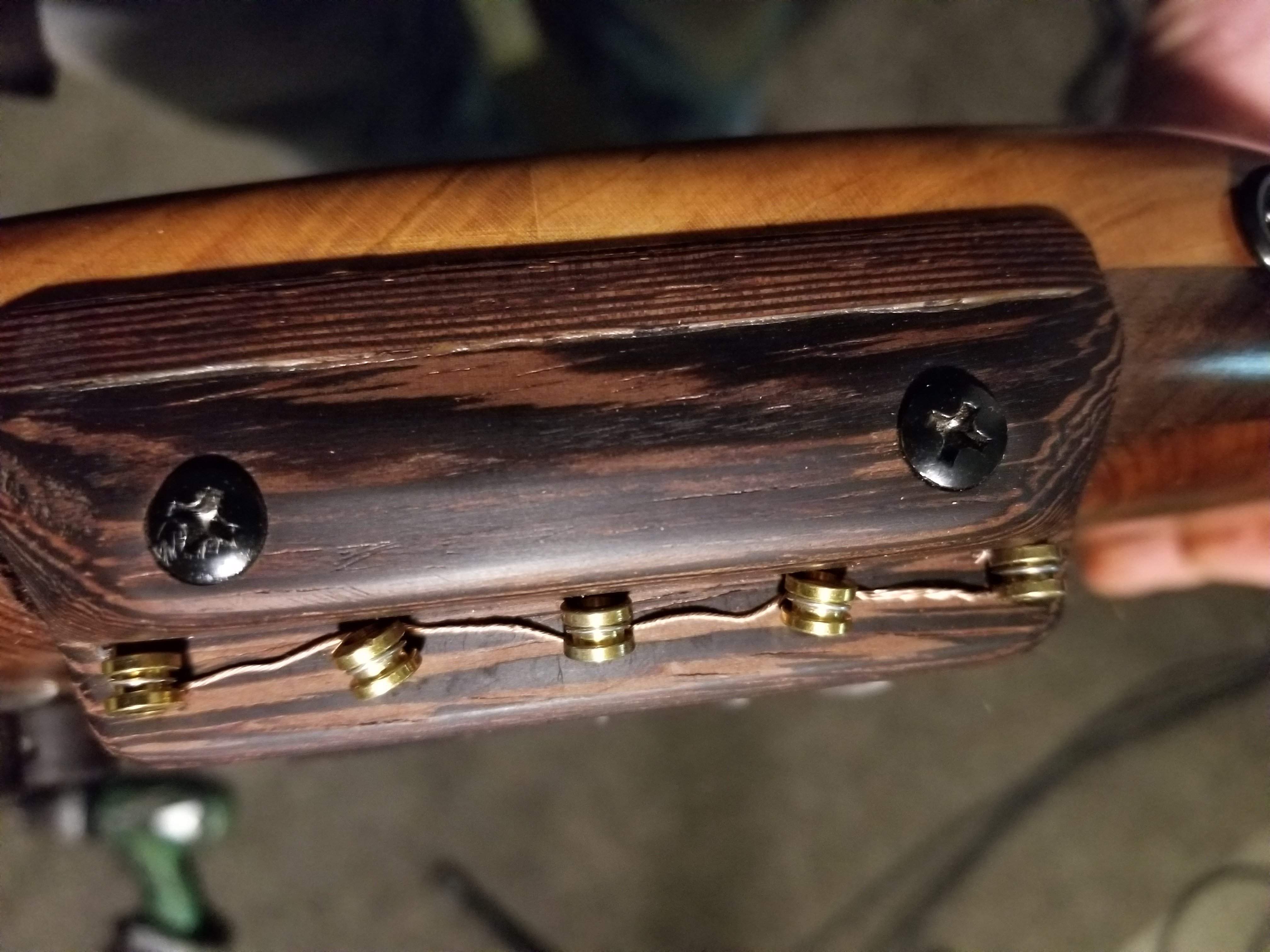
Any reason you couldn’t use a brass nut?I got the strings grounded. I was going to use a piece of copper foil to connect the string balls together, but it was impossible to get it under the ball ends, it's just not rigid enough. I didn't want to risk breaking strings or scratching the bass by trying to work the strings back through the bridge. Idea two was using a piece of stripped wire, which worked out perfectly, but I wouldn't sell it this way as changing strings would mean repositioning the wire. I suppose I could route a thin channel for the wire, but that could weaken the bridge. I think I'm going to make a copper plate to permanently install under the ball ends.
View attachment 3375292
I could, but given the wooden bridge, I feel like it would be out of place on this instrument. I did consider how I could connect all the strings together at the headstock though.Any reason you couldn’t use a brass nut?
So I assume when considering grounding them at the headstock were you going to use the truss rod as the 'wire' back to the bass body and then string a wire inside from the TR to the control cavity ground? Clever!
Oh yeah I hadn’t thought of that. I’m glad you mentioned it because I was just about to make this mistake! I am doing a bass with individual string saddles, so I figured a brass nut would earth the strings. I forgot I will still need to connect one of the saddles to earth. Duh!So I assume when considering grounding them at the headstock were you going to use the truss rod as the 'wire' back to the bass body and then string a wire inside from the TR to the control cavity ground? Clever!
This turned out so nice. The shape and design really compliment that gorgeous top.
For the string grounding - a really thin inlaid strip of copper or brass under the ball ends would look cool if you patina'd it and darkened it up so it was close in color to the wenge.
For the string grounding - a really thin inlaid strip of copper or brass under the ball ends would look cool if you patina'd it and darkened it up so it was close in color to the wenge.
I put together a quick song, if anyone wants to hear anything specific, let me know. There are three tracks with one "effects" track.
With most basses I anchor my thumb on the pickup. The sound when plucking down by the pickup is a lot different than when you pluck this further up (Captain Obvious). It might be worthwhile putting a thumb rest up close to the bottom of the neck.
With most basses I anchor my thumb on the pickup. The sound when plucking down by the pickup is a lot different than when you pluck this further up (Captain Obvious). It might be worthwhile putting a thumb rest up close to the bottom of the neck.

For a future build, you can always use a zero fret to help with string grounding. 
yeah, that's a good idea. I thought with this being a semi-hollow body and wanting a less bright tone, I'd use a wooden nut. I know it only impacts open string notes, but I'm trying to be more visually and aurally consistent with my builds - following a theme.For a future build, you can always use a zero fret to help with string grounding.


