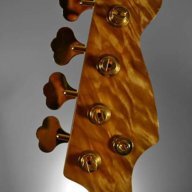
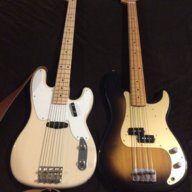
Please tell us more about "roasting" necks and how that contributes (but does not guarantee!) stability.
I'm no expert in roasting wood, but I have been fascinated by the process and outcomes for some time. Here's what I have learned.
The roasting of wood has been around since about 800 A.D., used by the Vikings in the building of their ships. They found that the roasted wood stood up to the ravages of water far better than unroasted wood.
The process of roasting, also known as torrefaction, exposes the wood to high temperatures in an oxygen-free environment. Removing oxygen from the environment keeps the wood from burning. The high heat causes chemical changes in the wood. First it drives the moisture content to zero. In normal wood drying, a zero percent moisture content is not desirable - the wood will absorb moisture again when exposed to a normal environment until it reached its equilibrium moisture content - that is where it is in balance with it's environment. That's because wood is "hygroscopic", meaning that it absorbs and releases moisture in relation to its environment. And that brings us to the second characteristic that roasting brings to the wood - it changes it so it is not hygroscopic. The wood no longer reacts to humidity in it's environment.
So what's the big deal if its hygroscopic or not? Well, it
is a big deal. As the wood absorbs moisture, the fibres swell. And that changes the dimensions of the wood. And since wood is not a homogenous substance, the swelling will not be even throughout the mass, and this can lead to bending and other distortions. Reducing the wood's reaction to environmental moisture has obvious benefits for an instrument builder.
What's actually happening as the wood is roasted is that there are changes to the properties of the major components of the wood; cellulose, lignin, and resins. The cellulose is partially crystallized, and this is the most significant contributor to the inhibiting of moisture absorption. Similarly the lignin is crystallized and that strengthens the bonds between the wood fibres. The resins in the wood are largely evaporated and degraded in the process which increases the wood's resistance to rot and insect infestation, not really significant for instrument builders.
The reduction of water in the wood to close to zero percent moisture content reduces the weight of the wood significantly. At the same time it makes the wood more resonant, partly because of the reduced mass, but also because the water moisture acts as a bit of a vibration damper. And the strengthening of the bond between wood fibres caused by the changes to the lignin adds to the rigidity of the wood. The result is a lighter, more resonant and stiffer wood, all desirable properties for a bass neck.
I mentioned that roasting contributes, but doesn't guaranty, the stability of the wood. The reason is that to achieve 100% stability requires the wood to be highly torrefied. That would leave the wood in a state where it is very brittle and also leads to machining and gluing problems. So roasted wood is really partially torrefied wood- (fully torrefied wood is also known as charcoal). So being only partially torrefied, it only partially gains the desired characteristics. And roasting will not make a poor piece of wood into a good one. So the result is dependent upon the quality of the wood to begin with and the degree to which it is roasted. And that degree of roasting can be a tricky balance.
I have heard of some folks roasting their own wood in their kitchen oven. The process may impart a nice toasty colour to the surface of the wood, but it will really only affect the
surface of the wood. Proper torrefaction effects the wood throughout, and to do that you need to maintain high temperature in an oxygen-free environment. If just the surface is treated the only benefit likely to be gained is that of the toasty colour, and to some that's not even a desirable characteristic.









 After I've finally fixed the issue - I had to do the complete fretwork to fight the fret-buzz problems both forward and backward (when the string buzzes between nut and fretted position). But since then it is stable and does the job. Besides, now I can set it up pretty low.