• TalkBass has been independent since 1998. Add your voice.
    Create a free account to reply to discussions, view embedded media, and browse with fewer display ads.
    Join freeLog in
    Want zero display ads or expanded classifieds tools? Compare plans.

Sizing up a Neck - quality evaluation

Turnaround

Commercial User
May 6, 2004
11,524
24,795
Toronto Canada
Disclosures
Independent Instrument Technician - Retired
I am starting this thread in the hope that it will help some folks understand some of the points they should consider when sizing up the neck on an instrument. There are plenty of "cheap" necks out there, imported and local. Many of them look pretty good on the surface, and you might think you are getting a bargain for under $100, but are you?

The information I am posting here applies to any instrument you are considering buying, not just replacement parts. And I am not talking just "good" or "bad" because there is a spectrum of quality at question - so I will look at "gooder" and "badder".

Within the contributors to the Pro Bench is a member who must rank as being one of the foremost authorities on neck construction. He not only makes high-quality instruments, he also builds and repairs necks for other premier builders. I am sure he will have lots to add you our discussion if he can find available time to post.

Stay tuned - I think this will be interesting.

Oh yes, the neck expert I was talking of is our friend Bruce Johnson. Search his posts on TB.
 
I realized as I worked on my post for this thread that it was so long and involved that nobody would read it. So I have abandoned that and will cut to the chase.

It all starts with the wood. For this purpose I will use maple as the neck wood, but the principles apply to all woods. So for a neck we want a pice of hard maple with straight grain, little to no runout and with closely spaced growth rings. Such wood will have good rigidity and stability with little tendency to warp or twist over time. Part of the equation here is in the growth of the wood, part of it is in the skill of the sayer who converted the log into boards. And of course, in the case of a finished neck, a good part of the equation is the skill of the craftsman who made the neck from a board.

Looking at a finished neck we can determine the degree to which the ideal has been approached. Lets start by looking at straight grain. Here's a poor example - I have highlighted the curve of the grain with a blue line:

curvedgrain2.jpg


Compare that to a neck with straight grain:

StrightGrain.jpg


One good way of thinking about this, though it's not really true, is that any grain pattern wants to eventually become straight. But thinking of it that way will lead you to an approximation of what is the tendency of the wood movement over time. Straight will tend to remain straight. Crooked is more likely to bend.

Next I'll look at grain runout. The ideal situation would be if the grain of the wood entirely follows the profile of the neck - parallel with the sides of the neck and parallel to the top and bottom surfaces. Here's a neck where the grain is not parallel to the sides:

AngleGrain.jpg


And an example where the grain is not parallel to the top/bottom surfaces:


Runout.jpg


The easiest way to spot grain not parallel to top and bottom surfaces is by looking for a pattern in the top/bottom surfaces. Here's the pattern you will see when there is significant runout:


Rounout2.jpg


Some folks like the look of this - interesting grain, but it's actually an indicator that the grain is not parallel to the surface of the wood. The best wood for a neck will have little or no runout. The worst case though is when there is significant runout combined with a curved/crooked grain:

Double runout.jpg


On the right side of the neck, the grain is running out one way, and at the left end it is running out the other way. And the fact that the runout is on the centre line at one end and off to one side at the other indicates that the grain is slightly skewed to one side as well. Compare that with a neck with no runout:

NoRunout.jpg


The final thing I will address is the tightness and eveness of the growth rings, but I will start a new post later about that. I've had enough for now.
 
Last edited:
You can tell the age of a tree by counting the growth rings. But the rings can tell you a lot more, most importantly to us, they can tell a lot about the suitability of wood for a bass neck.

Looking at the butt end of a board will tell us the rate of growth of the wood, whether the tree was leaning, the seasonal difference the tree faced, lean years and good years, whether the tree was large or small, and the way the board was cut from the log. Ideally we want to see wood that was slowly grown, not leaning, little seasonal difference, even climate year over year, relatively large and cut either on a perfect tangent or perfectly radially.

Here's the butt end of a piece of wood:

Centrecut.jpg


The growth rings are nicely regular with even spacing indicating that the tree grew straight and had good growth conditions year over year. However this board was cut from close to the centre of the tree, indicated by the tight curve of the growth rings at the bottom centre of the illustration. As it dries this wood will cup substantially, which is just beginning to show on the upper surface. And, as seen in this example, some cracking ma occur as well. Those growth rings are the edges of cylinders of wood, and the wood will shrink and expand along the circumference of the cylinders. So in the example above the stresses created will be going in all directions from vertical to horizontal. Compare that to this piece:
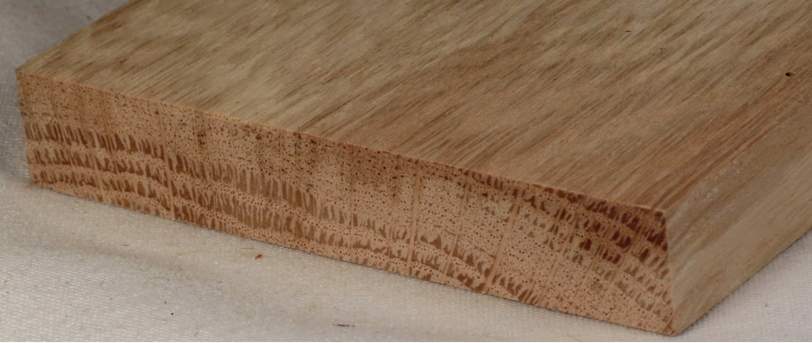
Flatgrowth.jpg


Here the growth rings are flatter, indicating that the board was cut further from the centre of the tree. Because the growth rings are relatively flat, this board will exhibit less cupping than the previous example. And the stresses induced by drying will all be working in the same direction. The board will thus shrink across it's width evenly and will likely remain flat. The even spacing of the growth rings also indicates an even density in the wood, thus enhancing its stability.

Below we see the cross section of a log showing "reaction wood". The growth rings are much further apart on the left side than on the right side. This is because this tree was leaning to the right side, and to compensate for the weight being carried off centre, the tree grew more wood on the opposite side of the lean. The wood on the left side is under tension, and the wood on the right side is under compression. Not only is the density of the wood eneven, it will distort more readily over time than a board containing less reaction wood.
reaction.jpg


This is not an ideal wood for use in a neck where rigidity and stability are key elements.

The way the board was cut from the tree is also relevant to our concerns. In the previous post I discussed the ideal condition of the grain of the wood running parallel to the sides and faces of the board. When we look at the end grain we see the third dimension of the way the board was cut. Looking at these two examples we see that the one ln the right has the growth rings running parallel to the face, and in the second running at right angles to the face. These are flat sawn and quarter sawn respectively.

FlatQuarter.jpg


But most boards we see are somewhere between these two cuts, more like this where the growth rings are on a diagonal:

diagonal.jpg


There's more chance of distortion since seasonal movement will also be on the diagonal, but regardless of the direction of the growth rings they must maintain the same angle along the whole length of the neck to avoid twist.

So from an ideal standpoint, the best neck is probably the most boring looking. Straight grain, closely spaced, no runout to form patterns - just plain flat and boring. But stable and rigid. We should probably discuss fingerboards too, but I will leave that topic for later.
 
The one-piece neck on my SRX (SR eXtreme) shows a fair bit of runout:
So far it's been stable, but Winter will be the truth teller. I've owned it since Spring.

I prefer a neck where I can see the grain vs. a opaque finished neck.
I think it's important to keep in mind that I am outlining ideal conditions for a neck. Just because a neck has some runout does not mean it will necessarily have problems. But obviously one with a lot out runout is more likely to develop problems than one that has none - all else being equal. Your neck may be fine.
 
A quick note on fingerboards. Much of what I said about necks applies to fingerboards. But we often want our fingerboards to look "sexy" so wilder grain appeals to us. For example this looks nice:

fboard-ld.jpg


The grain is quite dramatic, but because of it's un-straight nature it is putting uneven stresses on the neck as it cycles through changes in humidity. From the standpoint of stability a fingerboard like this is more desirable:

fboard-straight2.jpg


It may be less interesting to look at, but it won't be stressing the neck un-evenly. The choice we make is likely to be a compromise between visual appeal and optimum structural integrity. Something to keep in mind as we choose an instrument, the balance between risk and visual appeal. Some things can be done to mitigate risk, such as careful curing of the wood before manufacture, sealing of the wood surface, etc. but any extra effort taken will show up as additional cost.
 
Probably worthwhile talking a bit about pretty figured woods. We all have seen some real beauties like this one:

FidgureMaple.jpg


It may not be to everyone's taste, but generally a wood with such figure is considered desirable. It was prized by better violin makers for centuries, and many instrument makers pay a big premium for wood like this.

On the above example, we are looking at the wood that is used as a top plate over an alder body. Alder by itself is quite plain. The addition of a figured maple plate adds visual appeal to the finished instrument. Some may say that the maple also adds to the tonal quality of the bass, but we will leave that discussion aside for the moment and consider only the visual appeal.

So why not continue the visual appeal into the neck of the instrument?

FiguredNeck.jpg


Good idea? Maybe. Maybe not. Part of the problem is that nicely figured grain more often occurs in soft maple, whereas the best necks are made from hard maple (they call it 'rock maple' for a reason). But figure does occur in hard maple as well, just far less frequently, and usually less dramatically. The problem with figured woods is that they are often less dimensionally stable than plain straight-grained wood, and less rigid. Both dimensional stability and rigidity are the hallmarks of a good quality neck, and thus in a structural sense, highly-figured wood is less desirable than straight-grained. Additionally, highly figured maple sells at a premium cost, the more pronounced the figure, the higher the price. You can have both dramatic looks and good structure, but at significant cost. It's much less of an issue if we are considering using a highly figured piece of wood for the top cap on the body. There the issue of rigidity is not significant, wheres the value of visual appeal is very high.

Other forms of figured maple have been used in bass necks, such as quilt and bird's eye. Like flame maple, the grain in the wood swirls around a lot and varies in density throughout the board. Aside from dimensional stability and rigidity, such woods are more prone to cracking and warping, not the kinds of characteristics we want to see in a neck wood. To some degree it is less of an issue when such figured woods are used in the fingerboard rather than the neck itself, but even then we have to assume the risk of instability. The roasting process that is becoming more popular lately helps to overcome much of the stability issues. It reduces, but does not eliminate the risks.
 
When you talk to a winemaker they will tell you that fine wine begins in the vineyard. It is the same thing with guitars made of wood. A fine guitar starts in the forest. Straight trees that have regular growth rings will produce the best wood if it is harvested and sawed correctly. That is the job of the sawyer.

There are a number of different strategies when cutting a log. The choice of which to use is driven by the goal of the company. Most often that is to maximize the yield by using a method called live sawing. It is sometimes referred to as slab sawing. Imagine a cylinder that is simply sliced tangent to the side and continue the sawing to the other side. The result is:

slab sawn log.jpg


Live sawing maximizes the use of the tree. All three patterns of lumber are present using this method:

quarter.rift.flat three edges.jpg


Note that there is significant run out in flat sawn lumber. Rift sawn has some. There is very little run out in quarter sawn lumber.

So this would be the best way to use the tree? It depends. If the goal is to sell a lot of lumber, then yes. Or if the goal is to minimize waste the answer is yes. Here's why:

sawing-diagrams_2017-01-20_DRAFT_lores-2.jpg


True quarter sawn lumber leaves a lot of waste. (So called "modern" quarter and rift sawn incorporate both cuts to minimize waste. However, the yield of quarter sawn lumber will be greater using true quarter sawing methods.)

So why is all of this lumber mill information so important? It is because one of the most important goals when building a neck is stability. Quarter sawn lumber from a straight log is inherently more stable than any other cut. Here's what can happen to the various cuts of wood once the wood is cut and after the neck is shaped:
woodcuts&shrinkage_lead.jpg


Quarter sawn lumber tends to be the most stable.

As an aside, multi-laminate necks imitate quarter sawn lumber. Phil Kubicki used multi-lam construction in his X Factor instruments. Framus used multi-lam necks in the fifties. (Framus went out of business in the seventies but the owners son started his own company and called it Warwick.) These necks are among the most stable of necks, rivaling composite construction like Steinberger and Status.

As you can see, great necks start in the forest and the lumber mill.
 
Last edited:
Good idea? Maybe. Maybe not. Part of the problem is that nicely figured grain more often occurs in soft maple, whereas the best necks are made from hard maple (they call it 'rock maple' for a reason). But figure does occur in hard maple as well, just far less frequently, and usually less dramatically. The problem with figured woods is that they are often less dimensionally stable than plain straight-grained wood, and less rigid. Both dimensional stability and rigidity are the hallmarks of a good quality neck, and thus in a structural sense, highly-figured wood is less desirable than straight-grained. Additionally, highly figured maple sells at a premium cost, the more pronounced the figure, the higher the price. You can have both dramatic looks and good structure, but at significant cost. It's much less of an issue if we are considering using a highly figured piece of wood for the top cap on the body. There the issue of rigidity is not significant, wheres the value of visual appeal is very high.

Other forms of figured maple have been used in bass necks, such as quilt and bird's eye. Like flame maple, the grain in the wood swirls around a lot and varies in density throughout the board. Aside from dimensional stability and rigidity, such woods are more prone to cracking and warping, not the kinds of characteristics we want to see in a neck wood. To some degree it is less of an issue when such figured woods are used in the fingerboard rather than the neck itself, but even then we have to assume the risk of instability. The roasting process that is becoming more popular lately helps to overcome much of the stability issues. It reduces, but does not eliminate the risks.

Figure in grain, like a flame pattern, is usually attributed to compression or twisting in the tree trunk. Softer woods will compress more. So soft maples tend to show dramatic patterns. Hard maple, not so much. The cause of bird's eyes is a bit more of a mystery.

Depending on the board, quartersawn can exhibit the medullary rays. These are most prominent in the oaks and other coarse grained woods. It is occasionally seen in hard maple. But since the grain in maple is fine it is less prominent when found.

Please tell us more about "roasting" necks and how that contributes (but does not guarantee!) stability.
 
Thanks for this thread!
A lot of great info, And nice to have it all in one place.
Having this knowledge will not only help give a better chance at picking a well made instrument, but I find it also gives a better appreciation of the art & process of building a structurally sound yet attractive instrument.
From tree, to lumber, to bass - really an incredible process!
 
Great thread!
Re: Maple tops on alder (or other) changing the tone.
I went to a seminar with Seymour Duncan, he stated if a maple top is under 1/4" thick, treat it as what the back is (alder). Over 1/4", and it will sound like the top wood. Some of the Fenders FMT are under 1/4", do you agree they are just a thick veneer, and it's an alder instrument?
 
I could've used this info a few days ago, I took a chance on a no-name Geddy style neck on ebay, it looks nice in the photos even though it's a cheap one. It should be here in a few days, I'm very curious to see how it compares to a legit Fender neck. Other than stability issues, and things like fretwork, what else would you consider to be risks with cheaper necks?
 
  • Like
Reactions: jamro217 and murphy
Great thread!
Re: Maple tops on alder (or other) changing the tone.
I went to a seminar with Seymour Duncan, he stated if a maple top is under 1/4" thick, treat it as what the back is (alder). Over 1/4", and it will sound like the top wood. Some of the Fenders FMT are under 1/4", do you agree they are just a thick veneer, and it's an alder instrument?
It's a question of degree. There's nothing magical about the 1/4" thickness. Less than that you might not notice a difference. Then again you might not notice a difference at 1/2". Each change makes a difference - the question is how much and will you detect it?
 
Great thread!
Re: Maple tops on alder (or other) changing the tone.
I went to a seminar with Seymour Duncan, he stated if a maple top is under 1/4" thick, treat it as what the back is (alder). Over 1/4", and it will sound like the top wood. Some of the Fenders FMT are under 1/4", do you agree they are just a thick veneer, and it's an alder instrument?
This is a very interesting post and a very interesting topic. I actually just came across this particular Fender Jazz Bass when I stopped in at a local music store (Pickering Long and McQuade, ON Canada), on the way home from looking at a job tonight. It is a 2004 Fender American Deluxe jazz bass with a flame Maple top. This kind of bass is not generally my cup of tea however, not only does it look incredible ; it is lightweight, and by that I mean if it's even 8.5 pounds I would be surprised, and the combination of all the woods (alder with maple top), with the active preamp and noiseless Pickups made for an unbelievable sounding Jazz bass. I could scarcely put it down, but I am financially tapped out right now, so unfortunately I could not do anything about taking it home! All that said, aside from the heavy influence of the preamp to the overall sound of the bass, I didn't notice any major difference between this instrument and other deluxe Jazz basses that I have played that did not have maple tops, although it is easily one of the sweetest sounding J basses I have ever heard in its own right. I think that it can be quite difficult to discern the differing sound of two basses even when they share identical passive electronics, the same pickups, and the same woods ; as the varying molecular composition of the different pieces of wood put together will have different effects on the overall sound of each instrument as a whole. I would like to hear this instrument as a passive setup, as I feel that this would allow more of the basic and natural tone of the instrument to become prominent. Whether or not a maple top would more significantly affect the tone of an instrument whether it was a quarter inch or a half inch thick, is a question that I cannot answer, but in this case I think that the maple veneer was only a quarter inch thick, and to me it did not seem to heavily affect the sound of the bass. Anyhow, those are my thoughts regarding this lovely instrument, that is for sale for only $1,100 Canadian. Financing available.....:smug:
20180103_193740.jpg