• TalkBass has been independent since 1998. Add your voice.
    Create a free account to reply to discussions, view embedded media, and browse with fewer display ads.
    Join freeLog in
    Want zero display ads or expanded classifieds tools? Compare plans.

So if wood type makes no difference in tone...

Of course wood makes a difference. But there's so much overlap that one cannot say definitively that Wood X always sounds one way and Wood Y always sounds another way. In fact, you can't even say that one example of Wood X will sound exactly like another example of Wood X.

In short, wood makes a difference, you just can't quantify exactly what that difference will be. You can only generalize.
 
  • Like
Reactions: Kelly robinson
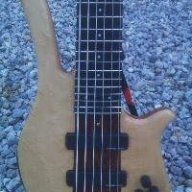
After building a few basses, I'm one of those that believes the wood choice does contribute to the instruments overall tone. In fact, not just wood, but other materials. My 6 string in my avatar that I built has a graphite neck, which heavily contributes to it's tone, as does the bridge and tuners. So believe what you want to. That is what is great about having the freedom to agree or disagree.
 
After building a few basses, I'm one of those that believes the wood choice does contribute to the instruments overall tone. In fact, not just wood, but other materials. My 6 string in my avatar that I built has a graphite neck, which heavily contributes to it's tone, as does the bridge and tuners. So believe what you want to. That is what is great about having the freedom to agree or disagree.

I don't think many really disagree that wood type contributes to the overall tone. It's more that is the contribution really that distinguishable. The truth is that to test it would best extremely cumbersome. It would be nearly impossible to truly test the affect of the bass body wood (or neck/fretboard wood). You'd have to somehow objectively compare dozens (preferable hundreds) of samples tested with the same instrument, electronics, strings, etc. If you are testing the affect of the fretboard, you'd have to somehow ensure that you are mounting different fretboard materials onto 1 particular neck with the exact same string specifications and frets; that is not an easy feat. Now imagine trying that with a whole neck. Try taking a fretboard and attaching it to 1000 different necks with the exact same frets and strings mounted to 1 bass body to document the results. Not exactly feasible. There are just too many variables.
 
  • Like
Reactions: Novarocker
I don't think many really disagree that wood type contributes to the overall tone. It's more that is the contribution really that distinguishable. The truth is that to test it would best extremely cumbersome. It would be nearly impossible to truly test the affect of the bass body wood (or neck/fretboard wood). You'd have to somehow objectively compare dozens (preferable hundreds) of samples tested with the same instrument, electronics, strings, etc. If you are testing the affect of the fretboard, you'd have to somehow ensure that you are mounting different fretboard materials onto 1 particular neck with the exact same string specifications and frets; that is not an easy feat. Now imagine trying that with a whole neck. Try taking a fretboard and attaching it to 1000 different necks with the exact same frets and strings mounted to 1 bass body to document the results. Not exactly feasible. There are just too many variables.
Like I said, it's great that we can agree or disagree.:)
 
  • Like
Reactions: N4860
Did you see the results from the Leonardo Guitar project a few years back

6 luithers built 12 guitars, same specs like internal bracing etc. Each built 1 from traditional acoustic timbers and 1 from poplar,plane and a few other timbers. Blind folded audience was asked which were traditional.

Turned out each guitar got 50% of the votes and the folks behind the test put this down to guessing. Once the blindfolds came off the traditional timbers gained 75%.
This is how electro-magnatic radiation interferes with air pressure waves :)
 
Not apples and oranges at all. The people who say wood doesn't matter hold the belief that all tone emanates from the strings, the pickups and the fingers. I've seen this written on TB many times.

Taking in the idea of structural differences, why can't that also be true of wood? After all, wood is organic, having been a living thing,and has a cellular structure that varies from species to species.
i really think that the "main" opinion here is that wood makes a difference but that the effect is quite little compared to pickups (and their location), strings and for example something like the construction (e.g. hollowbodies...). I´m firmly in this camp and as long as i see someone that can tell me the wood of an electric bass by listening to it or repeatedly discern basses with identical strings and pickups that differ in body- or neckwood in a bandmix i will continue to believe that i´m right on this...
 
Wood matters, as does every other minute detail of an instrument's construction. By comparing two different instrument styles under the premise that they are both constructed with wood isn't exactly a fair question. If you have two identical hollow bodies made of two separate species of wood, or two solid bodies that were, comparisons could be made and the results might have merit.
 
Wood matters, as does every other minute detail of an instrument's construction. By comparing two different instrument styles under the premise that they are both constructed with wood isn't exactly a fair question. If you have two identical hollow bodies made of two separate species of wood, or two solid bodies that were, comparisons could be made and the results might have merit.

I have three Hofner Ignition Club hollowbodies. That may seem overkill but I originally bought the second as a backup to the first and I found the third at a very good price. They're all set up the same and all three of them sound different both acoustically and plugged in. One sounds very mellow and somewhat upright-ish so I use it with my jazzy guitar duo. Another sounds less mellow that I use for country/roots/swing. The third sounds brighter and I use it more for rock/blues/funk.
 
Taking in the idea of structural differences, why can't that also be true of wood? After all, wood is organic, having been a living thing,and has a cellular structure that varies from species to species.

Well played, sir. Wood is mostly air anyway. This is alder.

p%3A%2F%2Fwww.sciencephoto.com%2Fimage%2F710824%2Flarge%2FC0283075-Alder_Wood_Vessels%2C_SEM-SPL.jpg
 
... How come hollow bodies sound different from solid bodies? Hmmmm?

:D

The question, IMHO, should have been: "How much part of the energy of a given signal produced by an electric instrument can be related to wood qualities keeping everything else unchanged?"

I suspect, without spectrograms to my support, that the signal energy percentage depending on wood is way smaller than the one linked to strings or pickup positions for example.

My two cents.

Luigi
 
  • Like
Reactions: DrMole
Not apples and oranges at all. The people who say wood doesn't matter hold the belief that all tone emanates from the strings, the pickups and the fingers. I've seen this written on TB many times.

Taking in the idea of structural differences, why can't that also be true of wood? After all, wood is organic, having been a living thing,and has a cellular structure that varies from species to species.
I agree - IMHO wood does matter. I have also read comments from the (extreme) opposing opinion - that on an electric instrument, only the strings and electronics influence tone. Again, IMHO, all of these things affect tone, the only question is to what degree.

My position is simple: if strings are a primary contributor to tone, then anything that influences the vibration of the strings will also affect tone. It can be measured and proven that wood resonance affects string vibration. And different wood types resonate differently. Hard stop.
 
Last edited:
I don't think many really disagree that wood type contributes to the overall tone. It's more that is the contribution really that distinguishable. The truth is that to test it would best extremely cumbersome. It would be nearly impossible to truly test the affect of the bass body wood (or neck/fretboard wood). You'd have to somehow objectively compare dozens (preferable hundreds) of samples tested with the same instrument, electronics, strings, etc. If you are testing the affect of the fretboard, you'd have to somehow ensure that you are mounting different fretboard materials onto 1 particular neck with the exact same string specifications and frets; that is not an easy feat. Now imagine trying that with a whole neck. Try taking a fretboard and attaching it to 1000 different necks with the exact same frets and strings mounted to 1 bass body to document the results. Not exactly feasible. There are just too many variables.

If manufacturers cared to prove these types of things to consumers, they could provide data showing differences in the tonal characteristics of their basses using spectral analysis of the outputs. In fact, they could include a datasheet with the bass showing it's tonal characteristics. Variations between build materials could be identified by analyzing data from hundreds of instruments. This is all in theory of course and would not be practical to carry out.

But I think builders want to maintain an air of mystique that might get blown away by this type of analysis. You'll never sell a $5,000 bass again if you could quantitatively compare outputs like that. They depend on intangibles and are aware that it is very difficult to prove claims about the impact of build materials and techniques on tone.
 
  • Like
Reactions: StayLow and Luigir

Latest posts