
Enjoy the benefits of a premium membership!
Upgrade Account
-
TalkBass has been independent since 1998. Add your voice.
Create a free account to reply to discussions, view embedded media, and browse with fewer display ads.
Join free Log in
Want zero display ads or expanded classifieds tools? Compare plans.
You are using an out of date browser. It may not display this or other websites correctly.
You should upgrade or use an alternative browser.
You should upgrade or use an alternative browser.
Soldering Simplified..
- Thread starter ZenG
- Start date
More options
Who Replied?


Yep! Got me one of these ^ puppies.A soldering stand. You can find them without the magnifier. I have a huge counter clamp magnifier so mine doesn't have one. Some companies literally call their stand a "third hand". Those little clamps have all kinds of locking bolts so you can turn them wherever you want and lock them into place. So use them to hold a wire or small component in place while you go to work.
View attachment 1179025

i use this liquid flux:
Invalid Link Removed
in one of these:
2 Needle Tip Bottle Liquid Flux Dispenser Oil Solvent Applicator Dropper 0.7 Oz: Amazon.com: Industrial & Scientific
I also use rosin core electronics solder, I can't remember what I actually have and am not at home to look, but think I remember it to be 60/40 rosin core. I know it has some silver content, but I don't remember how much.
You probably know all this already, but just in case, and also (probably mostly) putting in the extra info for others who might be reading this...
What I typically do it put the solder flat on the work table and pull, maybe 6" or so up off the spool sticking straight up, like in snake charmer cobra out of the basket position.
When I solder, I'm OCD on having a clean tip. I use one of those brass brillo-pad looking deals and it really does the trick.
Invalid Link Removed
LIke when I'm soldering 2 wires together for example, I take the wires i'm wanting to solder, strip and twits them together and put on a few drops of the liquid flux. Then heat them up with my very clean soldering tip. The I touch the top of my spool if solder that's sticking straight up. That goes straight to the fluxed and heated wires I've twisted together. A nice uniform coat of solder will instantly be on those wires. - Almost done at this point. If you want to solder that onto a pot, for example, sufficiently heat up the back of the pot with your iron where you want to solder, Not too much, it's decently hard to cook one of those, but it can be done. You can then solder your wire set to that, and so on....
Saw where someone posted about one of those little "helping hands" alligator clip gizmos. You should get one. They're good. Mine has a heavy base and is very helpful as a "third hand". Also, this is a cool trick; pun intended. If you want to protect something downstream of the heat you are applying, put one of those alligator clips between your soldering work and the thing you don't want getting too hot. You can clip it right on the wire you are soldering. Put it close to your work, but just out of the way. It becomes a heat sink. In other words, you have to heat that up before heat can get past it to what you are trying to protect. I use it when I want to put heat shrink tubing over what I just soldered into place.
Invalid Link Removed
Two last things, The links I put in this are to illustrate what I'm talking about, and may not be the best deal out there, but could be, please shop carefully.... Also Sorry this got a little long. I guess some times you just get on a roll!
Hope this helps, and sorry again for how long it ended up...
Invalid Link Removed
in one of these:
2 Needle Tip Bottle Liquid Flux Dispenser Oil Solvent Applicator Dropper 0.7 Oz: Amazon.com: Industrial & Scientific
I also use rosin core electronics solder, I can't remember what I actually have and am not at home to look, but think I remember it to be 60/40 rosin core. I know it has some silver content, but I don't remember how much.
You probably know all this already, but just in case, and also (probably mostly) putting in the extra info for others who might be reading this...
What I typically do it put the solder flat on the work table and pull, maybe 6" or so up off the spool sticking straight up, like in snake charmer cobra out of the basket position.
When I solder, I'm OCD on having a clean tip. I use one of those brass brillo-pad looking deals and it really does the trick.
Invalid Link Removed
LIke when I'm soldering 2 wires together for example, I take the wires i'm wanting to solder, strip and twits them together and put on a few drops of the liquid flux. Then heat them up with my very clean soldering tip. The I touch the top of my spool if solder that's sticking straight up. That goes straight to the fluxed and heated wires I've twisted together. A nice uniform coat of solder will instantly be on those wires. - Almost done at this point. If you want to solder that onto a pot, for example, sufficiently heat up the back of the pot with your iron where you want to solder, Not too much, it's decently hard to cook one of those, but it can be done. You can then solder your wire set to that, and so on....
Saw where someone posted about one of those little "helping hands" alligator clip gizmos. You should get one. They're good. Mine has a heavy base and is very helpful as a "third hand". Also, this is a cool trick; pun intended. If you want to protect something downstream of the heat you are applying, put one of those alligator clips between your soldering work and the thing you don't want getting too hot. You can clip it right on the wire you are soldering. Put it close to your work, but just out of the way. It becomes a heat sink. In other words, you have to heat that up before heat can get past it to what you are trying to protect. I use it when I want to put heat shrink tubing over what I just soldered into place.
Invalid Link Removed
Two last things, The links I put in this are to illustrate what I'm talking about, and may not be the best deal out there, but could be, please shop carefully.... Also Sorry this got a little long. I guess some times you just get on a roll!
Hope this helps, and sorry again for how long it ended up...
As an Amazon Associate, TalkBass may receive commissions from qualifying purchases made via links on this site.


This won't work for everyone, but for difficult joints I sometimes use a hot-air rework station and solder paste (I make a lot of my own circuit boards, so I have that stuff laying around). Like Walter said though, don't be stingy with the flux. It's remarkable how much it helps.
To add to this, if your iron has replaceable tips, a large chisel tip will help dump more heat into things more quickly, or failing that, lay the tip so that the length of it is against the pot. I think at least part of the problem that some people have with soldering is trying to use a tip that's too small for the job at hand.
If you want to solder that onto a pot, for example, sufficiently heat up the back of the pot with your iron where you want to solder, Not too much, it's decently hard to cook one of those, but it can be done.
To add to this, if your iron has replaceable tips, a large chisel tip will help dump more heat into things more quickly, or failing that, lay the tip so that the length of it is against the pot. I think at least part of the problem that some people have with soldering is trying to use a tip that's too small for the job at hand.

First off, wires should already be mechanically attached before soldering if at all possible. When not possible, I hold the solder in between my thumb and index finger and position the wire with my ring finger and pinky.
This is exactly what I do. Even with the wires mechanically attached together, sometimes you still need to hold that set of wires. Like car wiring, or working up on the satellite dish, or whatever. I've got one of those multi hand tools, but the only time I've ever used it is for small circuit boards, small switches, or things just too small to hang on to.
I normally just rosin core solder.i use this liquid flux:
Invalid Link Removed
in one of these:
2 Needle Tip Bottle Liquid Flux Dispenser Oil Solvent Applicator Dropper 0.7 Oz: Amazon.com: Industrial & Scientific
I also use rosin core electronics solder, I can't remember what I actually have and am not at home to look, but think I remember it to be 60/40 rosin core. I know it has some silver content, but I don't remember how much.
You probably know all this already, but just in case, and also (probably mostly) putting in the extra info for others who might be reading this...
What I typically do it put the solder flat on the work table and pull, maybe 6" or so up off the spool sticking straight up, like in snake charmer cobra out of the basket position.
When I solder, I'm OCD on having a clean tip. I use one of those brass brillo-pad looking deals and it really does the trick.
Invalid Link Removed
LIke when I'm soldering 2 wires together for example, I take the wires i'm wanting to solder, strip and twits them together and put on a few drops of the liquid flux. Then heat them up with my very clean soldering tip. The I touch the top of my spool if solder that's sticking straight up. That goes straight to the fluxed and heated wires I've twisted together. A nice uniform coat of solder will instantly be on those wires. - Almost done at this point. If you want to solder that onto a pot, for example, sufficiently heat up the back of the pot with your iron where you want to solder, Not too much, it's decently hard to cook one of those, but it can be done. You can then solder your wire set to that, and so on....
Saw where someone posted about one of those little "helping hands" alligator clip gizmos. You should get one. They're good. Mine has a heavy base and is very helpful as a "third hand". Also, this is a cool trick; pun intended. If you want to protect something downstream of the heat you are applying, put one of those alligator clips between your soldering work and the thing you don't want getting too hot. You can clip it right on the wire you are soldering. Put it close to your work, but just out of the way. It becomes a heat sink. In other words, you have to heat that up before heat can get past it to what you are trying to protect. I use it when I want to put heat shrink tubing over what I just soldered into place.
Invalid Link Removed
Two last things, The links I put in this are to illustrate what I'm talking about, and may not be the best deal out there, but could be, please shop carefully.... Also Sorry this got a little long. I guess some times you just get on a roll!
Hope this helps, and sorry again for how long it ended up...
I only use paste with plumbing or when soldering to large objects.
The 60/40 is the lead to tin ratio, or tin to lead, I forget which way it goes.
When soldering two wires together, they should, whenever possible have as good as possible mechanical link before applying solder.
This usually means bending the two wires around each other kind of like links in a chain, then tighten them together before soldering.
As an Amazon Associate, TalkBass may receive commissions from qualifying purchases made via links on this site.

Passinwind
I know nothing.
- Dec 3, 2003
- 23,075
- 46,022
- Disclosures
- Designer/Toaster Tech @ Passinwind Electronics
I think at least part of the problem that some people have with soldering is trying to use a tip that's too small for the job at hand.
Yep. Always helps to have the right tool for the job.

They have those soldering stands at HF for cheap, works fine, though it can act as a heat sink in some situations. They also have hemostat type scissor clamps I use all the time for temporarily holding parts together, bending wire, a heat sink for soldering parts, etc. They have a hand tool section with some watch repair and jewelers tools. If you want a soldering station for a decent price, check out the Weller WLC100. I have this one, and it's more than hot enough for any conceivable guitar soldering job, but you can dial it way down if necessary
Weller WLC100 40-Watt Soldering Station - Soldering Iron - Amazon.com
Weller WLC100 40-Watt Soldering Station - Soldering Iron - Amazon.com
As an Amazon Associate, TalkBass may receive commissions from qualifying purchases made via links on this site.
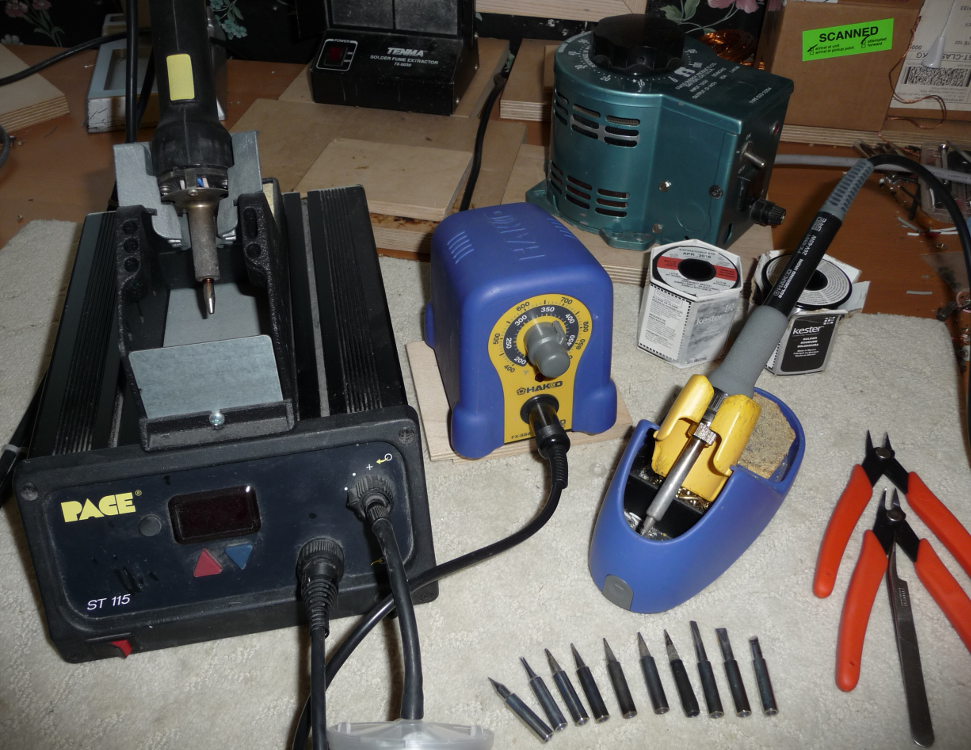
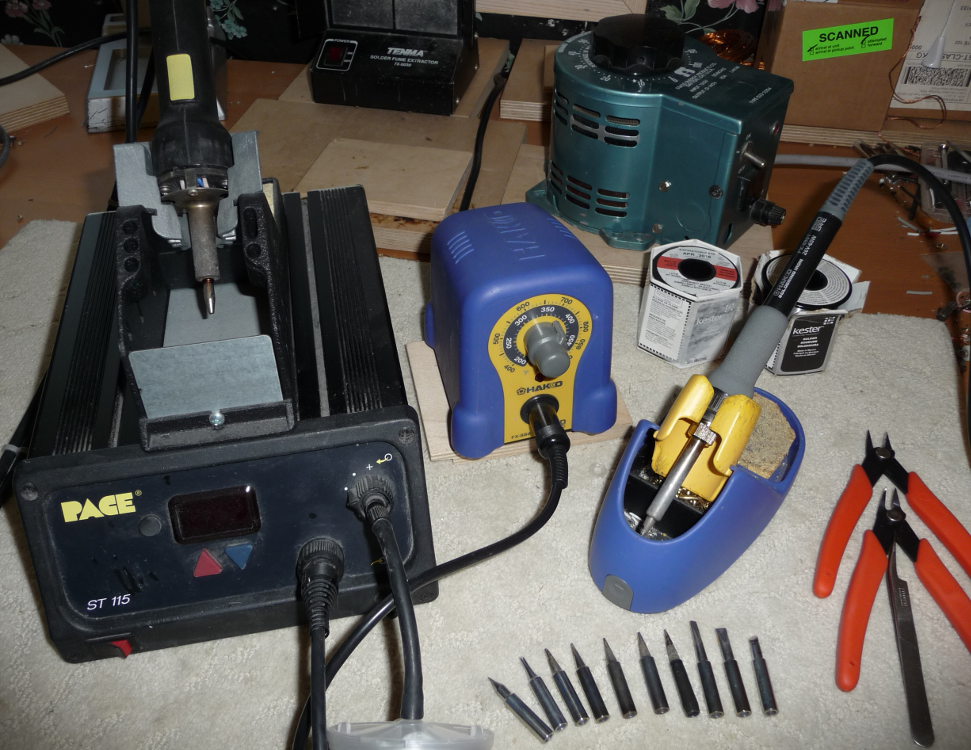
I don't have all that is in this pic, but have a different brand, good for purpose soldering station. Being able to dial in your required temps is an amazing help. Having used one of those little "radio shack" single-temp soldering irons, they are a pain. if you leave them plugged in too long they exceed a good target heat and everything you put together is sub-standard. If you unplug to cool off, you drift to well below target heat in very short order.
Also, those little nippers (with the red handle) are handy. They're one of those tools that you don't know how you got along without kinda tools....
I use the chisel tip and do recommend it. The little pinpoint one is good if you are doing samall work, especially in a tigh area. Unless you are, the chisel shaped tip is the deal.
Also, those little nippers (with the red handle) are handy. They're one of those tools that you don't know how you got along without kinda tools....
I use the chisel tip and do recommend it. The little pinpoint one is good if you are doing samall work, especially in a tigh area. Unless you are, the chisel shaped tip is the deal.
Yep. Always helps to have the right tool for the job.
Passinwind
I know nothing.
- Dec 3, 2003
- 23,075
- 46,022
- Disclosures
- Designer/Toaster Tech @ Passinwind Electronics
I don't have all that is in this pic, but have a different brand, good for purpose soldering station. Being able to dial in your required temps is an amazing help. Having used one of those little "radio shack" single-temp soldering irons, they are a pain. if you leave them plugged in too long they exceed a good target heat and everything you put together is sub-standard. If you unplug to cool off, you drift to well below target heat in very short order.
Also, those little nippers (with the red handle) are handy. They're one of those tools that you don't know how you got along without kinda tools....
I use the chisel tip and do recommend it. The little pinpoint one is good if you are doing small work, especially in a tight area. Unless you are, the chisel shaped tip is the deal.
Yep, I like chisels and screwdriver tips for the more electromechanical jobs. Just a couple of different ones would be plenty for most people. The little conical and elliptical ones are mostly for board assembly and/or rework, both of which I do a lot of. I also have quite a few other flavors of cutters and blenders that I obtained for specific tasks over the years.
The little pinpoint one is good if you are doing samall work, especially in a tigh area. Unless you are, the chisel shaped tip is the deal.
Sometimes even with work that might look delicate, a big honkin' chisel tip works better. Little-bitty TQFP packages are a breeze with it.

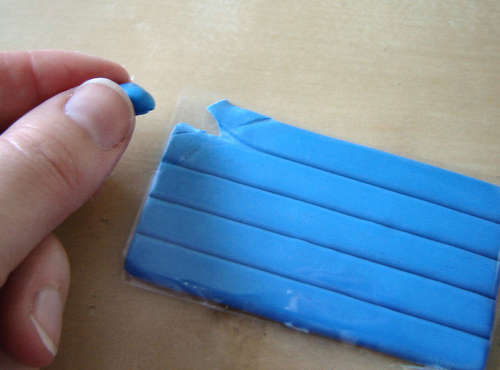
Ha, I just realized I have some of that Blue Tack stuff, the kind for putting up posters. I'll definitely break that out next time I'm soldering.

hakko FX-888!Yep. Always helps to have the right tool for the job.
i gots one o' dem! kicks butt for $100. mine is also the pre-"D" analog version (for better tone)
+1Sometimes even with work that might look delicate, a big honkin' chisel tip works better.
i mostly use a tip that looks like the last one to the right in @Passinwind's pic, the one that's a big fat cylinder with the end chopped off at an angle. makes it easy to put a big flat area of hot iron against what i'm working on.
Passinwind
I know nothing.
- Dec 3, 2003
- 23,075
- 46,022
- Disclosures
- Designer/Toaster Tech @ Passinwind Electronics
hakko FX-888!
i gots one o' dem! kicks butt for $100. mine is also the pre-"D" analog version (for better tone)
+1
i mostly use a tip that looks like the last one to the right in @Passinwind's pic, the one that's a big fat cylinder with the end chopped off at an angle. makes it easy to put a big flat area of hot iron against what i'm working on.
Yep, that big elliptical one is great for ground buses and pot bodies.

a simple clamp screwed to a piece of wood will work.
or a nice soldering clamp works even better.
or a nice soldering clamp works even better.
i ended up getting myself one of these panavise setups, the one on the left (cheap on ebay used, 'cause that's how i roll)
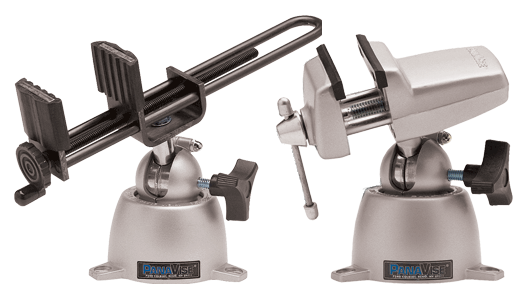
along with the spring accessory for holding wires, it's great for all kinds of soldering.
i discovered it after watching this series of videos, which totally unlocked the secrets of proper soldering, something i thought i had known before but turns out not so much:
along with the spring accessory for holding wires, it's great for all kinds of soldering.
i discovered it after watching this series of videos, which totally unlocked the secrets of proper soldering, something i thought i had known before but turns out not so much:
maybe the number one "secret trick" that nobody seems to know and that makes the biggest difference is making the "solder bridge", a little droplet of liquid solder hanging off the iron right before you attack the work; that's what makes the heat transfer so much faster, to the point that you can use even little underpowered irons if you know how.
scroll to 12:15 for the money shot:
scroll to 12:15 for the money shot:
i discovered it after watching this series of videos, which totally unlocked the secrets of proper soldering, something i thought i had known before but turns out not so much:
I'll check that out when I have a bit more time. Soldering is kinda like being a musician - no matter how good you think you are, there's someone out there that will school your sorry behind.


