• TalkBass has been independent since 1998. Add your voice.
    Create a free account to reply to discussions, view embedded media, and browse with fewer display ads.
    Join freeLog in
    Want zero display ads or expanded classifieds tools? Compare plans.

Solid state/class d vs tube amps


Is hard to escape facsimile music with digital CD, DVD and blue ray, digital radio, digital TV, digital phones and digital photograhy all around us. The human brain is remarkable in its ability to trade off performance against other competing factors like price and convenience. Good enough has become good enough - that's rational.

Class D emulates digital because it creates a sampled wave just like a DAC convertor from CD or DVD or the internet. We are becoming so used to the virtual world we are not only becoming a part of it but dependent upon it

Sullivan patented a Class D tube amplifier in 1961 - nearly 60 years ago - so Class D of itself cannot be regarded as "progressive".

Class D covers a wide range of driver and output stage configurations

The use of Class D for bass amps though is only progressive because it saves on weight, Class D amps are cheaper to buy new, they consume less mains power at low outputs and they are currently in fashion.

But the inherent attenuation of LF is a challenge for bass amp designers to get around.

Apart from that the technology is so complex it is beyond the realm of DIY experimenters and home constructors - and maybe many service techs.

That's good for manufacturers but no so good for those who want to build their own

Few companies now release schematics of their Class D amps so the fee for service tech has to devote much more time to analysing and problem solving - and running up a bill in the process. The five year warranties coupled with industry progress will result in bass amps becoming throwaway every five years or when they develop a fault or fail after that.

Besides, in five years time the Class D amp will be smaller and cheaper and better than ever so who wants an old model ?

Building a bass amp in the garage will soon become as daunting a task as building a desktop PC, cell phone, a flat screen digital TV or PC monitor, or a world band pocket radio

The writing is on the wall for DIY'ers - conquered by the global economy

All we will be left to experiment with is the humble tube amp relegated to museum status
I'm not only a recent class D convert, I'm also a bit of a record junkie. I haven't purchased a CD in years. Frankly, if I can't buy the record (or stream it while driving), I go without.

There are another half dozen boxes of 80-90ea elsewhere in the house :cool: Records ain't going anywhere... neither are tube amps.
20170909_221631.jpg


It's all about context, sir :thumbsup:

 
  • Like
Reactions: dukeorock
Not sure if this is the right thread to reach out for help....but let's run my delima up the flag pole here and see if anyone can give it a salute. Thanks to YouTube, I have been playing bass for 3 years now, a middle aged white guy with no rhythm or natural talent but fell in love with the bass since getting my first Allman Brothers LP (live at Filmore East) and managed to work my way into a Greatful Dead tribute band. I play a '78 Ric with flat wounds and love a warm vitage tone. Also love feeling the bass as much as hearing it and yes, my band mates do ask me numerous times a night to turn it down!

So, my delima..... it's time for me to purchase my first "new" rig that I can use at small gigs and big. Some big gigs have PA support, some don't, including outside gigs. It seems safe to say I need to have a modular system of cabs as well. The question is, for a rookie player that might not very the smoothest technique yet: Tube or Class D and......."10 vs "15 speakers?

I'm off to NAMM next week to do some deep research but as of now I like the Prodigy 4:88 and the Super Bassman 800 Hybrid. OK, let the heckeling begin!

Billy, in addition to the good advice already given, I'll add the speaker decision is also preference, so get out and try in the used section of Sam Ash or Geetar Center. You might look for something with a tweeter that can be turned off. That way you can turn it off except when you are at home working on fretting and technique. I suck and I sound better without too much high end. My musical preference anyway...
 
I showed you mine - now you show me yours

First off, you didn't show jack - some minor mods to an old amp, that apparently weren't very good at all... Now, if you truly have "a lifetime of amp design and building experience", as you *claim*, you could easily offer a little more than that...

2nd - *I* never claimed to having amp design and building experience, nor am I making myself look ridiculous by contradicting one of the most knowledgeable amp designers ever in the business...

Personally, I think you're trolling - and am done with you...
 
  • Like
Reactions: BadExample
Transformers! No not Optimus Prime! But any good tube amp uses huge transformers that weigh a ton.
Peavey VB3? Pretty light for a tube amp. Not that much love for them on TB perhaps ? or maybe not considered good?. It seems like there are still many myths floating around about short tube life also but all in all greatly entertaining thread this..... super Friday reading!!! an age old discussion that never seems to tire...try both go with what works for you. A pleasant weekend to all....
 
Last edited:
  • Like
Reactions: DavesnothereCA
First off, you didn't show jack - some minor mods to an old amp, that apparently weren't very good at all...

The Peavey MKIV is a great amp and has proven itself with some of the greats in the business. It is exceptionally well-made, has good functionality, adequate power, is 2 ohm stable and is still very relevant to today's players.

The mods I described have improved it even further. They are simple but effective.

Now, if you truly have "a lifetime of amp design and building experience", as you *claim*, you could easily offer a little more than that...

No need to - take me for what I say. If you do not believe me then so be it - is your call.

2nd - *I* never claimed to having amp design and building experience, nor am I making myself look ridiculous by contradicting one of the most knowledgeable amp designers ever in the business...

How can questioning, disagreeing or describing a different experience make one ridiculous ?

Sounds like a reoccurring theme. Maybe adjust your approach; come in as a player rather than an uninvited head coach.

Playing in TalkBass is open and free but if playing means accepting or agreeing absolutely with everything the head coach proclaims then there is no point in playing the game.

My posting commenced with an honest attempt to educate and inform aspects of tube amp design and construction but that was met with a barrage of vitriol, name calling and technobabble rhetoric. Is difficult to learn anything in that environment - even from a guru.

My participation is clearly discouraged, so guys for the time being I take your leave.

But if anyone wants to discuss any aspect of tube amp design as I understand it you may contact me via private message and I will try to assist. If I do not know the answer I will tell you straight up.

I take heart from the fact that Randall Smith, founder of Mesa Boogie, attended UC Berkeley for four years studying humanities, English Literature and "invitation only" creative writing courses but never quite graduated. He never once took an electronics course in high school or university but produced over 3000 amps out of his home workshop in the 1970s.
source: Mesa Boogie - Wikipedia
 
Last edited:
I sold my first SVT back in the eighties, I just didn't need it. All this time I've been SS, including some ultra light class D's. And I've been happy......

Last week I was waiting for something in a music store and I plugged into an SVT-CL. It caused instant dis-satisfaction with my current rig. It really is ALL THAT.

Now, my dilemma- I don't need 80 pounds, and elephant stunning volume- I always have good P.A. support, and the days of the audience needing to hear my stage rig are long gone. (With the exception of a few jazzy/loungey/bluesy gigs)
Yesterday I picked up a Traynor YBA200-2. 4x KT88 for 200 loud watts, and a vintage cut-only tone stack. Lots of SVT vibe in only 41 pounds.
I'm keeping my ultra light rig for said loungey gigs, I have a Mesa/QSC BIG, BIG rig for when I need to do demolition, but I think the tube rig will be my #1.
~
I am afraid to go and do that (had an SVT too back in the 70s), and I have only progressed as far as Class AB s/s so far.

But that 41 pound Traynor sounds semi-interesting, as a middle ground. - AND, I live in Traynor Land, to boot.
~
 
~
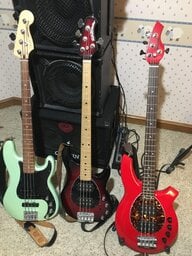
Nice Gear P0rn pic ! drool

Examples of some of the oldest, AND some of the newest.

What are the cabs in the left stack in the pic ?
~
Thanks!
Those cabs are Phil Jones C-4’s (4x5” woofers 400 Watts @ 8ohms each).

I play in bands ranging from 50’s, 60’s and doowop, all the way to others playing fairly current stuff incl Sunday’s for worship at a very lively church (that’s why I acquired the Eleven Rack).
Last Saturday night it was a pvt 50th B’day backyard party-jam.
All hard rock that night and we were joined by a member of LA band Great White.
Had a tough time deciding between tubes and SS. It ended up being the first gig for my newly returned from the tech Acoustic 270.
All my vintage amps have been purchased in the last 12-14 months, as I found myself unable to get the tones I remembered from certain eras from my newer gear. So glad I have these almost irreplaceable pieces of sonic history.
At the other extreme, I’m loving the high quality amp modeling available in my Eleven Rack too. Go figure.
 
  • Like
Reactions: DavesnothereCA
There is no one answer, there is no right or wrong, there is only your tastes, your volume needs, and your ability to transport everything. A 410 with a 300w amp is a very popular rig that combines a lot of these features into a rig that's usable in most any situation except the most high volume, and isn't too hard to transport. You can go modular with the cabs as well. Two 210's, or maybe two 115's, maybe a couple 12's, whatever.
~
Allow me to digress....

I'm leaning towards a couple of 1x12s in a wee stack, maybe the newer Neo-equipped, but at least something of 1x12 config (I currently own a recent Peavey Headliner 210 @ 52 LB, and an old Kroth 1x15 Baltic Birch ply with a Peavey BW in it @ about 65 LB, and usually use one at a time these days for most gigs).

I feel that around 35 pounds per cab might be a fair weight for me going forward, and even a few of the available 2x10s weigh that little or less (and I spotted a 1x15 online the other day which was 40 LB, IIRC - I think it was a Traynor).

Troubles are :

(1) Not all makers do the 1x12 config in a bassist targeted cab.

(2) Those which do are generally too pricey for me to buy new.

(3) Bassists who buy 1x12s must like them too, as hardly any used ones show up.

(4) I live in Canada, away from the larger cities, so that dilutes everything which is available to actually go and try.
~
 
~
Allow me to digress....
and an old Kroth 1x15 Baltic Birch ply with a Peavey BW in it @ about 65 LB, and usually use one at a time these days for most gigs).
~

I was just thinking about Gene Kroth. He and I did a lot of business back 40 years ago. Both the big p.a.'s I installed at the Horseshoe were Kroths. He made nice, but heavy stuff. I still see his 15" TL cabs for sale, and going strong.
Sorry, not to derail, but that name popped up, and I haven't even thought about him for years.
Edit- there's a couple of Eden 1x12's on Kijiji Ontario today.
 

Cast out again - the big boys will not let me play in their backyard !!

Have been trying to contribute to the title of this thread - Solid state/class d vs tube amps

Seems you technocrats have determined there is no "versus" at all

Am glad to learn there is no BS in the music amplifier industry - only in the hi-fi mob
When I was first learning upright, my teacher, who was principle bass for the Detroit Symphony Orchestra, told me that I needed to be more like the Jazz guys. I was obsessing over shifts and pitch at the time. I asked him what he meant by “being more like the Jazz guys;” because I was actually doing Jazz gigs at the time. He says to me, “well, if you say to a Jazz player that they missed a note or had a bad shift, they will simply turn to you and say ‘so what, what’s it to you!?’” He was originally from New York.

This thread has somewhat unfortunately dissolved into parochial/partisan and unconstructive exchanges, to some extent.

The reality is that every amp out there, regardless of class of the power supply, has a particular voicing that was chosen during the design process; and which will typically suit the instrument used in that design effort. But, no amp does everything better than all the others.

The older tube amps were generally designed for a P Bass with flats. The P Bass with flats is a very nice instrument, and is currently enjoying a deserved resurgence of interest among players. Since the old tube amps were voiced for that instrument, one should not be surprised that they still work for it.

Meanwhile, Leo Fender added a second pickup to the bass in 1959, and a little later round wound strings came along. Those changes had some interesting features; but, bringing them front and center has led in a somewhat different direction than P Bass with flats. It turns out that the two pickup basses with round wound strings are most expressive with a lot of clean power. They work just fine with the big tube amps; but, they really sit up and dance with a lot of power behind them.

The thing that amazes me in these TB amp discussions is few who post frame their remarks in the context of what kind of instrument they are playing. So, taking this thread, for example, we’ve got P Bass with flats players exchanging heated discussions with two pickup Bass with rounds players; and its kind of like two ships passing in the night.

Now, regarding tubes vs transistors; they are both amplifying valves for electrons in the circuit. They both perform similar functions. They are both analog signal functions. Yes, they have differing spectral character, which a player can hear, and may have preferences for one way or the other. Again, dependent on the instrument and sound goals. But the solid state versions are NOT digital emulation devices. So, comparisons to digital storage media are just completely uninformed and not germane to the discussion.

As to Class D and how did we get there? First of all, Class D simply indicates the way that the wall voltage is transformed to provide the bias voltage on the transistors. “D” does not stand for digital. The bias voltage on the circuit is ideally a constant. But, when drawing large amounts of power, that reference voltage can fail in its support. Class D is a switching architecture designed to provide a more constant bias voltage at high power levels with more efficient conversion. The signal going into the transistors is still analog. There isn’t some boogie man in there recreating the input signal in some non-authentic manner.

It is good to exchange different experiences with these different amps. It helps us make decisions about what to try next. We all play differently and have different gigs with different needs. But, it is more useful to both post and read than to take sides.

There is a lot of interesting development and progress going on. I’m all for it.
 
Last edited:
And another thing...

Gigs, even at the local club level are starting to go amp-less. Meaning that you don’t even get your own bass amp. You are playing through a Class D power amp in the FOH and listening with an IEM monitor system. Love it or hate it; that’s where gigs are headed. At least some of them, with the number increasing.

So, my $0.019 on Class D is that the question isn’t so much a “vs” thing as it is learning how to make it work. Just the way it is, if you want to keep playing gigs.
 
After much consideration, I have found that I love the response I get from an all tube amp. Especially my old Ampeg B15S. However, until they start making tube amps that sound that good in a 5-10lb package that I can fit in my gig bag and not worry about banging, I'll stick with Class D amps for gigging.

Sure, tubes tend to give a great sound and make me feel like a rock star. But not enough to make an appreciable difference in the mix on stage. I like my one-trip load in.

However, I always use my fliptop for recording and jamming in the music room.
 
  • Like
Reactions: DJ Bebop
So, my $0.019 on Class D is that the question isn’t so much a “vs” thing as it is learning how to make it work. Just the way it is, if you want to keep playing gigs.

Or keep building amps, for that matter.
Yel_wink.gif
 
Peavey VB3? Pretty light for a tube amp. Not that much love for them on TB perhaps ? or maybe not considered good?. It seems like there are still many myths floating around about short tube life also but all in all greatly entertaining thread this..... super Friday reading!!! an age old discussion that never seems to tire...try both go with what works for you. A pleasant weekend to all....
~
I just looked it up and it seems quite impressive.

A switching power supply is where they seem to have saved some weight.

Includes a graphic EQ, uses common tubes, and weighs only 37 pounds for 300 Watts RMS into various switchable impedances.

Hmmmm.... drool
~
 
Last edited:
  • Like
Reactions: Mark Andrew
Sold my Ampeg SVT 2 Pro Tube Head last night. Went back to the Hybrid Ampeg SVT 4 Pro. After all day A/B testing them against each other the 4 pro won in tone. Go figure. It was the first time I had them in the same room so I figured why not. Way more punch, growl, definition & overall control of sound with the 4 pro. The 2 pro just couldn’t control the speakers like the 4 pro. I was actually blown away. Changing the 3 12AX7s in the 4 pro preamp gave drastically different tones. So for me it’s Hybrid all the way. Now I need to start trusting class D amps. Maybe, lol
 

Attachments

  • 4DB764FF-4FE9-4708-848B-85C1C4062D56.jpeg
    4DB764FF-4FE9-4708-848B-85C1C4062D56.jpeg
    2.8 MB · Views: 27
  • Like
Reactions: agedhorse