• TalkBass has been independent since 1998. Add your voice.
    Create a free account to reply to discussions, view embedded media, and browse with fewer display ads.
    Join freeLog in
    Want zero display ads or expanded classifieds tools? Compare plans.

Some new thoughts on bass headstocks (I think)

Hi all, I alluded to this in another thread. But basically, alongside some serious thinking about reducing the weight of basses I build, it occurred to me that half the issue is too much weight in headstocks. Ie. we've got a stack of timber and metal tied up, where it becomes a problem for balance and weight.

There are answers to the metal weight problem in hipshot ultralights and Wilkinson Deco rotomatic guitar tuners like I've used on my recent 6 string.

http://www.ebay.com.au/itm/Guitar-P...rg=20140107090050&rk=3&rkt=10&sd=310871654657

So I took it all to the next logical point and started looking at reducing the amount of timber in the headstock. I figured, "neck timber is usually heavy. If I can use less timber, the headstock will get even lighter". Which got me looking at string tensions...

http://www.kevinkastning.com/D'Addario_tension_chart.pdf

These are the figures for D'addario XL 34" 45-105 gauges strings at regular EADG tuning;
G - 42.8 newtons
D - 51.3 newtons
A - 48.2 newtons
E - 40.3 newtons

It was when I saw these figures that I realized most of the designs we use for headstocks put the tuners for highest tension strings a long distance from the nut.

Specifically, traditional headstock designs are all wrong for the forces they encounter.


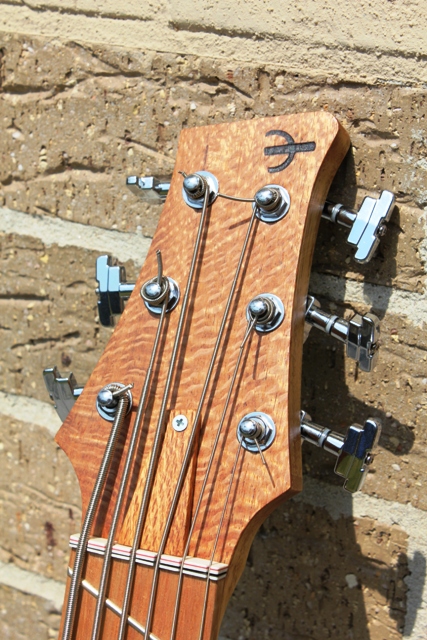
My wife warned me, "I hope you're right. That's a pretty arrogant claim." She's right, but indulge me. I think I'm onto something... Here's my 6 string headstock.
008ff6003_zpsd93181f2.jpg


The highest tension strings are D and A respectively... FURTHEST AWAY from the nut.
That is to say, more than doubling the leverage on the headstock than the B and C strings (34.5 and 38.9 newtons respectively).

:eek:

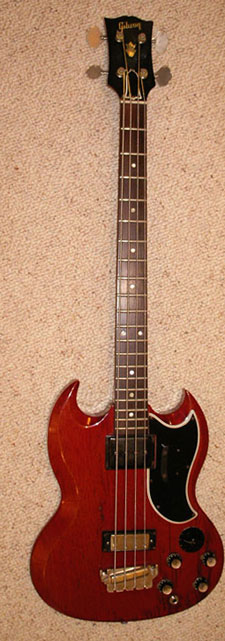
So, no wonder Gibsons with mahogany necks keep snapping their headstocks off when dropped backwards. The two strings pulling the hardest are pulling up near the end of the headstock.
61-Gibson-EB3.jpg


Fenders are little better really with the D string even further up the headstock than the A. So a fall that might not result in a crack without the strings, is exacerbated with the string tension on the neck causing structural cracks.

Solutions
When I started to consider a good engineering solution for this problem, I realised the issue was getting the D and A tuners as close the nut as possible. This is counter-intuitive to 500 years of guitar design. However, people have done it. I'll show you two headstocks that feature what I'd call a "low tension" headstock.

GibsonNedSteinberger20-20Bass-2_zpse417e27c.jpg


Gibson's 20/20 compact headstock.

[Invalid or Expired Link Removed]

Atlansia Stealth.

I'm not entirely sure if these guys figured out the tension issues I did, but in the case of Atlansia, it's entirely possibly. The guy is awesome and his designs are decades ahead the rest of us.

Anyway, I hope this will be the stimulus for some discussions on building stronger, lighter headstocks and basses for players to enjoy in the years to come.

Cheers,

Pete

As a post script, I came across Philip Kubicki's article on the first headless bass built at fender and it's effect on cancelling out deadspots... Fascinating reading! :hyper:

http://www.vintageguitar.com/1772/fender-headless-bass/

 
Gibsons headstock break because they use a one piece, no scarf joint, neck with to much headstock angle. I would imaging those problem solving necks would be hard to get used to as far as tuning goes.
 
There is such a thing as balanced string sets. Circle K (Kalium) specializes in them. They are designed such that each string has similar tension to the other strings. I submit that the headstock isn't the problem...the strings are. I have been using Kalium strings and shooting for about 40 pounds per string, because I like the feel and sound.

Those Wilkinson rotos are guitar tuners, not bass tuners. Bass tuners are bigger, stronger, and generally have higher gear ratios. They may work fine, and they may snap after a few weeks/months/years.
 
The +/- 25% in tension difference on the various pegs would be far less important than the force of the headstock hitting the floor, when the headstock is one-piece with tilt and therefor grain runout, and the mahogany wood used seems (empirically, I don't have figures) to have a very low radial tensile strength, hence prone to failure in that loading.
 
OP - although you are correct that re-ordering the tuners for tension would decrease tension on the headstock marginally the order of the tuners being different from the string order might prove onerous. I said "marginally" as I don't think changing tuner position 1-1.5" (2-3cm) is creating that huge a difference in the leverage forces at that point. Better neck joint construction would help some of the commonly snapped instruments immensely as others have noted. And as pilotjones mentioned, all mahogony necks aren't know for their strength during snappable moments - the grain is short and tight with little flex by shear natural construction.

Headless - I don't think they are ugly per se, I just don't like NOT having a volute or headstock to remind my hand it is at first position and hanging up a headless is a PITA. I'm preparing to de-head a Thunderbird and my plan will cut off the headstock right below the holes for the 2 lowest tuners. Actually hoping to re-attach part of the bird's beak and the stripe that says Epiphone to the headstock. A sparrows beak not the current eagle's beak.:bassist:
 
A balanced set of strings (instead of 'standard') will help.
Those are some good points- this should be good...
It's just that a lot of people (but certainly not everyone) seem to prefer old styles and designs along with their inherent problems, gives 'em something to fuss over. They wouldn't (and don't) buy something better even if it's priced far less.
Used to be the same with cars in US- most only looked at what they were offered, regardless of lack of innovation; more/different chrome to call a 'new model'. Then other sources were avail and the original sources had to change to compete- all for the better, or we'd be driving different sheet metal/chrome on '30's running gear, still. Of course, they can still restore/ drive an antique if they like.
It'll take longer for the Bass world to evolve, I think- different mindset. But there'll be some DeLorean's, Ferrarri's, Edsel's, Studebakers, McLaren's, etc along the way.
Also, an asymetrical extension off the end of a (vibrating) stressed beam is a sure recipe for harmonic imbalance. (Something to be run on Solidworks or a stress analysis program).
 
There is an ergonomic benefit to standard headstocks: the tuners are laid out in a very intuitive pattern. The tuner for the lowest string is closest to you, and you ascend strings by moving clockwise around the headstock (Fender-style headstocks are a simplified case in which you never make a turn to the other side, but the rule still works). You can debate how much that is worth vs. fixing this "problem" of tension, but it is a tradeoff and it shouldn't be ignored.

IMO, to the extent this is a concern I think a headless bass is a more elegant, not to mention proven, solution.
 
OP: I think you got your units wrong. Those numbers are about right for pounds, not newtons.

Secondly, as has been alluded to already, just because the strings you checked have the most tension on A and D does not mean that all string sets have the most tension on those same strings. Circle K has a PDF of string tensions here:

Link Removed

You can set yourself up with whatever strings you want that would, potentially, have the highest tension on E and G, just for example.

The point is, I don't know that it makes any sense to try and put specific string tuners closer to the nut than others because of a presumption about string tension. It seems to me that they should just all be as close as possible (if you're concerned about minimizing headstock tension).

Finally, an idea: You could use a headless design, to secure string ball ends just past the nut, and still have a headstock there, which (obviously) would be just for looks. I was actually contemplating doing something like this in the design I am working on. Make the headstock straight and flush with the front of the neck (haven't decided whether that means flush with the fretboard or just flush with the neck under the fretboard). Strings break over the nut and then disappear into the headstock, so the ball ends would only be visible from the back. Then just use the headstock to be whatever shape I decide on and be a display plate for my logo.

My biggest concern is the design of the tuning machines at the bridge end.

Speaking of which, if anybody can point me at some Web references for different bridge/tuning machines, I would appreciate it. Seeing some might help me figure out what I want to do.
 
A few thoughts/observations:

1. A good portion of the problem with broken mahogany headstocks has to do with the huge amount of wood removed for their antiquated truss rod. A modern double-action allen-headed rod only requires a straight 3/8" channel. Less wood removed = stronger neck/headstock join.

2. Re aesthetics: completely subjective. I think Fender's headstocks are uniformly fugly. I dislike them intensely for cosmetic reasons. I also dislike them intensely for functionality/engineering reasons, but...

3. The force vector of the string tension for a tilt-back headstock is parallel to the plane of the headstock. For a non-tilt-back headstock, it's the same for any strings that pass through the string retainer(s), but not for the other strings. What does this imply structurally?

4. Rev, I've been following your musings, and in another thread you suggested the benefits of using lighter-weight wood for a scarfed-on headstock. This idea intrigues me - have you had any further thoughts in this area? What about using strong wood (rock maple) but swiss-cheesing out the portions that are not structurally contributory? What about a completely hollow headstock made of carbon fiber? Hmmm...
 
Thanks guys, some good points. Let me come back at them if I will...

1. Balanced string sets; very good point and it would help if everyone used them. However, they don't and won't so building a stronger headstocks bears thinking about.

2. Brownie; trad headstocks are only "intuitive" because it's what we're used to. Most headstocks used to use clockwise tuners, yet we changed to anticlockwise and all cope.

3. Gibson mahogany; In my mind, it's not that the tension causes the break, but rather 'accelerates' or 'exacerbates' the break. But I could be wrong.

4. Aesthetics; sure they're important. However, aesthetics should serve function, not the other way around. The other thing that bears mentioning is, we change our aesthetics often.

5. Headless; I love headless instruments. They are one answer to the issue, but there are others too I think.

6. Lightweight headstocks; thanks for reminding me. I've got some more ideas. They'll be part of the next build I think. ;)
 
  • Like
Reactions: josiah goldfish
This design might solve all of your problems...

The direct pull tuners on this thing are incredible—at a ratio of 40:1, they're much more accurate than standard tuners.
 

Attachments

  • xl2_m.jpg
    xl2_m.jpg
    55.2 KB · Views: 165
Unless the bass is a 24 strings, the weight of the wood of the headstock isn't much if compared to the weight of the tuners.
A piece of wood 15mm thick and maybe 15cm long and 10cm wide isn't going to be as heavy as 5 or 6 tuners. If I remember correctly, Warwick tuners are about 100-120gr each, maybe more. (These are my 2 cents about the weight/balance thing, of course, nothing to do with deadspots etc.). ;)
 
Thanks guys, some good points. Let me come back at them if I will...

1. Balanced string sets; very good point and it would help if everyone used them. However, they don't and won't so building a stronger headstocks bears thinking about.

Balanced string sets doesn't mean they are light pull. It just means they all pull the same. If you wanted to, you can go to Circle K and order yourself a set that all take 50 pounds of tension to achieve tuning. On a 5 string bass, that equals 250 pounds of "pull" on the headstock.

So building headstocks that are strong ENOUGH bears thinking about, regardless of string sets being balanced or not. My point earlier was that I don't think a good design should make any presumptions about which string(s) has the most tension. Any string in the set could have the most tension.
 
StuartV; All true, headstocks do need to be strong enough for any string set.

However, in the main, your 'average' bass player (me included) tends to use a .045-.105" set on a 34"-ish scale bass. That being true, planning and building for the 'average' is a good thing.

In my case, I'm planning a 4 string build that encompasses a traditional 34" P spec bass but with radically low weight. I say P spec, because it won't look like a P strictly, but it will sound and play like one.
 
[Invalid or Expired Link Removed]

Atlansia Stealth.

...but in the case of Atlansia, it's entirely possibly. The guy is awesome and his designs are decades ahead the rest of us.


Cheers,

Pete

As a post script, I came across Philip Kubicki's article on the first headless bass built at fender and it's effect on cancelling out deadspots... Fascinating reading! :hyper:

http://www.vintageguitar.com/1772/fender-headless-bass/

cool design! :cool: Thanks for the Kubicki link - his one year of passing is coming up (18th) - check out the Kubicki Factor fb page if you haven't already, worth the visit.