
DR Fat Beams. Pretty smooth for rounds, used them in classic rock and country bands. Good lo mid bottom with clarity.That is the exact pickup I am using-- the Vintage 63s....Ouch. Do you have a recommendation for a pick up and also a type of string?

Enjoy the benefits of a premium membership!
Upgrade Account
-
TalkBass has been independent since 1998. Add your voice.
Create a free account to reply to discussions, view embedded media, and browse with fewer display ads.
Join free Log in
Want zero display ads or expanded classifieds tools? Compare plans.
You are using an out of date browser. It may not display this or other websites correctly.
You should upgrade or use an alternative browser.
You should upgrade or use an alternative browser.
Sound too low in mix, no definition
- Thread starter Corn Pop
- Start date
More options
Who Replied?
What everyone else is saying.
They key is that the tone that sounds great solo is generally not good in a band. That honky mid forward tone is the one that works in a band.
When I use a Pbass, especially with flats, I dime the tone, turn up the mids at my amp, and often turn up the treble.
The clicks and clacks are lost in the mix of cymbals and guitars, but they add to your articulation over all.
One of the eye opening things is to listen to Chuck Rainey's isolated bass parts in Steely Dan. On the recording, in the mix, his parts are super warm, almost too dark for me.
Soloed, they're clacky, and there is a lot more fret noise that cannot be heard in the mix.
They key is that the tone that sounds great solo is generally not good in a band. That honky mid forward tone is the one that works in a band.
When I use a Pbass, especially with flats, I dime the tone, turn up the mids at my amp, and often turn up the treble.
The clicks and clacks are lost in the mix of cymbals and guitars, but they add to your articulation over all.
One of the eye opening things is to listen to Chuck Rainey's isolated bass parts in Steely Dan. On the recording, in the mix, his parts are super warm, almost too dark for me.
Soloed, they're clacky, and there is a lot more fret noise that cannot be heard in the mix.

A lot of people like chocolate. But if you give them pure 100% chocolate (cacao), it tastes pretty not great. What makes chocolate taste good is a few other ingredients including sugar, dairy, and sometimes even salt.
It's good you want to occupy the low end, but pure low end doesn't sound good. Bass is meant to fill the low-end frequencies in a mix however, many of those low-end frequencies can be hard to hear completely on their own. There are other frequencies a bass can occupy in addition to the low end that give more structure to the notes being played and make the bass sound better, and even bassier, in a mix. Talk to your band and see where else (frequency-wise) is good for you to be in the mix. An EQ pedal can help fine tune this, but most of your tonal issues will go away when you open up that tone knob a little adjust your amp settings.
It's good you want to occupy the low end, but pure low end doesn't sound good. Bass is meant to fill the low-end frequencies in a mix however, many of those low-end frequencies can be hard to hear completely on their own. There are other frequencies a bass can occupy in addition to the low end that give more structure to the notes being played and make the bass sound better, and even bassier, in a mix. Talk to your band and see where else (frequency-wise) is good for you to be in the mix. An EQ pedal can help fine tune this, but most of your tonal issues will go away when you open up that tone knob a little adjust your amp settings.
I think the bedroom vs live tone argument has already been well stated, and to me it's less that there's a difference between the two (there totally is, I dunno that it's really an argument with opposing sides), and more that most people's EQ/mixing knowledge is based on bedroom practice/recording environments. Live sound has a lot more variables to contend with, it's easy to fool ourselves, and a lot harder to get actionable sonic feedback. Great live sound from FOH and a great stage monitor mix never seem to go hand in hand. Where we think we need to fit in the mix might be dead wrong for the room.
For example, how many drummers love to put tape/gels on everything so it's not ringy from right on top of the kit, but 20 feet away it all sounds like cardboard boxes? The ringy mess usually sounds way better in the mix, but it's hard to accept that context matters just as much if not more to our actual sound.
(IMO, of course, and I'm an idiot.)
For example, how many drummers love to put tape/gels on everything so it's not ringy from right on top of the kit, but 20 feet away it all sounds like cardboard boxes? The ringy mess usually sounds way better in the mix, but it's hard to accept that context matters just as much if not more to our actual sound.
(IMO, of course, and I'm an idiot.)
Make the suggested tone tweaks on your P bass. If you still don't like it, look for a different bass. Maybe a Stingray or Jazz would work better for you. Don't keep flogging a dead horse.
There's a myth that only a P-bass can "sit in the mix" or "cut through". Last night I heard a Tom Petty tribute band and the BP was playing a J. That dude rocked! They were using subs and the sound guy knew what he was doing. It sounded great and he wasn't destroying birds that flew by the subs.
There's a myth that only a P-bass can "sit in the mix" or "cut through". Last night I heard a Tom Petty tribute band and the BP was playing a J. That dude rocked! They were using subs and the sound guy knew what he was doing. It sounded great and he wasn't destroying birds that flew by the subs.

Mids are all about cut through and definition.I am a hired gun playing classic country on a P-bass.
I am playing La Bella Deep Talking FS flats.
My settings are, I turn mids down low, and my tone knob is almost off
Issues:
Questions:
- I recently received 3 complaints: Steel guitar stated he couldn't hear the changes, that the I and IV sounded the same to him on stage. In another band, the lead guitar said he likes to hear the high on the bass and I have too much bass
- On 2 separate occasions, another bassist sat in and played my bass, and in the crowd I could finally hear my sound, and I hated it. It sounded so muddy and down in the mix.
- Settings: I understand how my settings could be causing the problem. I assume the answer is to turn my tone knob up and turn up the middle. I just don't like the sound and feel like it doesn't fit with classic country music. Is this just a settings issue and not a strings issue? If so, suggestions?
- Strings: I've tried a lot of strings, rounds and flats...should I get off the La Bellas? Is turning up tone and mids not going to get me there with a string that sits so slow in the mix? I really like the beautiful full sound of La Bellas...
Start with EQ all at noon, with tone knob wide open(as the tone rolls off more than treble!!! It cuts the overall signal too)
Roll the treble back at the AMP, only till the clank and zing JUST tamed.
Roll the tone back on the instrument till you hear the resonance peak (a slight midrange bump)
Bump the mids on amp till it's honky (solo)
* pluck softer and turn the amp up.
ONLY bump bass at volume to fill the room (judiciously)
I use an HPF at about 50 hz or higher.
It WILL NOT sound good solo/ at home
It WILL slot into the mix with the full band!
***I run the sound for most bands I'm in:
I use a wireless to get out front to hear the whole mix! It sounds different in front of the amp, than out in the room.
If I'm in the mains, and there is a subwoofer involved, I cut lows on the Amp eq even MORE!
Last edited:
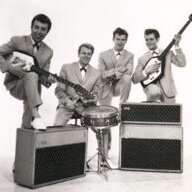
You need to play a Gibson EB2 for a while, then when you switch back to the Fender Precision everyone will say how your note definition has greatly improved.

Actually one of the best "Country" tones I got was from a Danelectro Longhorn, strung with LaBella gold tapes!You need to play a Gibson EB2 for a while, then when you switch back to the Fender Precision everyone will say how your note definition has greatly improved.
I'm gonna keep this simple.
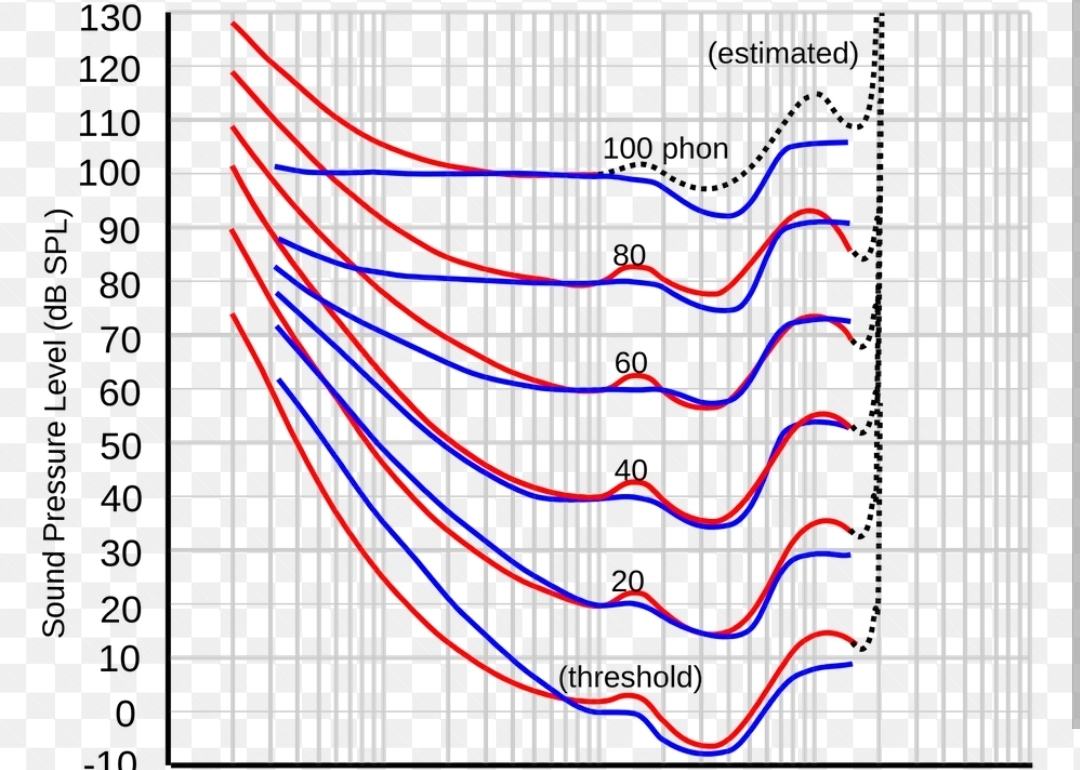
The quieter the sound, the more bass and treble there needs to be for the tone to "sound" even to us. At low volume , its harder for us to hear bass.
As the volume goes up, our ears start to hear frequencies more evenly.
This is why the bedroom tone doesn't work at gig levels.
We need to boost the lows at low volume to hear an even tone, but at high volume, we need to remove that boost to hear THE SAME TONE.
I know that may not make sense. But it's how our ears work.
This chart represents how much power from each frequency range we need to hear to hear even sound at specific volume levels.
Notice at low volume we need to hear a LOT more bass for it to sound even with the mid range.
Once we get to gig levels (around 120db)
Our ears are hearing frequency energy much more evenly. At high volume , our ears are almost as sensitive to bass as mids. In other words, we no longer need to boost the bass to make the sound full. In fact, depending on your amp and cab, you make actually need to cut bass just to get an even , not super bass heavy sound.
This is super important to understand. Once you fully grasp the concept, you will realize how much bass and treble you need to get your tone is volume dependent.
That the louder you are, the less bass you actually need to sound full.
When I set up for a gig, I like to cut the bass completely and get the mids up to volume, then add the bass back In a little at a time until the sound is full. For me, that usually means my bass knob is left of noon. What works for you will depend on your amp and cab, the sound you are going for and the room you are in. Those are different discussions though.
The quieter the sound, the more bass and treble there needs to be for the tone to "sound" even to us. At low volume , its harder for us to hear bass.
As the volume goes up, our ears start to hear frequencies more evenly.
This is why the bedroom tone doesn't work at gig levels.
We need to boost the lows at low volume to hear an even tone, but at high volume, we need to remove that boost to hear THE SAME TONE.
I know that may not make sense. But it's how our ears work.
This chart represents how much power from each frequency range we need to hear to hear even sound at specific volume levels.
Notice at low volume we need to hear a LOT more bass for it to sound even with the mid range.
Once we get to gig levels (around 120db)
Our ears are hearing frequency energy much more evenly. At high volume , our ears are almost as sensitive to bass as mids. In other words, we no longer need to boost the bass to make the sound full. In fact, depending on your amp and cab, you make actually need to cut bass just to get an even , not super bass heavy sound.
This is super important to understand. Once you fully grasp the concept, you will realize how much bass and treble you need to get your tone is volume dependent.
That the louder you are, the less bass you actually need to sound full.
When I set up for a gig, I like to cut the bass completely and get the mids up to volume, then add the bass back In a little at a time until the sound is full. For me, that usually means my bass knob is left of noon. What works for you will depend on your amp and cab, the sound you are going for and the room you are in. Those are different discussions though.

It's almost certainly been said elsewhere in this thread, but I'm gonna get a into the "why" of your sound not working instead of just saying "turn the tone knob up and boost the mids on the amp" (although that is completely true).
On double bass, bass guitar, or any other bass/contrabass instrument, most of what we hear from the low E (or B) to about the open G are the overtones starting from the 2nd partial: the 30–100-ish hz range is preeeetty close to the bottom edge of human hearing, and at the extreme ends (approaching 20hz or 20khz) our hearing isn't as sensitive (not coincidentally, our ears are best tuned to the fundamental pitch of the natural speaking range, the overtones from the sound moving through the nasal cavity, and the very high frequencies created from consonants). So if you're using flats and turning the tone knob to zero, the only parts of the frequency spectrum you're hearing are the fundamental and maybe the first couple partials (to put numbers on it, probably around 30–200hz), which is just starting to get into the "low mids". It's not a bad sound, but there's not going to be much note definition and you're going to be fighting with the kick drum for that same sonic territory. Adding more of the frequencies in the 200hz–1khz range will increase the note definition and is usually what allows the bass to be heard in a dense mix, and alone boosting those low mids can often sound "honky", but in a band setting it usually translates to "punch".
In addition, bass frequencies take longer to reach our ear and travel farther than the midrange or treble, so what might sound like crushing bass by the amp will translate to mud by the time it reaches the audience because all they're hearing is rumble with no definition.
I recommend finding some isolated bass tracks from some popular recordings, you'll be amazed at how "bad" the sound is soloed compared to the full mix. I also recommend recording rehearsals and performances, preferably from an audience member's distance and maybe just using your phone's built-in mic.
On double bass, bass guitar, or any other bass/contrabass instrument, most of what we hear from the low E (or B) to about the open G are the overtones starting from the 2nd partial: the 30–100-ish hz range is preeeetty close to the bottom edge of human hearing, and at the extreme ends (approaching 20hz or 20khz) our hearing isn't as sensitive (not coincidentally, our ears are best tuned to the fundamental pitch of the natural speaking range, the overtones from the sound moving through the nasal cavity, and the very high frequencies created from consonants). So if you're using flats and turning the tone knob to zero, the only parts of the frequency spectrum you're hearing are the fundamental and maybe the first couple partials (to put numbers on it, probably around 30–200hz), which is just starting to get into the "low mids". It's not a bad sound, but there's not going to be much note definition and you're going to be fighting with the kick drum for that same sonic territory. Adding more of the frequencies in the 200hz–1khz range will increase the note definition and is usually what allows the bass to be heard in a dense mix, and alone boosting those low mids can often sound "honky", but in a band setting it usually translates to "punch".
In addition, bass frequencies take longer to reach our ear and travel farther than the midrange or treble, so what might sound like crushing bass by the amp will translate to mud by the time it reaches the audience because all they're hearing is rumble with no definition.
I recommend finding some isolated bass tracks from some popular recordings, you'll be amazed at how "bad" the sound is soloed compared to the full mix. I also recommend recording rehearsals and performances, preferably from an audience member's distance and maybe just using your phone's built-in mic.

This is exactly why I don't like the advice of "getting the amp up to ear level so you can hear it" as it won't allow you to hear the sound within the context of the band. I always have my amp on the floor, so it's not beaming treble at my ears. That way I won't feel the need to dial down the treble/miss.
When playing country I leave the amp pretty flat, neck pickup of my jazz bass with tone rolled off about a quarter. Flats. That's it. Sounds middly on its own, right in front of the amp, but nice and deep/round in the context of the band.
When playing country I leave the amp pretty flat, neck pickup of my jazz bass with tone rolled off about a quarter. Flats. That's it. Sounds middly on its own, right in front of the amp, but nice and deep/round in the context of the band.

In addition, bass frequencies take longer to reach our ear and travel farther than the midrange or treble, so what might sound like crushing bass by the amp will translate to mud by the time it reaches the audience because all they're hearing is rumble with no definition.
Bass frequencies travel at exactly the same speed as mids and highs.
One of the big differences is lows tend to be omniderectional, while mids and highs tend to be focused more in front of the cab. Because the low frequency energy is shooting off in all directions, it winds up taking multiple paths to the audience in the distance. So you have the direct low frequency sound traveling straight from the cab to the listeners ears. You also have the indirect/reflected low frequency sound that has bounced around and taken multiple longer paths the listeners ears.
Hopefully it's obvious that this causes the low end to become smeared and uneven. AFAIK, it also tends to result in a build up of low frequency energy, that takes a certain amount of time to dissipate/die out. By this I mean if something where to cause all of the amps to suddenly become silent, you would still hear the reverberant energy bouncing around for some time after the direct energy from the speakers has already passed you by.
AFAIK on average, the decay time for lower frequencies is often longer than the decay time for higher frequencies.
Ref: Understanding Decay Time and Waterfall Graphs - GIK Acoustics
This is exactly why I don't like the advice of "getting the amp up to ear level so you can hear it" as it won't allow you to hear the sound within the context of the band. I always have my amp on the floor, so it's not beaming treble at my ears. That way I won't feel the need to dial down the treble/miss.
When playing country I leave the amp pretty flat, neck pickup of my jazz bass with tone rolled off about a quarter. Flats. That's it. Sounds middly on its own, right in front of the amp, but nice and deep/round in the context of the band.
As long as the audience and your band mates are happy, use whatever approach is best for your situation. However don't assume the approach that works best for you works equally well for everyone else. We all have different expectations and needs.
A big part of why I elevate my cab and tilt it to aim at my head, is so I can monitor at the lowest possible stage volume. The idea is for my rig to put as little energy into the room as possible, so it fights less with the PA.
I personally key more off the mids and highs. If I can't hear the mids and highs clearly, it feels like the sound coming from my rig is significantly behind, and this makes it difficult for me to play in the pocket. If I run my cab flat on the floor, I generally can't hear as well as I want without blowing out the room. I would much rather be asked to turn up than to be begged to turn down.
Most of my gigs were with full PA support. My rig served primarily as my personal monitor and the PA was responsible for delivering my sound to the audience and other band members.
Just because I focus more on the mids does not mean I don't like big fat lows. But during live performances, I typically find the need to strike a balance between fat lows and the clarity and focus I want to hear.
I have done plenty of gigs where my amp was expected to carry the room. If the room is relatively dead, then I may run my cab(s) on the floor. If the room is fairly live, I will almost surely elevate my cab. This is based on what I want to hear as both a bass player and an audience member....and of course YMMV.
Yeah I was talking more about using my amp to cover the room. Different approaches for different situations and people.As long as the audience and your band mates are happy, use whatever approach is best for your situation. However don't assume the approach that works best for you works equally well for everyone else. We all have different expectations and needs.
A big part of why I elevate my cab and tilt it to aim at my head, is so I can monitor at the lowest possible stage volume. The idea is for my rig to put as little energy into the room as possible, so it fights less with the PA.
I personally key more off the mids and highs. If I can't hear the mids and highs clearly, it feels like the sound coming from my rig is significantly behind, and this makes it difficult for me to play in the pocket. If I run my cab flat on the floor, I generally can't hear as well as I want without blowing out the room. I would much rather be asked to turn up than to be begged to turn down.
Most of my gigs were with full PA support. My rig served primarily as my personal monitor and the PA was responsible for delivering my sound to the audience and other band members.
Just because I focus more on the mids does not mean I don't like big fat lows. But during live performances, I typically find the need to strike a balance between fat lows and the clarity and focus I want to hear.
I have done plenty of gigs where my amp was expected to carry the room. If the room is relatively dead, then I may run my cab(s) on the floor. If the room is fairly live, I will almost surely elevate my cab. This is based on what I want to hear as both a bass player and an audience member....and of course YMMV.

buldog5151bass
Kibble, milkbones, and P Basses. And redheads.
Do you prefer the "High Wind" or "Spilt coil" lollar?Pretty much ANY decent P-bass alnico pickup will open up the tone and give you better definition than the PV63. Especially with "old school" flats like LaBellas. I've been saying this for YEARS. The PV63 does NOT sound like any real vintage P-bass pickup I've ever tested. Tone wise the PV63 is WAY into overwound territory. Too bloated in the lows, muddy in the low mids and lacking in the upper mids/highs for flats (for MY taste anyway).
If you replace the pickup you may not need to change the strings.
Lollar standard winds are one of my favorites. They are very much in the "vintage voiced" category but with a nice bite in the upper mids, which can be great with dark sounding flats.
One question though:
Is your bass by any chance a stock Fender Original or Vintage Reissue? Or did you buy the PV63 separately? I ask because every Fender basses I've tested that used the PV63 also used a .100 uF tone cap, which means the tone gets EXTREMELY dark/muddy when rolling off the highs. If your bass has a .100 uF tone cap you can open up the tone significantly by simply changing the tone cap to .047 uF. This will only have a significant effect on the tone when you're rolling off the tone below 60% (ish) but from your description it seems like that's exactly what you do.
The PV63 is simply not a great choice if you want to use old school flats and roll off the tone (in my opinion) and if the tone cap is .100 uF it gets even worse.
Of course you can take a different route and replace the strings with brighter ones instead, but if you like the feel of the LaBellas you might not be as happy with other strings.
But dark sounding strings + dark sounding pickup + rolling off the tone will nearly always be a recipe for a muddy tone (and even more so if the tone cap is .100 uF).
Of course the problem MIGHT be somewhere else in your rig/signal chain too, but that's impossible to answer without actually being there.
Also, I tried changing pups to Seymore Duncan quarter pounders and I did not like how hot and not warm they sounded, in case they are similar to Lollars. Thanks for the help
D
Do you prefer the "High Wind" or "Spilt coil" lollar?
Also, I tried changing pups to Seymore Duncan quarter pounders and I did not like how hot and not warm they sounded, in case they are similar to Lollars. Thanks for the help
My recommendation was for the standard split coil, because that's the one I've actually used extensively myself. With this particular pickup I don't think I've tested the "high wind" version, although it's relatively easy to make an educated guess on how it will sound compared to the standard version.
They're both split coils btw. The standard version is close to the tone of a vintage early 60s P-bass, although slightly on the bright side of that "vintage voiced" spectrum to my ears. It's not unusually "zingy" bright, just SLIGHTLY more aggressive/forward in the upper mids compared to some other "vintage voiced" P-bass pickups. This is great for improved clarity with old school flats, and nothing that can't be mellowed out with a passive tone control if it gets too bright with fresh roundwounds.
The "high wind" version is an overwound pickup, which normally means slightly thicker/fatter sounding and the highs rolled off a bit. I'm generally not a fan of overwound pickups so I've only used the standard version of this Lollar myself. The standard version is one of my personal favorites for a P-bass. Based on your description I think you would probably prefer the standard version too. I could be wrong of course , but the Lollar standard wind is a tried and tested P-bass pickup that most people seem to love.
It's nothing like the SD QP. The QP is a VERY differently voiced pickup, nothing like a classic P-bass tone at all. More deep lows, more zingy highs, scooped mids. Very "hit-or-miss", people seem to either love it or hate it. The QP is basically a P-bass on steroids. It doesn't "sit" in the mix like a classic P-bass AT ALL. Not really my thing, but it does sound great for some styles of music, just not the type of music I normally play.
Last edited:


