• TalkBass has been independent since 1998. Add your voice.
    Create a free account to reply to discussions, view embedded media, and browse with fewer display ads.
    Join freeLog in
    Want zero display ads or expanded classifieds tools? Compare plans.

Speakon Vs. 1/4" Pros & Cons

Status
Not open for further replies.
It can be dangerous to use 1/4" plugs with some class D amplifiers (not Peavey) that have bridged outputs because the negative side is not ground, it is a DC voltage that can be upwards of 50V, so if you touch the metal case of the 1/4" plug and the chassis at the same time, you get shocked. Since class D is becoming more popular, expect to see more Speakons.

+1, and many thanks to you and agedhorse for patiently educating us on these matters.

This is an extremely important point. We are accustomed to associating "bridge mode" with PA power amps, but many Class-D mono bass amps operate in bridge mode with non-ground-referenced outputs. This includes many of the new "micro" bass heads. You can no longer assume that the outer shell of a 1/4" speaker connector is at a safe ground potential. The connector shell could touch another piece of gear and cause a short circuit.
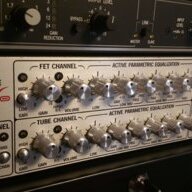
 
My cabinet doesn't yet have a speakon so I use one of these to hook it up my Shuttle 6.0

05708980000?hei=600&wid=600&op_sharpen=1&qlt=90,0&resMode=sharp&op_usm=0.9,0.jpg
Link Removed

You can get speakon X 1/4" cables for those type of cabs.

http://accessories.musiciansfriend....on-to-14inch-Speaker-Cable-14Gauge?sku=584161

My 410 doesn't have speakon but my 212 does. When I ordered my Genz Benz amp I had one speakon x 1/4 going 1/4 from the amp and speakon into my 212. I had to turn it around until my new cables came in.
 
I spoke for myself, you feel free to speak for yourself, but don't tell me how things are for me OK?

I live in a big city yet the last time I found a Speak-On for sale, all I could get was a 10-ft cable from the PA dept. which cost infinitely more than the already paid-for (thus no cost) regular cables I'd been happily using for years. Just the shipping for the cable I had to order online was much more than a fiver, and I prefer to spend my time and fivers on pints of beer.

Need? I only 'need' Speak-Ons because they exist. My life was whole without 'em, without shopping for 'em, and without fiddling with 'em behind my rigs on dark stages. I don't care what PA's use. I use bass rigs, lots of different ones that sometimes aren't mine, so FOR ME the idea that Speak-Ons are completely superior is completely false. Your comfort with the connectors or Genz's desire to sell amps in Europe do not factor into it. As for old technology, I only care what works for me not how old it is. Let me know when you're riding a Segway to gigs at which you play an 11-string fanned-fret with Lightwave 'pickups' and MIDI output.

Again, I'm not denying they have some purposes and advantages in certain situations, or denying that it's an ego boost to have a bigger thicker connector, but FOR ME and many others they're of as much value as your 'harden the #### up' comment, which is to say of no value or purpose at all. The OP asked for some cons, and I provided many. Admittedly some are minor or even of no consequence to some people. Doesn't matter. For me they're a nuisance. I can't stand strap locks either. Live and let die.

It's not so much that Speakon connectors are superior (it just does what a speaker-level connection should do, without any actual disadvantages associated with it), it's that 1/4" ones are inferior.
 
All they do with it is coil the high freq wires around the low, since they travel at a faster rate & have them meet up @ the same point(as far as time it takes from instrument to amp). That's all it is

Uh, no. There are no "high-frequency" and "low-frequency" wires, and no difference in the propagation velocity of different audio frequencies.
 
Be careful using an adapter cable like this with ANY amp that uses a full bridge output section. The shell is not at ground potential and damage could result if it touches any grounded part of the signal chain (like the amp's chassis, another piece of rack gear, a metal cased power strip, quad box etc.

Somehow, I knew you were going to post something like that.
 
Be careful using an adapter cable like this with ANY amp that uses a full bridge output section. The shell is not at ground potential and damage could result if it touches any grounded part of the signal chain (like the amp's chassis, another piece of rack gear, a metal cased power strip, quad box etc.

Yeah, makes the case for a resurgence of polymer shells on 1/4" cable connectors.
 
Uh, no. There are no "high-frequency" and "low-frequency" wires, and no difference in the propagation velocity of different audio frequencies.

Read my previous response. I've been whipped, lashed & flamed for my mis-information. That & somebody already said exactly what you did. I understand I've been told some BS from monster, just another reason I don't use their cables.
 
..there's nothing in a speaker cable to increase bass response, and frankly there's nothing in a speaker cable to decrease HF response..

not exactly; solid conductor 12g would have 4.1kHz, 14g would have 6.7kHz and 16g 11kHz limits. Thicker cables would have lower HF limit but they would also have less passive resistance which may affect LF if long cables used (25-50ft)

granted speaker cables use multi-wire core..

there is also a question of shielding..

I know this might be a tangent, but what about wire guages? I read about 12, 14, 16 guage wires. Can anyone tell me what those are about?

they about load. In 14g are rated at 15amp, so in 4om load you can put 15x15x4=900w w/o heating/melting wires, ~1/2 over 16g..

Also at 900w load you also have losses about ~.8% over 6ft 14g, and ~.6% over 3ft 16g..
 
this is not very scientific responce.. are you familiar with "skin effect"?? if not check wikipedia

You might want to do more than point vaguely in the direction of wikipedia when making assertions of "not very scientific" when you are talking to someone who's acquitted themselves well in the industry and is an AES member ; } ...In fact, since you are flying in the face of both common sense and science you might want to discuss some in-depth references so you won't be considered "not very scientific".
 
You might want to do more than point vaguely in the direction of wikipedia when making assertions of "not very scientific" when you are talking to someone who's acquitted themselves well in the industry and is an AES member ; } ...In fact, since you are flying in the face of both common sense and science you might want to discuss some in-depth references so you won't be considered "not very scientific".

Skin effect is the tendency of an alternating electric current (AC) to distribute itself within a conductor so that the current density near the surface of the conductor is greater than that at its core. That is, the electric current tends to flow at the "skin" of the conductor, at an average depth called the skin depth. The skin effect causes the effective resistance of the conductor to increase with the frequency of the current because much of the conductor does little. Skin effect is due to eddy currents set up by the AC current. At 60 Hz in copper, skin depth is about 8.5 mm. At high frequencies skin depth is much smaller.

read the rest http://en.wikipedia.org/wiki/Skin_effect

let me know if you need more help
 
this is not very scientific responce.. are you familiar with "skin effect"?? if not check wikipedia

read the rest http://en.wikipedia.org/wiki/Skin_effect

let me know if you need more help

Since you are so fond of using Wiki to back up your argument, maybe you should have gone to the bottom of the page you yourself cited, and read the link to the article which debunks "skin effect":

http://www.audioholics.com/education/cables/skin-effect-relevance-in-speaker-cables
 
"and" you just complained about a response from an established industry professional/AES member being "not very scientific" while referencing a source that is only as authoritative as the last random person off the internet who decided to edit it.
 
Posting irrelevant links to technical articles that can only serve to confuse other members in order to make yourself look cleverer than you actually are constitutes trolling, pure and simple.

We're lucky to have input here from some people who are genuinely knowledgeable enough to comment with authority. Please let's avoid obfuscating the issue in the manner I just described - especially when doing so includes adopting a tone of unbearable smarminess.

Continuing this silliness will result in firm moderator action. Knock it off.
 
Status
Not open for further replies.