• TalkBass has been independent since 1998. Add your voice.
    Create a free account to reply to discussions, view embedded media, and browse with fewer display ads.
    Join freeLog in
    Want zero display ads or expanded classifieds tools? Compare plans.

Special Edition Build Off: The Thumfinizenvette

I think you should go ahead and put a strap button on the lower horn too. Tell people it's a courtesy to right handed people, in case you want to let them try it out.

And yes, I've done my share of dumb mistakes like that too!

If you do this, be sure and install the extra strap button upside down!

:roflmao::laugh::roflmao::laugh: <--- still laughing at you!!
 
...I drilled the hole in the tail correctly, but I put the other hole on the WRONG FREAKING HORN. I drilled the end of the lower horn instead of the upper one.

View attachment 3807468

:banghead::banghead::banghead::banghead:

I'm not sure if I should laugh or cry, so I figured I'd post here and let you guys do either one on my behalf, as you see fit.

Anyways, I went ahead and drilled a new hole on the correct horn. I'll do a sawdust fill on the lower one and I'm sure no one but me will ever know it's there, but man oh man...

View attachment 3807470
When this thing ends up the "Bass Of The Week" on No Treble this will be my first comment. :roflmao:
 
  • Like
Reactions: Dark Horse
I do stuff like that all the time! My piano teacher in college once told me, "a master is just a person who has made all the mistakes."

Funny, one of my mentors once told me, "a beginner makes mistakes, a master makes unintended features."

When this thing ends up the "Bass Of The Week" on No Treble this will be my first comment. :roflmao:

I don't even know what No Treble is, so feel free! :D
 
Well not to make you feel slightly better I brain farted and thought i would be all smart and run a ground wire in mine and the screw in the bottom of the control cavity was a few ml to long and straight out through my nice new finish top...After a build of being so careful and not messing up much lol. Wrong horn is a cracker though...you'll never do that again.
 
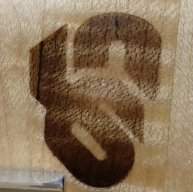
I should mention - I started putting serial numbers in my instruments last year as a way to keep track of which one got built when. This bass is lucky number 13.

Part of me wants to make the extra hole a "feature" in some way, but I'll probably just end up filling it and hiding it. I guess if the fill job turns out ugly I can always change directions. It was a 3/32" drill and I do have 3/32" abalone dots I use for side markers, so I could always pop one of them in there. I could even go crazy like Warkwick did on this one:

 
Anyways. Back on track. Lots of wind here today, which has meant that my power and internet have been off and on all day so I can't really get much work done on my "day job." So I brought my tools upstairs (too dark in the shop without power), finished the hardware, and got it strung up. Luckily all the soldering was done last night.

Hopefully power is back on soon and I can hear what it sounds like (and get on "normal" internet instead of my phone's hotspot). But I'm happy to pass the time playing it unplugged in the meantime!

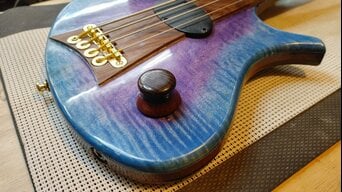
IMG_20200430_140613.jpg
 
I'm a firm believer that an instrument should sound good unplugged; the electronics then are not hampered by a substandard structure.

And I often practice unplugged, because I can still hear myself just fine, and practice (for me) is all about finger/hand dexterity, rhythm, and memorizing the lines.
 
@ctmullins I've enjoyed playing it unplugged. It sounds great unplugged, and it's given me time to focus on the setup and the mechanical aspects. I don't play unplugged at all in general, but my guitarist friend does almost all of his practice and writing unplugged. He swears by it for the same reasons as you're mentioning here. I can see how I could enjoy playing more unplugged.

Which is good, because the power just turned back on for a few minutes and then went off again. But I got to plug it in, very briefly. Aaaand, it sounds like crap. :D I think I need to play with the trimpots on the preamp when I get power back again. Right now it's got way too much gain, or something else weird is going on, because it basically sounds like a cheap amp getting pushed way into the realm of nasty unhappy distortion. @Ripthorn if you see this and have any words of wisdom, let me know - I set the trimpots such that there's 4.5v on each transistor's drain pin as a starting point. When I get some free time I'll try tweaking them to see if I can make it better. It seems like the clipping is happening in the EQ stage, since it's present even with the volume knob turned way down.
 
@ctmullins I've enjoyed playing it unplugged. It sounds great unplugged, and it's given me time to focus on the setup and the mechanical aspects. I don't play unplugged at all in general, but my guitarist friend does almost all of his practice and writing unplugged. He swears by it for the same reasons as you're mentioning here. I can see how I could enjoy playing more unplugged.

Which is good, because the power just turned back on for a few minutes and then went off again. But I got to plug it in, very briefly. Aaaand, it sounds like crap. :D I think I need to play with the trimpots on the preamp when I get power back again. Right now it's got way too much gain, or something else weird is going on, because it basically sounds like a cheap amp getting pushed way into the realm of nasty unhappy distortion. @Ripthorn if you see this and have any words of wisdom, let me know - I set the trimpots such that there's 4.5v on each transistor's drain pin as a starting point. When I get some free time I'll try tweaking them to see if I can make it better. It seems like the clipping is happening in the EQ stage, since it's present even with the volume knob turned way down.
A couple questions on your preamp, are you using j201 (or mmbfj201)? Are they genuine (I've had done crappy fakes before)? If the distortion is there with volume down low, then you have way too much gain in the first stage. The tone stack is passive and should therefore never cause clipping. When I built mine, it was a beautiful clean tone. Do you have your schematic that you used for the layout?
 
  • Like
Reactions: dwizum
I think I've got way too much gain in both of the transistors. Besides the distortion, it gets REALLY loud as the volume gets turned up, it's louder than any of my other active basses after about a third of the travel.

I just fooled with the trimpots and couldn't get the distortion or crazy volume solved, so I took the preamp out and swapped another J201 in for the first stage, just to see if I had a part that was way out of spec or something. Then I re-set the trimpot to have 4.5v on the drain and tried it. The clipping is still there but not as bad. If I play gently it's gone. But there's still way too much gain overall, the output to the amp is still craaaaazy loud with the volume turned up.

I'm using the SOT-23 MMBFJ201 from Fairchild/onsemi. I ordered them from Mouser so I'm assume they're legitimate. I've used this same part in the preamp/buffers I've built for piezos and have had good luck with it. I've got 4 of those in regular use now. But I'm starting to wonder if I got a batch that's just really hot or something when I ordered the parts for this thing.

Here's a screen capture of the re-drawn schematic:

Screenshot 2020-04-30 at 7.39.27 PM.png


Basically I just copied your schematic but drew in the pot connections as 1-pin headers since the pots are off the board. I also got rid of the bright switch.

Here's your schematic just to have them side by side:

FET-2BSchemRevised.png


I'm going to go over the two schematics with a fine comb and then compare them to my Mouser order to make sure I actually ordered and used the right parts. Then compare to the actual built part.

I feel like this thing is probably reeeeeeeeeal close to sounding awesome, I'm sure it's just some trivial little mistake I've made and once I find it I'll go "wow, I'm an idiot". I'm comfortable with digital circuits but really have almost zero experience with DIY analog stuff so this is stretching my skills a bit (which was the whole point!)
 
  • Like
Reactions: Reedt2000
Well I think I see one mistake already. The bright switch on your schematic is between pins 2 and 3 on the volume pot. When I left the bright switch out of mine, I connected those two pins. So I basically made a short where the switch and 120pF cap are. I'm guessing that's a problem and I should probably break that connection (or hard wire a 120pF cap between those two pins, if I have one).
 
  • Like
Reactions: Reedt2000
Well I think I see one mistake already. The bright switch on your schematic is between pins 2 and 3 on the volume pot. When I left the bright switch out of mine, I connected those two pins. So I basically made a short where the switch and 120pF cap are. I'm guessing that's a problem and I should probably break that connection (or hard wire a 120pF cap between those two pins, if I have one).

Yup, "T2V23" means you efffectively hard wired it for full volume all the time, except when the wiper is very near ground, and then you are effectively shorting out the tone circuitry. Instead, the gate of Q2 should connect to V2, and then you also need a separate connection from V3T2 (which doesn't actually connect to anything on the circuit board).
 
  • Like
Reactions: dwizum
I cut the connection between the 2 and 3 pins on the volume pot this morning and wired it such that the 2 pin connects to the gate of Q2 and V3 connects only to T2. It sounds amazing! The distortion is gone and it's nice and clean.

However - the volume knob still goes way too high, if that makes sense. It now responds nice and linearly and doesn't cause clipping, but if I set the volume knob at about 1/3, it's already louder than every other bass on my rack (I've got active basses, passive basses, lots of different styles and pickup types). 25% on this volume knob is probably about the same as full volume on the Air Jazz bass I just finished, which has Bartolini jazz pickups and an 18v bartolini preamp. Ideally I'd like to get this bass set up to match that one, more or less, in terms of output.

So - my question, for those of you who grasp analog circuits better than me - how can I "limit" the volume response such that the current 1/4-1/3ish position is essentially mapped to maximum? Should I swap this 1M pot out for a 250k pot, and then put a 750k (ish) resistor in between the wiper pin on the pot and the gate of Q2? Or leave the 1M pot and add a resistor there? Or do I need to leave that all as is and fiddle with the 1.8k resistor on the source of Q2 to change the current flowing there? And/or do something with Q1 as well?
 
I cut the connection between the 2 and 3 pins on the volume pot this morning and wired it such that the 2 pin connects to the gate of Q2 and V3 connects only to T2. It sounds amazing! The distortion is gone and it's nice and clean.

However - the volume knob still goes way too high, if that makes sense. It now responds nice and linearly and doesn't cause clipping, but if I set the volume knob at about 1/3, it's already louder than every other bass on my rack (I've got active basses, passive basses, lots of different styles and pickup types). 25% on this volume knob is probably about the same as full volume on the Air Jazz bass I just finished, which has Bartolini jazz pickups and an 18v bartolini preamp. Ideally I'd like to get this bass set up to match that one, more or less, in terms of output.

So - my question, for those of you who grasp analog circuits better than me - how can I "limit" the volume response such that the current 1/4-1/3ish position is essentially mapped to maximum? Should I swap this 1M pot out for a 250k pot, and then put a 750k (ish) resistor in between the wiper pin on the pot and the gate of Q2? Or leave the 1M pot and add a resistor there? Or do I need to leave that all as is and fiddle with the 1.8k resistor on the source of Q2 to change the current flowing there? And/or do something with Q1 as well?
Glad you got it sorted! Yeah, a lower value volume pot is all you need. Keep in mind I had mine out board, so a large volume boost wasn't a bad thing. My gut tells me try a 100k volume pot first, as our hearing is logarithmic and I assume you are using an audio taper pot. I look forward to you having it done and posting your clip!