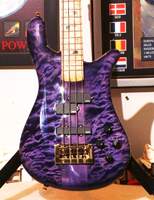
Well... it's sort of an interesting reality of the guitar/bass making business.
The first Spectors from 1974-1975 were made by Stuart. Then Alan Charney, a friend of Stuart's from the Brooklyn Woodworker's Cooperative, joined him and they formed Spector Guitar Company.
Alan and Stuart would work side-by-side, day in and day out until the sale of Spector Guitar Company to Kramer in late 1985.
In the first decade of Spector, Stuart and Alan worked together; all the Brooklyn Spectors have BOTH Stuart and Alan's mark on them.
As things towards the end of the Brooklyn Era started getting busy, artists, dealers, etc... Stuart was spending more and more time running the company as Alan continued to build guitars.
When the Kramer deal was inked, Stuart didn't want to move to NJ and he wasn't interested in a 5 day a week commute. Alan didn't mind.
So of the Kramer Era Spectors... really the two guys who had ALWAYS been Spector, Stuart and Alan, were there for every build. Alan was there full-time, Stuart there 3 days a week. So Kramer models are no less "Spectors" than the Brooklyn Era models. Towards the end of the Brooklyn Era it was pretty much the same setup... Stuart had a couple a days a week of phone calls, meetings, talking to artists, etc...
What's so cool about the Kramer Era was the willingness of Stuart to experiment. Kramer was catering to some of the most famous bassists on the planet. And they wanted new and "different" things.
From Ian Hill's skinny neck NS-2 to Doug Wimbish's Jazz nut Spector... to the creation of a real in-production 5-string. A lot of cool things were born during the Kramer Era.
Kramer had in-house finishing, so Stuart and Alan didn't have to send things out to get finished (they figured out pretty early on in Brooklyn how toxic a small space could get when you had to do lacquer finishes).
And still, where the USA Spectors were concerned, nothing left Kramer without both Stuart and Alan inspecting it.
The SSD Era was cool because the first year of production Stuart was pretty much working by himself. So if you want a Spector made by Stuart (the way Mike Tobias works) then you look for an SD-4 or SD-5. Those are pretty much the only basses except for very early Spector (which PJ Rubal owns most all of them) that would be built by Stuart and Stuart alone.
By the end of 1993 Stuart had hired employees to work with him. One of those people is a man named Jim Quick who STILL works at Spector today and Stuart's right arm when it comes to the physical building of the basses. If Stuart is out sick or at NAMM or on vacation, production continues and Jim Q and Jimmy Eppard (who does the electronics and final setups) keep things moving. Jimmy Eppard has been there going on 15 years.
The main people helping Stuart build Spectors today have been there no less than 10 or so years.
And they work like a well-tuned machine.
The ONLY way for Stuart to have kept Spector in a place where he built everything would have been if he had gone through with his original plan after Kramer to just work in his garage alone and built 5-7 (max) basses a month.
The bottom line is that Stuart is hands-on with supervising everything that goes on, regardless what Era we are talking about. The trick is that he's always been smart and hired talented people to work with him to spread out the duties so things are more consistent and workflow is better. There are in reality, very few Spector basses that were 100% made by Stuart beginning to end.