• TalkBass has been independent since 1998. Add your voice.
    Create a free account to reply to discussions, view embedded media, and browse with fewer display ads.
    Join freeLog in
    Want zero display ads or expanded classifieds tools? Compare plans.

Double Bass Spirocore Stark- initial thoughts and encouragements

Question for the bass construction guru's. I have a 1941 Kay O-100. I normally play Weichs or Medium. Would a Kay top hold up with a Stark E if I was wanting try it? I have never had a whole set of Spiro Mittels as I was concerned about the tension on the top. Thanks
 
Just bought a set a used starks and put them my 1878 Rivere and Hawks. Coming from weichs, I had to drop the bridge 1 and 3/4 turns to get them playable, but they definitely produce an even, dark, full-bodied sound with articulate attack on this bass. Have to see how the technique adjusts to the added tension. I'm exclusively a pizz player.
Weich to Stark: sounds like quite a jump!
 
Progress report: I was in a rehearsal last night and my E string broke in the pegbox. It wasn't even on my bass for a whole month. I was just standing with my bass, not even playing when it snapped. I have heard of that happening to people. I loved the power of that string so much! I'm gonna go back to my mitt E for now, and hopefully I can get reimbursed for the string. Good thing it didn't happen on a gig...
 
Just bought a set a used starks and put them my 1878 Rivere and Hawks. Coming from weichs, I had to drop the bridge 1 and 3/4 turns to get them playable, but they definitely produce an even, dark, full-bodied sound with articulate attack on this bass. Have to see how the technique adjusts to the added tension. I'm exclusively a pizz player.

Switching from Weichs to Starks! Now that is taking a leap. At least for me, the switch from Weichs to Mittels was not only a new sound but, what would be even more prominent in going straight to Starks, a new feel and much more power. That volume and power and bigness of sound will also require strength in your hands, which you will develop over time if you don't have it yet. My only thought would be: Take your time with them, allow your hands to grow into them. If you keep them on, you will find at some point in a few weeks or months that suddenly they feel a lot easier to play.

Me, I am leaving the Starks all on. Amping with a quartett last night, I can get deep whispers just feather-strumming the Starks! Everyone I play with tells me what an amazingly big, round, and powerful sound my bass produces. I just smile and say thanks. But don't think it was easy. It has been a long time getting here, a lot of experimenting, buy this and that string, aka Uncle Toad's wormhole, etc., finding the right string for my bass and being able to make the sound I am hearing in my head and want to make.
 
Progress report: I was in a rehearsal last night and my E string broke in the pegbox. It wasn't even on my bass for a whole month. I was just standing with my bass, not even playing when it snapped. I have heard of that happening to people. I loved the power of that string so much! I'm gonna go back to my mitt E for now, and hopefully I can get reimbursed for the string. Good thing it didn't happen on a gig...
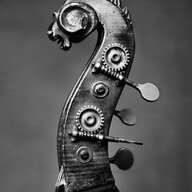
Why does everybody insist on putting the E string around the closest tuner to the nut and stress an E string with the sharp angle over the nut? Upton's in-house basses have the stagger reversed. I've done the extreme, taking a cue from those who have C-extensions: taking the E string up to the top peg.

This is the most illogical tradition that must be changed. There is no reason to stress an E string with the almost perpendicular bend over the nut to the closest tuner.
 
  • Like
Reactions: John Chambliss
I just put them on my 10 month Upton Concord (replacing Dominants). The bass has opened up remarkably well over the year, but it just exploded (sonically, that is) with the starks on. I did bring the adjusters all the way down, but the feel of any increase in tension was minimal. Great strings on a great bass.

Louis

Just a note: I've been told by several luthiers I've spoken with that it's always better to have the adjusters up AT LEAST a half turn from zero. All the way down is not a good position for them in terms of conducting vibration.
 
Less tension, maybe less tendency to snap. On the other hand, I had a Spiro medium E snap on me a few years ago. I doubt the Stark E would snap, more likely the neck! :)

I don't think it's dealing directly with tension. The A string is not as thick so it can corner more tightly. Try coiling a guitar string; it can wrap fairly tight, a small diameter. Now try coiling one of your upright strings; it won't make as small of a circle because it's thicker, it can't handle bending at such a degree. Since the A string has a smaller diameter it should be placed on the lowest peg because it can handle the bend. The E string should go on a higher peg because the bend is less severe from a physics standpoint.

I think that's the argument being made, but please correct me if I'm wrong.
 
Last edited:
How would the A string be different?
Being a little bit thinner core, there is a little bit less risk of metal fatigue when strung over the nut.

That said, I go to the extreme: my G string is on the tuner closest the nut, as being the thinnest core has the least chance of metal fatigue from the oblique angle over the nut to the tuner, then the D string, then the A string, then the E string is on the top peg. Overkill probably, but why take a chance?
 
Being a little bit thinner core, there is a little bit less risk of metal fatigue when strung over the nut.

That said, I go to the extreme: my G string is on the tuner closest the nut, as being the thinnest core has the least chance of metal fatigue from the oblique angle over the nut to the tuner, then the D string, then the A string, then the E string is on the top peg. Overkill probably, but why take a chance?

Hey what about the endstring overtones comin' outta the peg box? Switching the E and A? You'll have to adjust for overtones!
 
For all non-gut strings the rule to make strings is using the same core for all four strings and add the mass by adding one or several layers of windings.

The string gets stiff from the thick layers of windings because they press against the neighbors on on the inside of the bend and spread on the outside.
I'm not sure what the reason is that stiff stings get more flexible with a lot of playing and time, maybe the windings deform a bit to get micro-spaces between them or the core stretches over time so that the windings separate from their neighbors because they stick to the core and build micro spaces between the windings because of that.

Anyway, I think these micro-spaces make thick strings flexible. Since it is almost impossible to make a string with these micro spaces we need to play strings in for best sound and response.
 
Why does everybody insist on putting the E string around the closest tuner to the nut and stress an E string with the sharp angle over the nut? ...

This is the most illogical tradition that must be changed. There is no reason to stress an E string with the almost perpendicular bend over the nut to the closest tuner.

That Stark E can take it. Another reason to switch to Starks!
 
  • Like
Reactions: Chris Fitzgerald