

Enjoy the benefits of a premium membership!
Upgrade Account
-
TalkBass has been independent since 1998. Add your voice.
Create a free account to reply to discussions, view embedded media, and browse with fewer display ads.
Join free Log in
Want zero display ads or expanded classifieds tools? Compare plans.
You are using an out of date browser. It may not display this or other websites correctly.
You should upgrade or use an alternative browser.
You should upgrade or use an alternative browser.
Double Bass Spirocores... dammit
- Thread starter Kael
- Start date
More options
Who Replied?

Greg Clinkingbeard
Commercial User
I work on basses everyday and agree with all of this.Setup??? Since the D sounds worse open than stopped, I'd be wondering if there's a nut issue with that string, maybe the slot is too tight, or maybe just a problem with the nut itself? Also, perhaps a sound post adjustment would help? Perhaps a visit to your favorite luthier might be in order?
Then also, there are lots of different types of Spiros. Are these S42 (4/4) or 3885 (3/4) Spiros? What tension are they (Weich, Mittel, Stark, Solo)? These different categories all represent different tensions and gauges. If your D is giving you trouble (after the setup questions have been addressed), you might want to try a different length or tension/gauge of Spiro.
And, it might just be your double bass. If you're having similar problems with the D strings from other types/brands, I'd be suspisious that there's something going on with the instrument, not necessarily the strings.
Lastly, having complaints about any type/brand of D string on a double bass is not uncommon. I've read many accounts of this, and even experienced it within my 7 short years on the double bass, to some extent with each of the three different types/brands of strings I've used. Something about the acoustic geometry of a double bass seems to make that D more difficult to tame than the other strings, except by touch while playing.
Anyway, lots of setup variables. Lots of possible valid approaches. Plenty of string choices to consider. If it were me and I could not control this with touch, I'd have a luthier look it over, with the current strings on it so I could demonstrate it, before diving into more strings.
-Nut. When I recently put Spirocores on a bass, the D behaved as you described and sure enough, it was contacting the nut slightly above the point where the nut and fingerboard meet. Consequently, it was buzzing at the nut. The Helicore Hybrid didn’t sound weird at all.
-Soundpost. On a few occasions I’ve found that moving the soundpost down a bit will tame Spirocores. It’s well known that this adjustment will result in less focus and more spread to the tone, and with Spirocores it can help.
Spirocores can be frustrating because they reveal so much about the bass they are on. It’s my opinion that they are a bit like critics; they will tell us what’s wrong with our bass and its setup.


Earl
Supporting Member
I do the same thing with a cut rubber band under the strings at the nut. Gives the open strings a 'closed' sound.I often use a hair tie (my wife calls them “scrunchies”) to dampen the sound of the open D and G strings with Thomastik Spiros or Dominants, especially when they are new-ish. They always helped me a lot in this regard. Just pull over the scroll and place over the nut and tighten against the bottom of the scroll. One of my basses has been sporting two of them for years.

I think you're on to something with bowing a Spiro G to settle it. My McLagan bass is almost 4 years old and my previous bass was a Shen hybrid. On both basses with full sets of Spiros, the G sounded meaty and punchy once broken in. But never super bright with too much sustain. I do also bow a lot when I practice and in general play. Then again, maybe my ear has adjusted to the sound of a Spiro G.I wonder if this has anything to do with usage. I tend to bow most of the time off the stand and my spiros settle pretty quickly. Or perhaps a darker bass may be a factor.
However I've been thinking of trying a plain gut D and G in the new year, of course with Spiros on the bottom. Still, why would I mess with the nearly perfect set of strings?

With one of the brands of low-tension synthetic strings I've been using, one that has transparent synthetic windings over a synthetic core, bowing had an obvious effect during the new string stretch-in period... While this brand was not explicitly made for arco, these strings respond well enough to the bow that it was worth practicing.I wonder if this has anything to do with usage. I tend to bow most of the time off the stand and my spiros settle pretty quickly. Or perhaps a darker bass may be a factor.
After one practice that included a fair amount of arco, I examined the thickest of the strings (E) very carefully and found that the windings were separating near where I was bowing. They were still tight and not broken, but there were noticeable voids in the normally consistent windings. The area where I play pizz was unaffected. So I manually moved the windings back into place, and avoided arco with them for a week or so. After that, I never saw that happen again with those strings even with pretty serious arco practice...
A few years later when I changed those strings out with a new set of the same kind, I found the same thing happening, so again waited about a week with arco, and had the same positive experience for a period of years afterward.
With wound low tension synthetics being so much softer and more stretchy than metal-core / metal-wound strings, during stretch-in multiple components potentially don't stretch at exactly the same rate and if the windings allow more excursion during arco than the core, or vice versa, things can get misaligned. After seeing this happen twice now I have been left with the impression that arco, especially during stretch-in, grabs and stresses the strings for a consistently longer period than pizz.
While higher tension metal core / metal-wound strings are very different, I can imagine that their components also respond to arco more than pizz. They may not become misaligned, but it wouldn't surprise me if their break-in period, for tuning as well as for tone, is noticeably shorter with arco.
Last edited:
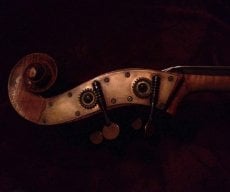
An unstopped D is almost always the loudest note on any bass. Artful tweaking of the soundpost night help.
You can make strips of thin rubber with different widths, put one of them under the D string, pull the the ends up and move it towards the nut. This is similar to what Chris recommended, just a bit different. This simulates the damping of the flesh of a stopping finger.
Thickness depends on your nut height.
If it breaks while moving it towards the nut, tune the string a bit down, move it and tune up again.
I use that method on my high C string and sometimes on the G. Mostly when they are new.
When I used S42 Spiros, the D was always very dominant, but somehow I got used to it (or was to ignorant to get disturbed by it during playing).
The soundpost was very close to the bridge foot at that time.
Thickness depends on your nut height.
If it breaks while moving it towards the nut, tune the string a bit down, move it and tune up again.
I use that method on my high C string and sometimes on the G. Mostly when they are new.
When I used S42 Spiros, the D was always very dominant, but somehow I got used to it (or was to ignorant to get disturbed by it during playing).
The soundpost was very close to the bridge foot at that time.
Last edited:

The hairless guy pushing hair ties- classic talkbass! 
We were all thinking it...but you said it out loud.The hairless guy pushing hair ties- classic talkbass!
Thx, James!


…and our playing.(…) they will tell us what’s wrong with our bass and its setup.
I don’t know how true tis is for other strings, but it is definately true for all the iterations of Spiros I had on ever since. I guess people like to switch stuff because it seems to be low effort to address strings, setup, pickup etc. when you run into unhappiness while a lot really depends on how you deal with it (given that everything is “playable” at least), and use hands and ears to correct unevenesses. And even when you not get there, you learn a lot about modulating the sound with only your fingers, a knowledge that always comes handy, and if it’s only for playing instruments other than yours.


I am another person that plays primarily arco and has had zero issues with the G or D settling.
I don't think Spiros are the perfect string, I think they are the best we have. The real problem is string makers always retreat from Spiros for "new" variants. We are not going to get anywhere until they try to expand on Spiros.
I don't think Spiros are the perfect string, I think they are the best we have. The real problem is string makers always retreat from Spiros for "new" variants. We are not going to get anywhere until they try to expand on Spiros.
Prestoflex are one of the few examples I can think of for a recently introduced string that's wholeheartedly in that direction, a relatively lightly damped, articulate flexible core steel string with "modern" (ie late 60s - 70s) sustaining pizz tones and bright, singing arco. Almost any other new string in the last 20 years is either a faux-gut or a darker "hybrid" string.I don't think Spiros are the perfect string, I think they are the best we have. The real problem is string makers always retreat from Spiros for "new" variants. We are not going to get anywhere until they try to expand on Spiros.
They didn't really give them a big publicity push and they haven't set the bass world alight, it's fair to say. I like the set I have on, somewhat like Spiro weichs with a slightly different attack and mids.

Hmm, looks like you're right. I wonder if the Gollihurs could be convinced to stock them, given that Eurosonic are from the same factory.Prestoflex are not currently distributed in North America I think, though.

Last I checked, if you order them from Thomann they will be ship here, unlike some other items that they're blocked from shipping in.
But given that they are apparently a recreation of old Lycons that Drurb sent in to the maker, I'm not entirely certain I'd call them "something new" in the sense of expanding on Spiros like Damon brought up.
But given that they are apparently a recreation of old Lycons that Drurb sent in to the maker, I'm not entirely certain I'd call them "something new" in the sense of expanding on Spiros like Damon brought up.
Last I checked, if you order them from Thomann they will be ship here, unlike some other items that they're blocked from shipping in.
But given that they are apparently a recreation of old Lycons that Drurb sent in to the maker, I'm not entirely certain I'd call them "something new" in the sense of expanding on Spiros like Damon brought up.
It's something the company or Jonas Lohse (who does distribution and works with them on development, I believe) don't seem to have communicated about publicly. We know from DRURB that examining a set of Lycons was part of the design process, but Presto don't appear to have directly stated that their intent was to recreate them.
I haven't had experience with Lycons to compare them, but it is a recently released string somewhat in the Spirocore school of steel strings, at least.
Jonas told me the (medium) Prestoflex got a bit too much tension, so he also made a lighter set if I remember correctly. Not sure if that is still available, may from Jonas only.
I measured a Lycon set on the way from the UK to Australia and published the measured tension here on Talkbass.
I shortly had them on my bass too and liked the E and the A, but the D and G had too much tension for my taste.
As far as I know the two upper plain gut and two low steel Lycons were a popular combination.
I also measured a lot of Jonas strings, but didn’t got permission to make the data publicly available. (I can do it for strings I have, but I don’t have any Prestoflex.)
Have to look at home if the Prestoflex were included. If I have the data I can at least tell you an approximate tension difference to the Lycons.
I measured a Lycon set on the way from the UK to Australia and published the measured tension here on Talkbass.
I shortly had them on my bass too and liked the E and the A, but the D and G had too much tension for my taste.
As far as I know the two upper plain gut and two low steel Lycons were a popular combination.
I also measured a lot of Jonas strings, but didn’t got permission to make the data publicly available. (I can do it for strings I have, but I don’t have any Prestoflex.)
Have to look at home if the Prestoflex were included. If I have the data I can at least tell you an approximate tension difference to the Lycons.
Last edited:
It's something the company or Jonas Lohse (who does distribution and works with them on development, I believe) don't seem to have communicated about publicly. We know from DRURB that examining a set of Lycons was part of the design process, but Presto don't appear to have directly stated that their intent was to recreate them.
I haven't had experience with Lycons to compare them, but it is a recently released string somewhat in the Spirocore school of steel strings, at least.
I'm in the opposite boat, haven't played the Prestoflex, but I did play on Lycons in college and have the low strings on my plywood. Wouldn't surprise me, even if they were just a complete copy (rather than being somewhat modified like I would expect but would still be willing to call a recreation), that they wouldn't outright publicize that information—just from a marketing standpoint, I don't think "look guys, we copied these old strings that a lot of people don't really know about!" would work anywhere near as well as "look at this new steel string we designed!"
I measured a Lycon set on the way from the UK to Australia and published the measured tension here on Talkbass.
I shortly had them on my bass too and liked the E and the A, but the D and G had too much tension for my taste.
As far as I know the two upper plain gut and two low steel Lycons were a popular combination.
I also measured a lot of Jonas strings, but didn’t got permission to make the data publicly available. (I can do it for strings I have, but I don’t have any Prestoflex.)
Have to look at home if the Prestoflex were included. If I have the data I can at least tell you an approximate tension difference to the Lycons.
Would certainly be interesting to know. I think the light and heavy Prestoflexes are the only sets available, Thomann only has the light, and from what I remember Martin Beer said the light set felt somewhere in between 3/4 Spiro weichs and 4/4/ mittels, which at least sounds about the right ballpark from what the full Lycons felt like to me, but I haven't tried them on the same bass that I've had any Spirocores on.


