

Enjoy the benefits of a premium membership!
Upgrade Account
-
TalkBass has been independent since 1998. Add your voice.
Create a free account to reply to discussions, view embedded media, and browse with fewer display ads.
Join free Log in
Want zero display ads or expanded classifieds tools? Compare plans.
You are using an out of date browser. It may not display this or other websites correctly.
You should upgrade or use an alternative browser.
You should upgrade or use an alternative browser.
Squier Affinity Precision vs Squier Affinity Jazz
- Thread starter stuffedbread
- Start date
More options
Who Replied?
My general opinion of the Affinity series is that they are built to the cheapest price point possible, but still a decent instrument. Which just means it's the most affordable way to get a Squier. Great choice if you (or your kid) are starting out and don't want to invest a ton of money, or don't have a ton of money, or just need a cheap axe to play at sketchy venues with sketchy people.
I briefly had an Affinity P that needed minor repair and setup work, it was literally a bargain at twice the price (which is what I sold it for).
Don't expect great fret work or top shelf electronics; but it will still be solid. That said, if you can afford and justify something nicer - even a better used Squier - do it. If you can't, IMHO the P has much better pickup but I prefer the look and feel of the J myself. If you're on a budget it's also worth considering entry level options from Yamaha and Ibanez.
I briefly had an Affinity P that needed minor repair and setup work, it was literally a bargain at twice the price (which is what I sold it for).
Don't expect great fret work or top shelf electronics; but it will still be solid. That said, if you can afford and justify something nicer - even a better used Squier - do it. If you can't, IMHO the P has much better pickup but I prefer the look and feel of the J myself. If you're on a budget it's also worth considering entry level options from Yamaha and Ibanez.


I think they're great. You don't even need new strings. You just set it up real nice and it'll sound fantastic.

I'm a little confused by the title. Do you want to know which one is a better bass to get out of the Affinity line?
Why a PJ Affinity of course.
Seriously though, between the two, the P Bass is probably the least obvious it's the budget Affinity from my experience.
Why a PJ Affinity of course.
Seriously though, between the two, the P Bass is probably the least obvious it's the budget Affinity from my experience.
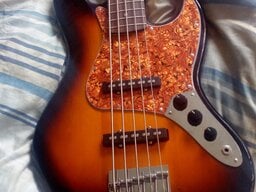
Now, the fret work on the Affinity series is very hit and miss, so it almost always needs attention before anything else. But I think they're FINE instruments for their price. Great, in fact.
Right out the box, I feel like the Affinity P is a better instrument all around. BUT - I kind of do have a nasty habit of taking a cheap instrument and dropping nice things in them, and Jazz basses are some of the most modifiable things in the world.
With an Affinity J, which I personally don't mind at all right out of the box, or an Affinity P, I don't lose sleep over the original investment if my experiment didn't pan out. I have a John East J Retro pre in my 2017 Jazz V Affinity paired with Quarter Pounders on a bass which has become my GO TO over a much, much more expensive fiver. To my chagrin. Thing is an *animal* with a fresh pack of Elixirs. There's a LOT you can do to an Affinity to make it sound and play like it broke the bank, and it sure as hell won't break the bank!
Right out the box, I feel like the Affinity P is a better instrument all around. BUT - I kind of do have a nasty habit of taking a cheap instrument and dropping nice things in them, and Jazz basses are some of the most modifiable things in the world.
With an Affinity J, which I personally don't mind at all right out of the box, or an Affinity P, I don't lose sleep over the original investment if my experiment didn't pan out. I have a John East J Retro pre in my 2017 Jazz V Affinity paired with Quarter Pounders on a bass which has become my GO TO over a much, much more expensive fiver. To my chagrin. Thing is an *animal* with a fresh pack of Elixirs. There's a LOT you can do to an Affinity to make it sound and play like it broke the bank, and it sure as hell won't break the bank!

I have a 90s Affinity P (China) and 2021 Affinity J (Indonesia).
I like them both. They make suitable racket for me and look the part.
I like them both. They make suitable racket for me and look the part.
I have a 90s Affinity P (China) and 2021 Affinity J (Indonesia).
I like them both. They make suitable racket for me and look the part.
I'm very curious about the '21 line. Even the Affinity series looks pretty okay. How is the Jazz right out of the box?
There were no sharp edges the Affinity J of mine, and no crackling controls. I looked up the SN, and it was actually made in Dec 2020.
I think I took a little bit of the bow out of the neck, then raised one of the saddles little so it wouldn't sound like a sitar.
At first I thought the laurel fretboard looked dry, so I used Ballistol on a small part, and it didn't really change it none. I think that's just the nature of laurel vs rosewood.
The Affinity J is not as loud as a the Affinity P (1997), but I don't care.
I think I took a little bit of the bow out of the neck, then raised one of the saddles little so it wouldn't sound like a sitar.
At first I thought the laurel fretboard looked dry, so I used Ballistol on a small part, and it didn't really change it none. I think that's just the nature of laurel vs rosewood.
The Affinity J is not as loud as a the Affinity P (1997), but I don't care.

They're better than they used to be, from what I understand, but they're a rung below the VMs and a few rungs below the CVs.What are your thoughts on them.
If someone can't go another $100 for a used VM...there are plenty around...I guess an Affinity would be okay for a beginner to learn on.
(And this is coming from a big Squier fan from way back.)

CV 60s p bass, laurel fretboard also looked grayish and dead, there might be a layer of varnish or other finish on it. I sanded mine lightly but thoroughly with extra fine (220 grit) sandpaper to remove this finish, then applied fretboard oil. Definitely darker and more luxurious looking (and feeling) now. I even find it warmed and softened up the tone some if that is possible.There were no sharp edges the Affinity J of mine, and no crackling controls. I looked up the SN, and it was actually made in Dec 2020.
I think I took a little bit of the bow out of the neck, then raised one of the saddles little so it wouldn't sound like a sitar.
At first I thought the laurel fretboard looked dry, so I used Ballistol on a small part, and it didn't really change it none. I think that's just the nature of laurel vs rosewood.
The Affinity J is not as loud as a the Affinity P (1997), but I don't care.
Although none of this was necessary, just a personal obsession, Squiers are very nice instruments as is.